
Contractors quote 6 mil, 10 mil, 12 mil, and 20 mil liners, and the price roughly triples from one end of that range to the other. Homeowners reasonably assume thicker plastic blocks more moisture.
It does not, meaningfully. All of these are effectively vapour-tight. What thickness actually buys you is puncture resistance and service life, which matters enormously — just not for the reason most people assume.
Here is how to choose without overspending or under-buying.
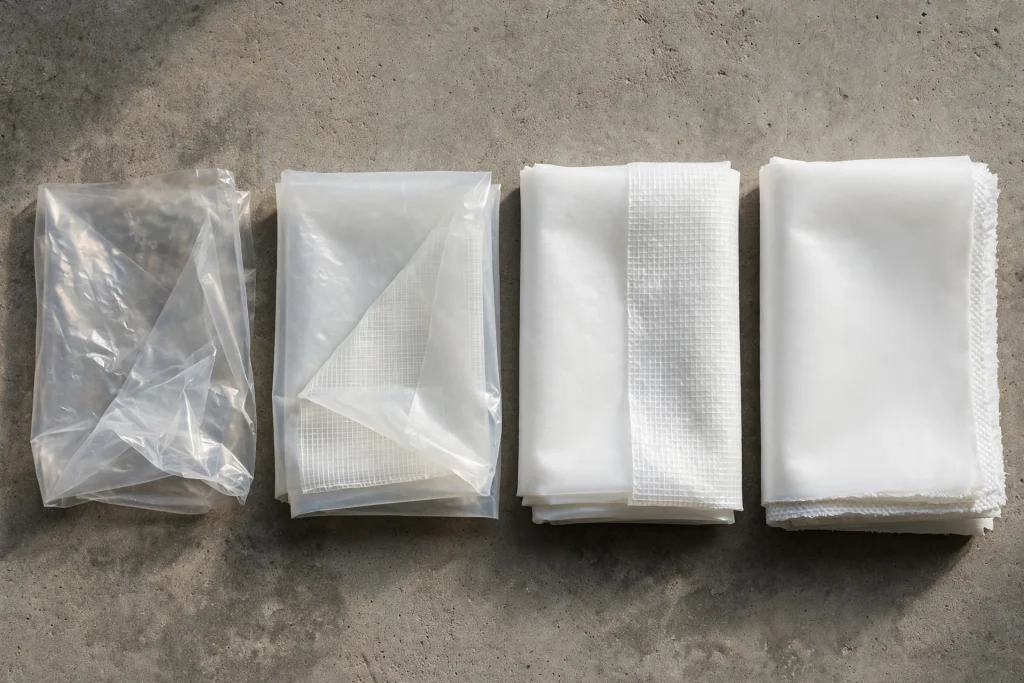
What a mil is
One mil is one thousandth of an inch. Not a millimetre — a common and costly confusion.
- 6 mil = 0.006 inches, about the thickness of two sheets of paper
- 20 mil = 0.020 inches, about the thickness of a credit card
The counterintuitive part
Vapour resistance is measured in perms. A material under 0.1 perms is Class I, meaning effectively impermeable.
6 mil polyethylene is roughly 0.06 perms. 20 mil is roughly 0.03 perms. Both are well inside Class I. Both stop essentially all vapour diffusion. The building code requirement for a crawl space ground cover under IRC R408.2 is 6 mil, and that is a genuine standard rather than a bare minimum with an asterisk.
So if the sheet stays intact, 6 mil performs the same job as 20 mil.
The catch is “if it stays intact.” A 6 mil liner tears when someone crawls across it, punctures on a sharp stone, and pulls away from tape over time. A torn vapour barrier is no longer a vapour barrier at the tear, and nobody notices for years.
Thickness buys durability, and durability is what preserves performance. That is the real argument, and it is a good one — it is just a different argument than the one usually made.
Reinforced vs non-reinforced
More important than raw thickness, and frequently ignored in quotes.
Non-reinforced is plain polyethylene sheet. Cheap, tears easily, and a tear propagates across the sheet once it starts.
Reinforced liners have a scrim, a woven polyester or fibreglass mesh laminated between layers of poly. The scrim stops tears propagating: a puncture stays a hole rather than becoming a rip.
A 12 mil reinforced liner outperforms a 20 mil non-reinforced one in practice. If a quote says “20 mil,” ask whether it is reinforced. The answer changes what you are buying.
Reinforced products are typically string-reinforced with a visible grid pattern, and most quality crawl space liners at 10 mil and above are reinforced.
Thickness guide
| Thickness | Best for | Typical cost installed | Life |
|---|---|---|---|
| 6 mil | Code minimum, no-traffic spaces, temporary or budget work | $0.50 to $1.50/sq ft | 5 to 10 yrs |
| 10 mil | Light use, occasional access, most reinforced products start here | $1.50 to $3/sq ft | 10 to 20 yrs |
| 12 mil | The practical sweet spot for most homes | $2 to $4/sq ft | 15 to 25 yrs |
| 20 mil | Storage, frequent access, rocky soil, permanent encapsulation | $3 to $7/sq ft | 20+ yrs |
Choose 6 mil when
Budget is tight, nobody enters the space, the soil is smooth and free of sharp stone, and you accept replacing it sooner. It satisfies code and it does remove the bulk of the vapour load, which is genuinely worth doing even as an interim step.
Choose 10 to 12 mil when
This covers most residential situations. You occasionally access the space for plumbing, HVAC, or wiring. It is reinforced, durable enough to survive service visits, and priced sensibly.
If you want one recommendation: 12 mil reinforced. It handles normal use, lasts decades, and does not carry the premium of 20 mil for benefits most homes never use.
Choose 20 mil when
You will store things down there. Someone crawls in regularly. The soil is rocky or full of construction debris. You are doing a full encapsulation and want it to be the last one. Or you are selling and want a transferable warranty, which some manufacturers only offer on heavier products.
What actually matters more than thickness
Installation quality determines outcomes more than the number on the roll.
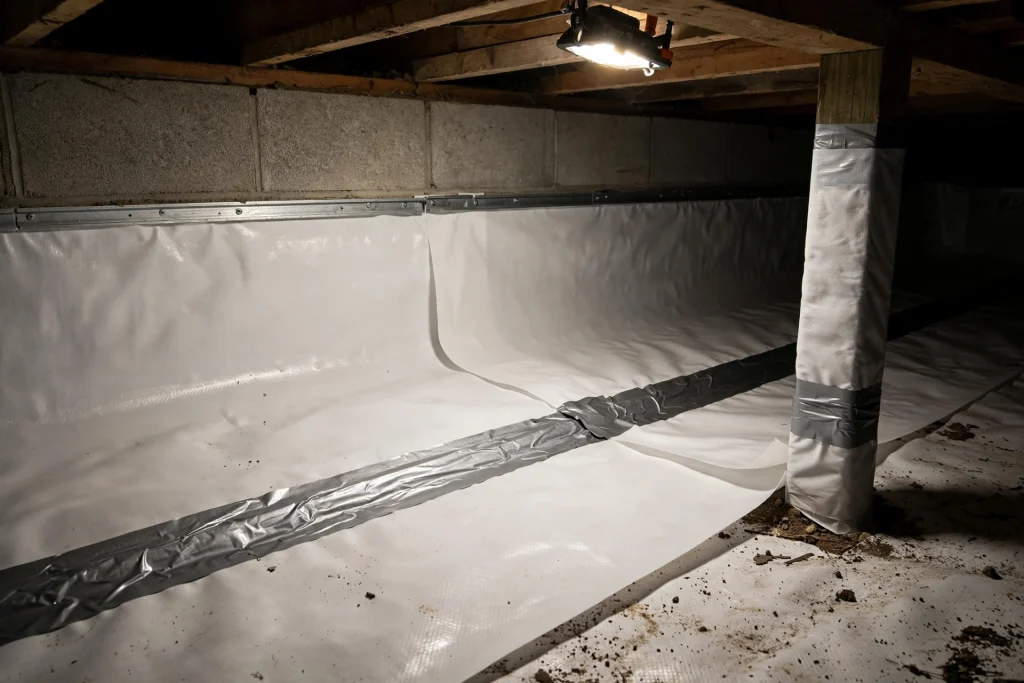
Full coverage. Every square foot of exposed soil. Gaps under ductwork and behind piers are where vapour keeps coming.
Seam overlap and tape. Minimum 12 inches of overlap, sealed with a purpose-made seam tape. Duct tape fails within a year or two.
Wall coverage. The liner should run up the foundation walls, be mechanically fastened with a termination bar or fasteners and washers, and be sealed at the top edge.
Terminate 3 inches below the sill plate. This gap is deliberate. It leaves the wood visible for termite inspection, and many jurisdictions and pest warranties require it.
Seal around every pier and penetration. Piers, plumbing, ducts, and support posts each need the liner cut and taped tightly.
Prepare the ground. Remove sharp rocks, construction debris, and old insulation first. On genuinely rocky soil, a layer of sand or a geotextile beneath the liner prevents punctures regardless of thickness.
Do not skimp on tape. It is a small fraction of the job and the first thing to fail.
Under-slab is a different standard
Worth knowing, because people conflate the two.
For a concrete slab, the relevant standard is ASTM E1745, which classifies vapour retarders as Class A, B, or C based on puncture resistance and tensile strength, not just thickness. Modern practice specifies 15 mil Class A under residential slabs.
For a crawl space ground cover, IRC R408.2 sets 6 mil as the minimum. Different application, different requirement.
The broader vapour barrier principles are here, including the important rule that an assembly must be able to dry in at least one direction.
What thickness will not fix
Standing water. A liner over water is a pool cover. Diagnose and fix the water first, with drainage and a sump if needed, installed before the liner goes down.
Surface water problems. Downspouts at the foundation and ground sloping toward the house keep supplying water regardless of what is on the floor.
Existing mold or rot. Sealed under a liner, it continues out of sight.
Humidity by itself. Vapour still diffuses through walls, and the liner is not perfectly sealed. Most encapsulated crawl spaces need a dehumidifier holding 45 to 50 percent.
Cost in context
For a 1,000 square foot crawl space, liner material and installation:
- 6 mil: $500 to $1,500
- 10 mil: $1,500 to $3,000
- 12 mil: $2,000 to $4,000
- 20 mil: $3,000 to $7,000
The difference between 12 and 20 mil on that space is roughly $1,000 to $3,000. Whether that is worth it depends almost entirely on whether anyone will be walking on it.
Set against a full encapsulation at $3,000 to $15,000, or a joist replacement at $5,000 to $15,000, none of these are the expensive part of the project.
Frequently asked questions
What mil vapor barrier do I need for a crawl space? Code minimum is 6 mil. For most homes, 10 to 12 mil reinforced is the sensible choice. Go to 20 mil if you will store items down there or access it frequently.
Is 6 mil enough? It meets code and stops vapour effectively while intact. It tears easily, so it suits a space nobody enters or a budget interim measure.
Is 20 mil worth the extra cost? For a storage or high-traffic crawl space, yes. For a space nobody enters, the extra $1,000 to $3,000 buys durability you will not use.
Does thicker plastic block more moisture? Barely. 6 mil and 20 mil are both Class I vapour retarders. The difference is puncture resistance, which preserves performance over time.
Reinforced or non-reinforced? Reinforced, and it matters more than thickness. A tear in non-reinforced sheeting propagates; scrim stops it. A 12 mil reinforced liner beats a 20 mil plain one.
Should the liner go up the walls? Yes, for a proper encapsulation, mechanically fastened and sealed, terminating about 3 inches below the sill plate so termite inspection stays possible. A ground-only liner is a partial measure, though still worthwhile.
Can I install it myself? Yes, given headroom and patience. Prepare the ground, overlap seams 12 inches, use real seam tape, and seal around every pier. Wear an N95 and do not work alone in a confined space.
How long does a liner last? Roughly 5 to 10 years for 6 mil, 20 years or more for a well-installed reinforced 12 to 20 mil product. Damage usually comes from foot traffic rather than age.
Do I still need vents if I have a liner? That depends on your approach. A liner in a vented crawl space reduces vapour load. Full encapsulation seals the vents and adds a dehumidifier, which is the better approach in humid climates.
The bottom line
Thickness is about survival, not vapour resistance. Every option from 6 to 20 mil stops vapour while intact; the thicker ones simply stay intact longer under foot traffic and against sharp soil.
12 mil reinforced is the sensible default for most homes. Go heavier only if you will use the space, and go lighter only if nobody ever will and the budget demands it.
Then spend your attention on installation instead. Full coverage, 12 inch overlaps, real seam tape, sealed around every pier, and up the walls with a proper termination. A carefully installed 10 mil liner outperforms a carelessly installed 20 mil one every time.