
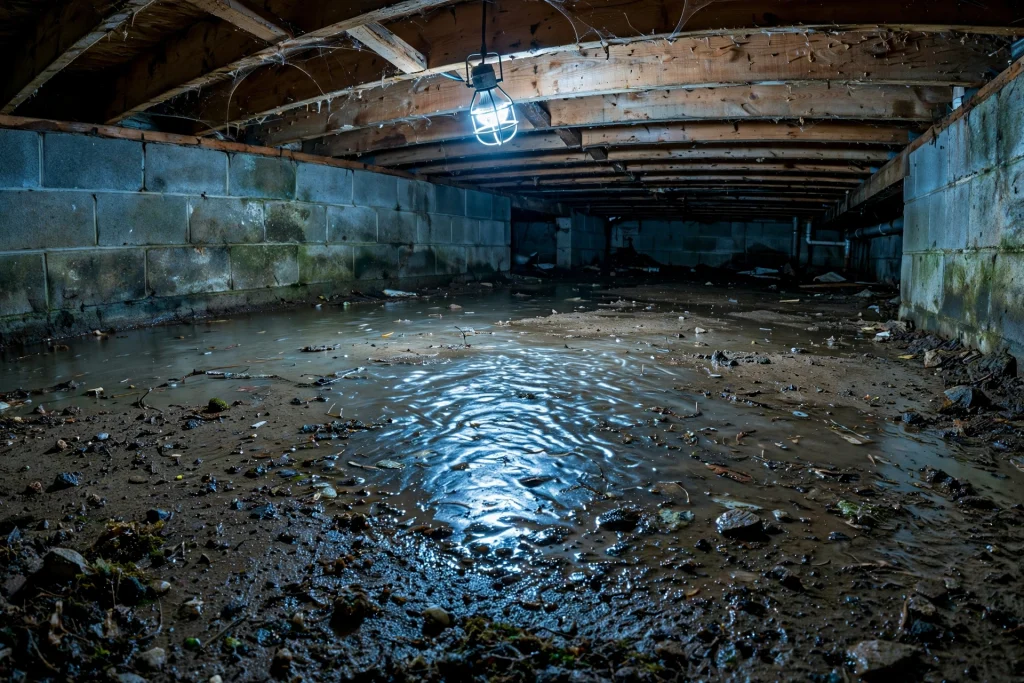
Water under a house gets ignored longer than water in a basement, for the obvious reason that nobody goes down there. It is discovered during a home inspection, or when a floor starts feeling soft, or when a plumber crawls in for something unrelated and comes back out with news.
By that point it has usually been there for a while, and standing water in a crawl space does more damage per gallon than the same water on a basement slab, because it sits directly beneath wood framing in an unventilated space.
Here are the causes, how to distinguish them, and what each fix costs.
Why it matters more than you think
Wood rot. Framing above roughly 20 percent moisture content supports decay fungi. Joists, girders, subfloor, and sill plates sitting above standing water routinely exceed that. Sill plate replacement runs into thousands of dollars and requires jacking the house.
Mold, distributed throughout the building. Because of the stack effect, roughly 30 to 50 percent of first-floor air originates in the crawl space. Whatever grows down there ends up in the air you breathe.
Pests. Termites specifically need moisture in wood to establish. Standing water is an invitation, and termite damage plus water damage compounds fast.
Insulation failure. Wet fiberglass loses R-value and holds water against the subfloor.
Ductwork and equipment. HVAC ducts in a wet crawl space corrode, and condensation forms inside them.
Humidity in the whole house, making it much harder to hold 45 to 50 percent anywhere.
The nine causes
1. Downspouts discharging at the foundation
The most common, and the cheapest to fix. One inch of rain on an average roof sends hundreds of gallons to each downspout, and delivering that beside a shallow crawl space foundation puts it under the house within hours.
Signs: water worst near an exterior corner, correlating with a downspout position. Erosion or a soggy patch outside at that spot.
Fix: extend six to ten feet, $15 to $40 each.
2. Negative or flat grading
Backfill settles over decades. Ground that once sloped away now slopes back, and surface water runs to the foundation and through the vents or the block.
Signs: water pooling outside against the wall after rain, soil visibly lower at the house than three feet out, mulch built up above the foundation.
Fix: six inches of fall in the first ten feet, $500 to $3,000.
3. Water entering through the vents
Foundation vents sit at or near grade. When surface water reaches that level, it pours straight in.
Signs: water entry directly below a vent, silt fans spreading inward from the opening.
Fix: regrade so the ground falls away, raise the vent, or install a well and cover. Sealing vents as part of encapsulation also resolves it.
4. High water table
On low-lying lots, groundwater can rise above the crawl space floor seasonally, typically in spring. It seeps up through the soil rather than running in from anywhere.
Signs: water appears evenly across the floor, worst in spring, persists for weeks, no correlation with individual rain events, unaffected by surface fixes.
Fix: interior perimeter drain and sump pump beneath the liner, $1,500 to $5,000.
5. Plumbing leaks
Supply lines, drain lines, and water heaters in the crawl space. A slow supply leak can run for months unnoticed.
Signs: water present in dry weather with no rain to explain it. Clean water rather than muddy. Localised beneath a bathroom or kitchen. Water bill higher than usual.
How to test: turn off every fixture, note the water meter reading, wait two hours without using water, and check it again. Movement means a leak somewhere.
Fix: plumber, $200 to $1,500 depending on access and location.
6. Failed or absent footing drain
If the house has a perimeter drain that has silted up, collapsed, or filled with roots, groundwater that should be intercepted now accumulates instead.
Signs: a crawl space that was dry for years and gradually became wet with no other change.
Fix: camera inspection $200 to $500 first, then jetting at $400 to $1,200, or replacement.
7. Condensation, not intrusion
Sometimes the “water” is not coming in at all. Warm humid summer air entering through vents condenses on cool surfaces and drips. In a vented crawl space this can produce genuinely wet soil and dripping ducts. The physics is the same as summer basement sweating.
Signs: worst in summer, water beaded on ducts and pipes rather than pooled from an obvious source, no correlation with rain.
Fix: encapsulation and a dehumidifier.
8. Hillside or surface runoff
On sloped lots, water moving downhill through the soil arrives at the uphill foundation wall and enters.
Signs: water concentrated along the uphill wall, worst during and shortly after heavy rain.
Fix: a curtain drain uphill of the house, intercepting water before it arrives. $25 to $60 per linear foot. How french drains work.
9. A failed sump pump
If a pump is already installed, water means it has stopped working. Stuck float, dead motor, tripped breaker, blocked discharge, or a power outage during the storm that needed it.
Signs: pit full, pump silent, or pump running with no water leaving.
Fix: work through the troubleshooting sequence, and test quarterly once it is working.
How to diagnose yours
Note the timing. Within hours of rain means surface water. A day or two after, or persisting for weeks, means groundwater. Present in dry weather means plumbing or a high water table. Worst in summer with no rain means condensation.
Note the location. Concentrated at one corner points to a downspout or grading. Along one wall points to runoff direction. Evenly across the floor points to a rising water table. Beneath a bathroom points to plumbing.
Look at the water. Clean and clear suggests a supply line. Muddy suggests surface water carrying silt in. Foul suggests a drain line or sewage, which is a health hazard requiring professional handling.
Do the meter test to rule plumbing in or out.
Walk outside during rain and watch where water goes. Twenty minutes and a raincoat resolves a surprising number of these.
Check the vents for silt fans spreading inward.
Safety before you crawl in
Standing water in a confined space under a house deserves genuine caution.
Electrical. Do not enter standing water if wiring, junction boxes, or equipment could be energised. Cut power to the area at the panel first.
Sewage. Water from a drain line carries pathogens. That is professional cleanup, not a shop vac job.
Air quality. Confined, unventilated, potentially high in mold spores and soil gas. Wear an N95 at minimum, and a respirator if there is visible growth.
Structure. Do not put weight on joists or girders that may be rotted.
Never work alone. Someone should know you are down there.
Animals. Snakes, rodents, and insects. Look before you reach.
The fixes, cheapest first
Tier 1, under $500. Extend downspouts. Clean gutters. Clear surface low spots against the foundation. Fix any plumbing leak. Resolves a large share of cases.
Tier 2, $500 to $3,000. Regrade the perimeter. Raise or well the vents. Install a curtain drain uphill. Camera-inspect and jet the existing footing drain.
Tier 3, $1,500 to $5,000. Interior perimeter drain and sump pump inside the crawl space, installed beneath the liner.
Tier 4, $3,000 to $15,000. Full encapsulation with liner, sealed vents, wall insulation, and dehumidifier.
Structural repairs, separately. Rotted joists, girders, or sill plates, $1,000 to $10,000 or more.
Work upward through the tiers. Do not skip to tier 4, because a liner over standing water is a pool cover and encapsulation over rotted framing seals the problem out of sight.
Frequently asked questions
Is a little water in a crawl space normal? No. Damp soil is common in a vented crawl space; standing water is not, and it puts framing at genuine risk.
How fast will it damage my house? Mold begins within 24 to 48 hours on wet organic material. Wood decay takes longer, typically months to years of sustained elevated moisture, but it progresses invisibly and repairs are expensive.
Can I just put down plastic? Only after the water is dealt with. A liner over standing water traps it against the soil and hides it. Drainage first, liner second.
Do I need a sump pump in a crawl space? If groundwater rises above floor level or water accumulates faster than it drains, yes. A perimeter drain to a pit with a pump, ideally with a battery backup.
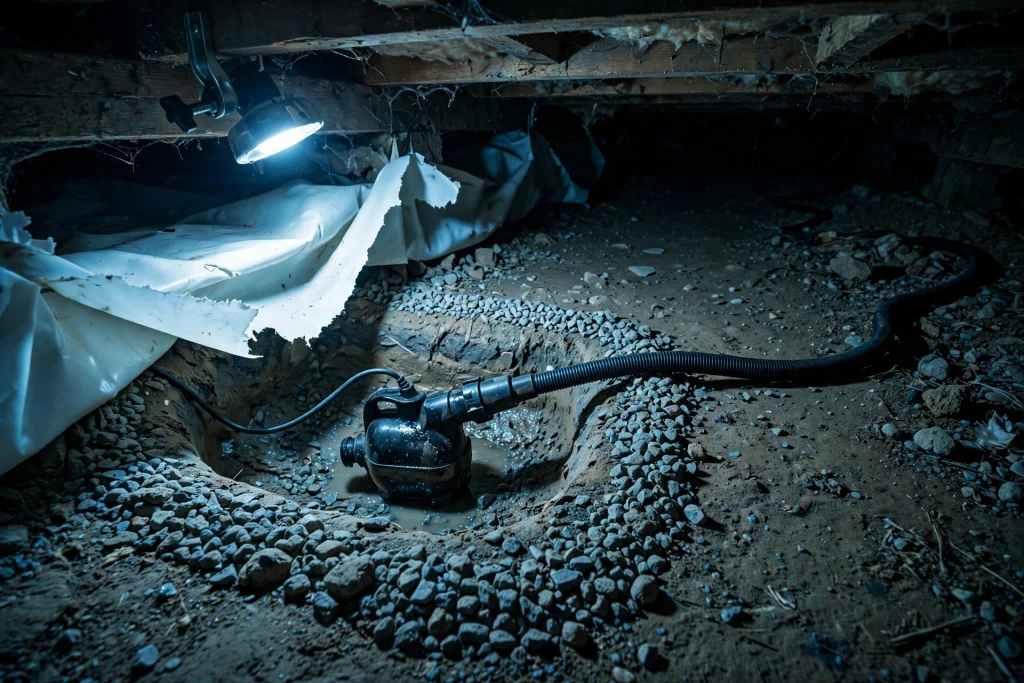
How do I get the water out right now? A submersible utility pump, rentable for $30 to $60 a day, or a wet/dry shop vac for small volumes. Discharge at least 20 feet from the house and downhill.
Does insurance cover it? Typically not for groundwater or seepage. A sudden plumbing failure may be covered. More on coverage here.
Should I disclose this when selling? In most states, yes. Documented, repaired water problems are far less damaging to a sale than something a buyer’s inspector finds.
How often should I check my crawl space? Twice a year, and after any major storm. A wireless humidity sensor lets you monitor without crawling in, which means you might actually do it.
The bottom line
Standing water under a house sits directly beneath the wood holding your floor up, in a space with no ventilation and no one watching. That combination is why crawl space water causes more structural damage per gallon than basement water.
Start with timing and location, because they identify the cause faster than anything else. Then work outward from the cheap fixes: downspouts, grading, and any plumbing leak. Save the liner for after the water is genuinely gone, because sealing a wet crawl space just means you stop seeing the problem.