
Six feet is the minimum. Ten feet is better. On flat lots or clay soil, further still.
That is the answer, and if you do nothing else after reading this, go outside and measure yours. This is the cheapest meaningful improvement available to any homeowner with a wet basement, it costs about thirty dollars per downspout, and it is skipped more often than any other drainage fix.
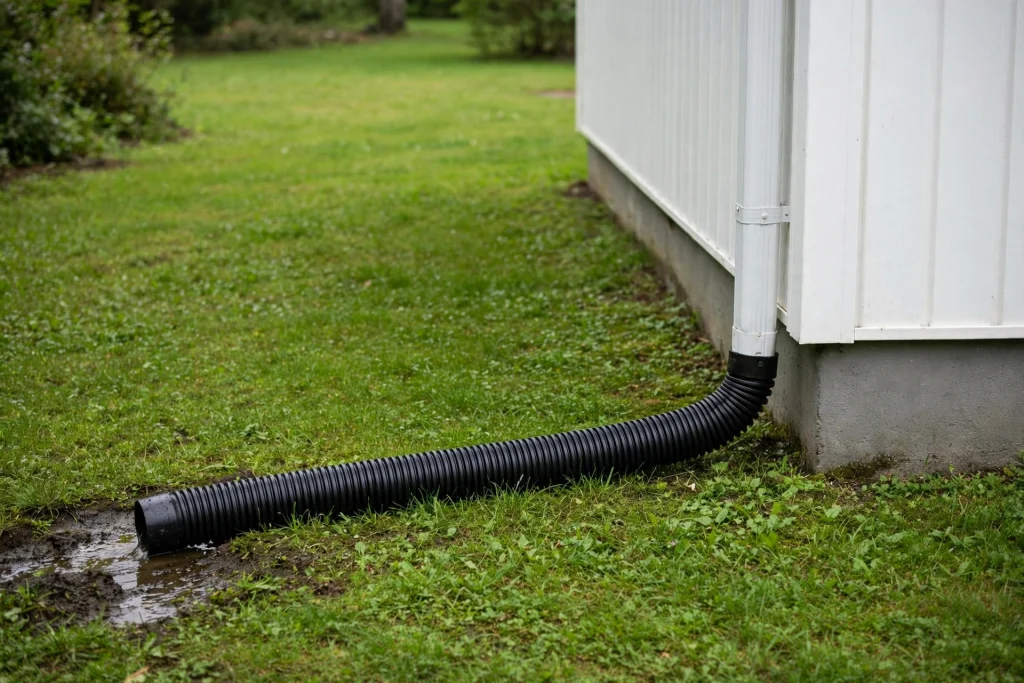
The reason it matters so much is a volume problem, and the numbers are larger than most people picture.
The math
A one-inch rainfall on a 1,500 square foot roof produces roughly 930 gallons of water.
That water does not arrive evenly across your yard. Your roof collects all of it and your gutters funnel it to a handful of discharge points. A house with four downspouts is delivering something like 230 gallons to each one, from a single inch of rain.
A heavier storm dropping three inches produces around 2,800 gallons, or 700 gallons per downspout.
Now consider where that lands. A downspout discharging at the base of the wall, or onto a splash block that moves it two feet, is depositing hundreds of gallons directly into the two feet of soil immediately against your foundation.
Quick reference:
| Roof area | 1″ rain | 2″ rain | 3″ rain |
|---|---|---|---|
| 1,000 sq ft | 620 gal | 1,250 gal | 1,870 gal |
| 1,500 sq ft | 930 gal | 1,870 gal | 2,800 gal |
| 2,000 sq ft | 1,250 gal | 2,490 gal | 3,740 gal |
| 2,500 sq ft | 1,560 gal | 3,120 gal | 4,670 gal |
Why the soil right next to your house is the worst place for it
When your house was built, the excavation was dug considerably wider than the foundation to give workers room. After the walls were poured, that gap was backfilled with the soil that came out of the hole.
That backfilled soil is looser and more permeable than the undisturbed ground around it, and it stays that way permanently. Rain preferentially percolates down through it rather than through the compacted native soil beside it.
The effect is that your foundation sits inside a trench of loose soil that fills faster than it drains. Builders call it the clay bowl effect, and it means water delivered near the wall does not spread out. It goes down, along the foundation, and accumulates.
From there it does three things: it saturates the soil and builds hydrostatic pressure against the walls, it moves through the concrete itself, and it loads up your sump pump with water that never needed to be there.
Getting the discharge six to ten feet out puts it beyond the backfill zone, into undisturbed soil that drains more slowly and spreads water sideways rather than funnelling it straight down your wall.
What determines your specific number
Six feet is the working minimum for a house on a well-drained lot with a decent slope away from the foundation.
Ten feet is the better default and what most drainage professionals recommend.
Fifteen to twenty feet or more where:
- The lot is flat, so water does not carry itself away
- The soil is heavy clay, which absorbs slowly and holds water
- The ground slopes back toward the house
- You have a large roof area feeding few downspouts
- The basement has a history of water
- The house sits at the bottom of a hill
The test that matters more than any number: go outside during heavy rain and watch where the water actually goes. If it pools, if it runs back toward the house, or if the soil at the discharge point stays soggy for days, your extension is too short regardless of how many feet it is.
Extension options, ranked
Splash blocks — not sufficient alone
A concrete or plastic tray that moves water two or three feet and disperses it. Cheap and better than nothing, but two feet is well inside the backfill zone.
They also tilt, crack, sink, and get shifted by mowing, and a tilted splash block returns water toward the house. Use them as a landing surface at the end of a real extension, not as the extension itself.
Cost: $10 to $25.
Rigid or flexible surface extensions — the practical default
A length of downspout pipe or corrugated flexible tubing running six to ten feet out.
Rigid aluminium or vinyl looks tidier and lasts longer. Flexible corrugated is cheaper and easier around obstacles, but it sags, holds water, and degrades in sunlight.
Cost: $15 to $40 each. Downside: they are in the way of mowing, and this is exactly why they get removed and never put back.
Hinged or flip-up extensions
Rigid extensions on a hinge at the elbow. Flip up for mowing, flip down afterward. Solves the single biggest reason extensions disappear.
Cost: $25 to $50 each.
Roll-out or accordion sleeves
Automatically unroll under water pressure and retract when dry. Convenient, and they tend to be less durable and less reliable over years.
Cost: $15 to $30.
Buried solid pipe to a pop-up emitter — the best solution
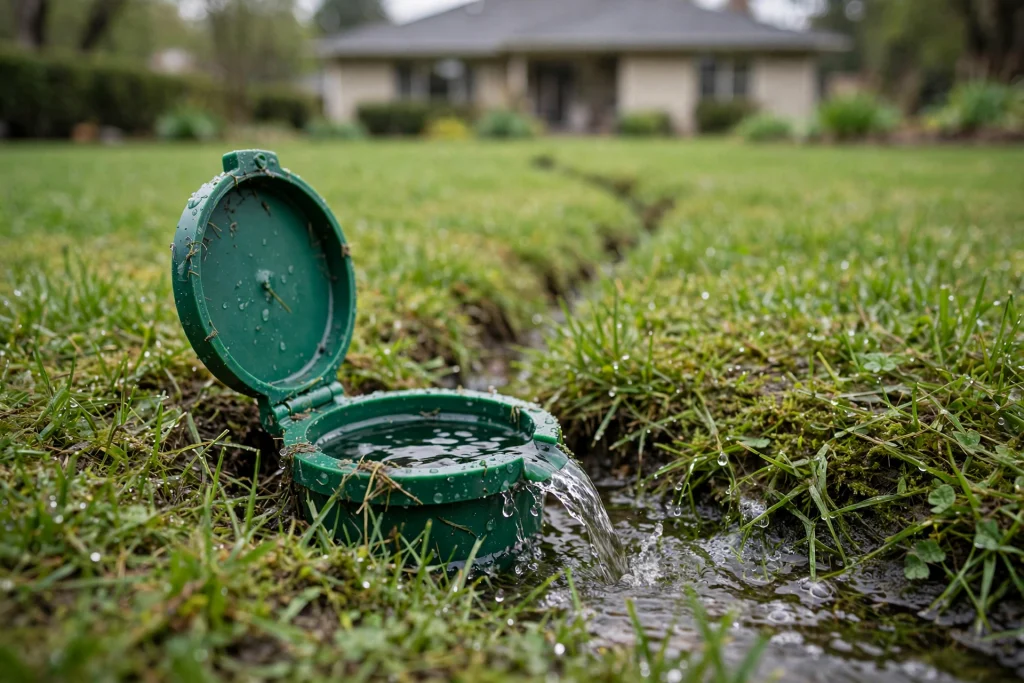
A solid, non-perforated 4 inch pipe buried a few inches below grade, running well away from the house to a spring-loaded pop-up emitter that opens under water pressure and closes flush with the lawn.
Invisible, mow-over, permanent, and it lets you get water 20 or 30 feet away without a trip hazard.
Critical specification: the pipe must be SOLID, not perforated. Perforated pipe is designed to release water into the soil, which is the exact opposite of what you want here. This is a common and destructive mistake, and it is also why you should never route downspouts into a french drain, which is built to collect groundwater rather than dispose of roof runoff.
Specifications: minimum 1 to 2 percent slope, continuous fall with no low spots, a cleanout at the upstream end, and the emitter set at a genuinely lower elevation than the inlet.
Cost: $10 to $25 per linear foot installed, or $200 to $600 per downspout DIY.
Dry well
A buried gravel-filled pit or manufactured chamber that holds the discharge and lets it percolate away over hours. Suitable where there is nowhere downhill to send water and the soil is reasonably permeable.
Useless in dense clay, where the water simply sits. Size it for your roof area, and keep it at least 10 feet from the foundation.
Cost: $500 to $3,000.
Rain barrels — with a caveat
Fine for capturing water for garden use. The important detail is that a full barrel overflows, and if the overflow discharges at the base of your foundation you have built a device that delivers water exactly where you did not want it. Plumb the overflow into a proper extension.
Common mistakes
Using perforated pipe for a buried run. It releases the water into the soil along the way. Solid pipe only.
Not enough slope on a buried line. Below 1 percent, water sits in the pipe, silt settles, and in cold climates it freezes. Check with a level, not by eye.
Discharging uphill. Gravity is not negotiable, and it happens more than you would think on gently sloping lots where the eye misjudges the grade.
Discharging onto a neighbouring property. Concentrating water onto adjacent land creates real legal exposure and some jurisdictions restrict it explicitly.
Connecting to the sanitary sewer. Prohibited essentially everywhere. Storm runoff overwhelms treatment capacity and causes area-wide backups. Fines are real.
Removing extensions for mowing and forgetting. Get hinged extensions or bury the line.
Discharging onto a patio or driveway that slopes back to the house. The extension length is irrelevant if the hardscape returns the water.
Ignoring winter. Extensions that hold water freeze and block. Rigid pipe with continuous fall drains fully between events. Disconnect flexible sections before hard freezes.
What this actually fixes
Correcting downspout discharge is disproportionately effective because it removes water at the source rather than managing it after it has arrived.
Homeowners who extend downspouts commonly see seepage stop entirely, sump pump cycling drop noticeably, efflorescence stop returning, and basement humidity fall.
It will not fix a high water table, a failed footing drain, or a structural crack. But it costs a few hundred dollars for a whole house, and doing it first is how you find out whether you actually need a five-figure drainage system.
The 20-minute audit
Count your downspouts and check the roof area each one serves. General guidance is one downspout per 30 to 40 feet of gutter run. If one downspout is draining a huge roof plane, the gutter system itself may be part of the problem.
Measure each extension from the wall to the discharge point. Anything under six feet needs attention.
Look at the discharge point. Is there an erosion trench? A permanently soggy patch? Dead grass? Those mean the water is not moving away.
Check the slope of the ground at the discharge. Water needs somewhere to go once it lands.
Go out during rain. This is the step that tells you the truth. Watch each downspout and follow the water.
Check for crushed or disconnected sections, particularly where extensions cross a driveway edge or a path.
Frequently asked questions
Is a splash block enough? No. Two or three feet is inside the backfill zone. Use one as a landing pad at the end of a longer extension.
Can I bury downspout extensions? Yes, and it is the best solution. Use solid 4 inch pipe with at least 1 percent slope, a cleanout, and a pop-up emitter at a lower elevation.
Solid or perforated pipe for a buried downspout line? Solid, always. Perforated releases water into the soil along the route, defeating the purpose.
How far is too far? There is no upper limit for the foundation’s sake. Practical limits are your property line, where you can achieve fall, and not creating a soggy spot elsewhere in the yard.
What if my lot is too small for ten feet? Get as far as you can, then use a dry well or connect to a storm system where permitted. On tight lots a buried line running along the side of the house to the front or rear is often the answer.
Should downspouts discharge onto a driveway? Only if the driveway slopes away from the house and drains to a street or a proper collection point. A driveway that pitches back toward the garage makes it worse.
Do downspout extensions help with ice dams? Not directly. Ice dams are an attic insulation and ventilation problem. Extensions do prevent the meltwater from ice dams pooling at the foundation, which matters during spring thaw.
How often should I check them? Twice a year with your gutter cleaning, plus after any storm with high winds, and any time someone has mowed or worked in the yard.
The bottom line
Six feet minimum, ten feet better, more on clay or flat ground. A single inch of rain on an average roof sends hundreds of gallons to each downspout, and delivering that into the loose backfill against your wall is the most efficient way to wet a basement anyone has invented.
Thirty dollars and ten minutes per downspout. Then go stand outside in the next real rain and watch where the water goes, because that is the only test that actually settles it.