
Target 45 to 50 percent relative humidity. Never let it sit above 60 percent.
That is the whole answer, and it is worth knowing because relative humidity is the single most useful number in a basement. It predicts mold growth, it explains condensation on your walls and pipes, it determines whether stored belongings survive, and it tells you whether a moisture problem is being managed or merely tolerated.
A $15 hygrometer turns an impression into data, and most homeowners are surprised by what it reads.
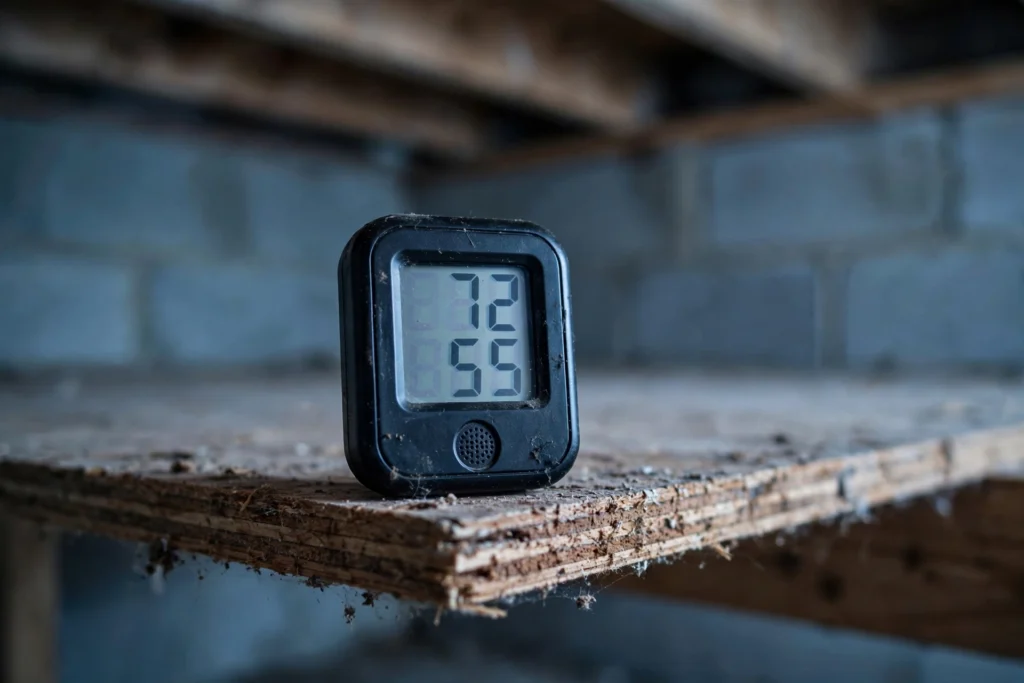
The numbers
| Relative humidity | What happens |
|---|---|
| Below 30% | Wood shrinks and cracks, static, dry skin. Rare in basements. |
| 30 to 40% | Very dry. Fine for storage, uncomfortable for living space. |
| 45 to 50% | The target. Mold cannot establish, condensation is unlikely, comfortable. |
| 50 to 60% | Acceptable but not ideal. Dust mites become active around 50%. |
| 60%+ | Mold and mildew become active. This is the line. |
| 70%+ | Rapid mold growth, condensation on most cool surfaces, musty odour. |
| 80%+ | Visible water on surfaces, rusting metal, damage to stored items. |
60 percent is the threshold that matters most. Mold spores are present in every indoor environment, including yours. They sit inert on dust, cardboard, and the organic film that coats every surface, and they stay inert until conditions let them germinate. Sustained relative humidity above roughly 60 percent is that condition.
This is why a basement can smell musty with no visible water anywhere. Nothing leaked. The air was simply humid enough for long enough.
Why relative humidity is confusing
Relative humidity is relative to temperature, and this trips people up constantly.
Warm air holds far more water vapour than cool air. So the same quantity of moisture produces a very different relative humidity reading depending on how warm the air is.
Take air at 75°F and 50 percent relative humidity upstairs. Move that identical air into a 62°F basement and it becomes roughly 80 percent relative humidity — without a single drop of water being added. The air did not get wetter. It got colder, so the moisture it was carrying now represents a much larger fraction of what it can hold.
This is the entire mechanism behind basement walls sweating in summer, and it explains why the intuitive fix, opening the windows on a warm day, makes things worse.
Dew point: the more useful number
Dew point is the temperature at which air becomes saturated and water starts condensing out of it. Unlike relative humidity, it does not change with temperature, so it is a direct measure of how much moisture the air actually holds.
The practical rule: if a surface is colder than the dew point of the air touching it, that surface will get wet.
Basement walls and floors stay cool year-round because they are in contact with soil at a stable temperature. In summer, when outdoor dew points climb into the 60s and 70s Fahrenheit, those cool surfaces sit below the dew point and condensation is guaranteed.
An infrared thermometer, $20 to $40, lets you measure surface temperature and compare it to the dew point on your hygrometer. Surface temperature below dew point means condensation, and no amount of wiping will change that.
Why the number matters
Mold. The threshold is 60 percent. Below that, growth cannot establish regardless of what spores are present.
Dust mites. They cannot regulate their own water content and need ambient humidity above roughly 50 percent to survive. Holding 45 to 50 percent suppresses them, which matters for allergy sufferers.
Condensation. High humidity means cool surfaces get wet, which feeds the mold problem and damages whatever is stored against them.
Stored belongings. Books, photographs, textiles, cardboard, wooden furniture, and musical instruments all degrade in sustained high humidity.
Mechanical equipment. Furnaces, water heaters, and electrical panels corrode faster in damp air.
The rest of the house. Air rises through a building via the stack effect and is replaced by air drawn up from the lowest level. A meaningful fraction of the air you breathe upstairs came out of your basement.
Wood. Framing above roughly 20 percent moisture content supports decay fungi, and framing moisture content tracks ambient humidity over time.
How to measure it properly
Buy a hygrometer. $10 to $30 for a basic digital unit. Spend a little more for one that displays dew point as well, which saves you a calculation.
Place it correctly. Away from the dehumidifier’s discharge, away from exterior doors, and not sitting directly on cold concrete. Chest height in the middle of the space is representative.
Use more than one in a large or divided basement. Readings vary considerably between a corner behind boxes and the open middle of the room.
Log it over time. A single reading tells you very little. Track it across a week, and then across seasons. Many hygrometers store daily minimum and maximum, which is more useful than the instantaneous number.
Add an infrared thermometer if you are chasing condensation. Comparing wall surface temperature to dew point is the diagnostic that settles it.
Watch the seasonal pattern. Summer is almost always the worst. If yours peaks in spring instead, that points toward groundwater rather than air, and the foil test will distinguish the two.
Why basements run humid
Four sources, and they stack.
Vapour through concrete. Soil against your foundation sits at essentially 100 percent relative humidity year-round. Concrete is porous, so water vapour migrates continuously through it from the wet side to the dry side. An uncovered slab can release several quarts per 1,000 square feet per day.
Warm humid air meeting cool surfaces. The summer mechanism described above.
Actual water intrusion. Seepage keeps the concrete damp, and damp concrete evaporates into the room. If you see efflorescence or damp patches, you have a source that no dehumidifier will turn off.
Indoor sources. An open sump pit evaporating continuously, a dryer vent that has come loose, an adjoining crawl space with exposed soil, bathrooms, and laundry.
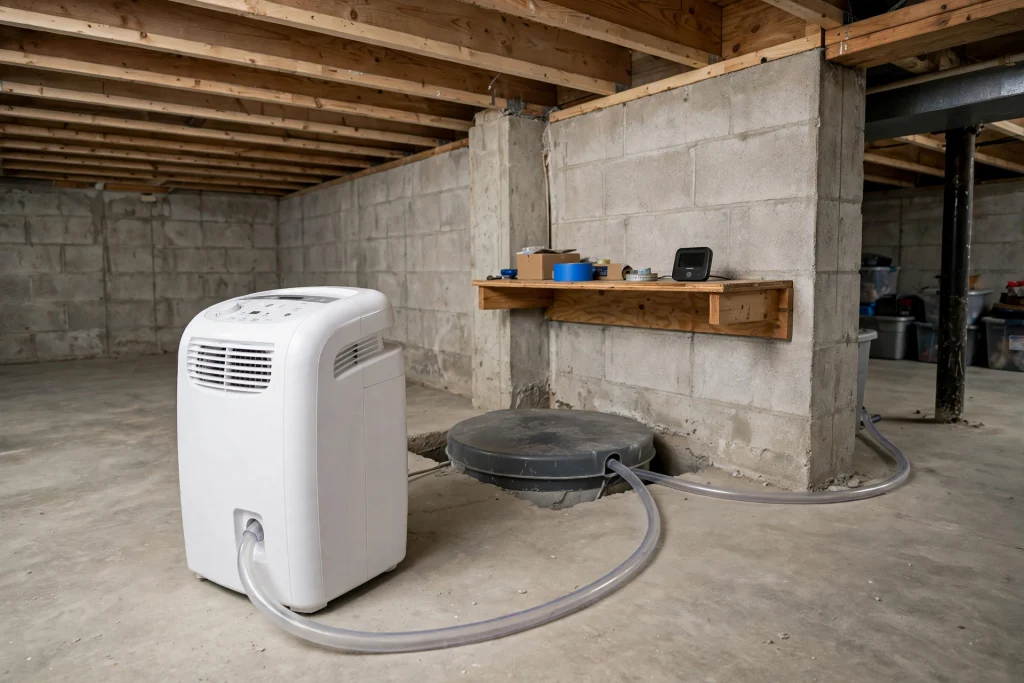
How to hold 45 to 50 percent
In order of how much work each one does.
Fix any actual water intrusion first. Running a dehumidifier against an active leak means paying electricity to remove water you are still letting in. Start with downspouts, gutters, and grading, which are cheap and remove water at the source.
Run a correctly sized dehumidifier continuously. For most basements that means a 50 to 70 pint unit, not a 30. Route the drain hose to a floor drain or sump so you are not emptying a bucket daily. More on what a dehumidifier can and cannot do here.
Keep the windows closed in humid weather. Check the outdoor dew point, not the relative humidity. Below roughly 55°F dew point, ventilating helps. Above that, opening windows adds moisture.
Cover the sump pit with a sealed, gasketed lid. An open pit is a continuously evaporating pool.
Insulate cold water pipes with foam sleeves. Pennies per foot, and it stops the drip that stains ceilings.
Encapsulate an adjoining crawl space. Exposed dirt releases enormous quantities of vapour into the house.
Confirm the dryer vents outside and that the duct has not come apart. A disconnected dryer vent puts gallons of water vapour into a basement every week.
Insulate the walls correctly if finishing. Rigid foam directly against the foundation keeps the interior surface above the dew point, eliminating the condensing surface. Fiberglass batts against bare concrete are a reliable way to grow mold you cannot see, and getting the vapour barrier strategy right matters more than the insulation value.
Seasonal targets
Summer: the hard season. Outdoor dew points are high and basement surfaces are cool. Run the dehumidifier continuously and keep windows closed. Expect it to work hard.
Autumn: conditions ease. Keep the dehumidifier running until outdoor dew points drop consistently.
Winter: humidity usually falls on its own as cold air holds little moisture. Many basements need no dehumidification at all. Watch instead for condensation at cold spots like rim joists and window frames.
Spring: the groundwater season. Rising water tables and thaw can push liquid water in. If humidity spikes in spring rather than summer, suspect seepage rather than air.
Frequently asked questions
What humidity should a basement be in summer? The same 45 to 50 percent, though it takes considerably more dehumidifier capacity to hold it. Do not accept 65 percent as “normal for summer,” because that is the range where mold becomes active.
Is 60 percent humidity too high for a basement? It is right at the threshold. Sustained periods above 60 percent allow mold and mildew to establish. Treat 60 as a ceiling you do not want to touch, not a target.
Can basement humidity be too low? Below about 30 percent causes wood shrinkage, cracking in furniture and trim, and discomfort. It is uncommon in basements and generally only occurs with an oversized dehumidifier running in winter.
Why is my basement humid even though it’s dry? Vapour diffusion through concrete happens continuously without any visible water, and warm air meeting cool surfaces raises relative humidity without adding moisture. Both produce a humid basement with dry-looking walls.
Will a dehumidifier alone get me to 50 percent? In many basements, yes, with a correctly sized unit running continuously. Where there is active seepage or an open crawl space, no, because the source keeps supplying moisture faster than the unit removes it.
How long should it take to bring humidity down? A correctly sized unit typically reaches target within 24 to 72 hours in a moderately damp basement. If it runs for a week without reaching 50 percent, it is undersized or you have an untreated moisture source.
Does humidity affect the rest of my house? Yes. The stack effect draws basement air upward, so basement humidity and any associated mold spores or odour end up in your living space.
Should I use a smart hygrometer? Useful if you want logging and phone alerts, particularly for a second property or a finished basement you do not visit daily. A $15 unit that you actually check works fine otherwise.
The bottom line
45 to 50 percent, and never sustained above 60. That single number tells you whether your basement is a healthy space or a slow-motion mold problem, and it costs fifteen dollars to find out.
Buy a hygrometer, put it in the middle of the space, and read it over a week. If it sits above 60, you have work to do, and the order matters: stop any water getting in, then run a properly sized dehumidifier continuously, then keep the windows shut when the outdoor dew point is high. Wiping the walls is not on the list.
[…] A hygrometer reading consistently above 60 percent means conditions permit growth, and summer condensation on cool walls is the usual driver whether or not you have found it. 45 to 50 percent is the target. […]
[…] Humidity by itself. Vapour still diffuses through walls, and the liner is not perfectly sealed. Most encapsulated crawl spaces need a dehumidifier holding 45 to 50 percent. […]
[…] the house. Removing the largest moisture source in the building makes it far easier to hold 45 to 50 percent relative humidity […]
[…] humidity at 45 to 50 percent with a […]
[…] 45 to 50 percent relative humidity. Size generously, usually 50 to 70 pints for a typical basement, and route the drain hose to a […]
[…] relative humidity. Bringing a basement from 70 percent down to 45 to 50 percent is exactly what these machines […]
[…] 60 percent relative humidity, mold and mildew become active. A dehumidifier sized for the space, held at 45 to 50 percent, usually resolves it. If it does not, you likely have a slow seepage source you have not found […]
[…] rather than guess. A $15 hygrometer tells you when you are actually done. Target is 45 to 50 percent relative humidity, held steady for several days. A $30 pin-type moisture meter checks whether framing and drywall […]
[…] How to check: A $15 hygrometer. Target 45 to 50 percent. […]
[…] is the reason a basement can smell musty and read 70 percent relative humidity while every surface looks bone dry. The water arrived as a […]