
A french drain is a gravel-filled trench with a perforated pipe at the bottom that collects water from the surrounding soil and carries it somewhere else by gravity.
That is the entire concept. No pump, no power, no moving parts. It works because water always takes the path of least resistance, and a trench full of clean stone is a far easier path than compacted soil.
The simplicity is deceptive, though. French drains fail constantly, and almost always for the same handful of reasons: the wrong gravel, no filter fabric, not enough slope, or an outlet that goes nowhere. This guide covers how they actually work and how to get those details right.
Where the name comes from
Not France. Henry Flagg French, a lawyer and farmer from Concord, Massachusetts, who described the technique in his 1859 book on farm drainage. His version used roof tiles laid in a trench. The name stuck, and the principle has not changed in 165 years.
You will also hear the same idea called a curtain drain, a footing drain, drain tile, or weeping tile, depending on where it sits and who is talking. They are variations on one design.
How it works
Three physical principles do all the work.
1. Void space
Compacted soil has perhaps 20 to 30 percent pore space, and most of those pores are microscopically small. Clean, uniformly sized gravel has roughly 30 to 40 percent void space in large, interconnected channels.
Water moving through soil encounters enormous resistance. Water reaching gravel encounters almost none. So when water in the soil meets the gravel trench, it preferentially flows into it, and once inside it moves freely downward.
2. Gravity and slope
The trench must fall continuously toward its outlet. The standard minimum is 1 percent, which is one inch of drop for every eight feet of run. Many installers target 2 percent where site conditions allow.
Below about 1 percent, water moves slowly enough that suspended silt settles out inside the pipe instead of being carried through. That is how drains silt up and eventually stop working.
3. The perforated pipe
Once water reaches the bottom of the trench it enters the pipe through its perforations and flows out at a much higher rate than gravel alone would allow. Gravel is a good conduit; a pipe is a far better one.
Which way do the holes face? Down, in almost all cases. It is counterintuitive, but a pipe with holes at the bottom starts collecting as soon as water reaches the trench floor, and it stays empty between rain events rather than holding standing water. Holes up means water must fill the trench to pipe height before entering.
The anatomy
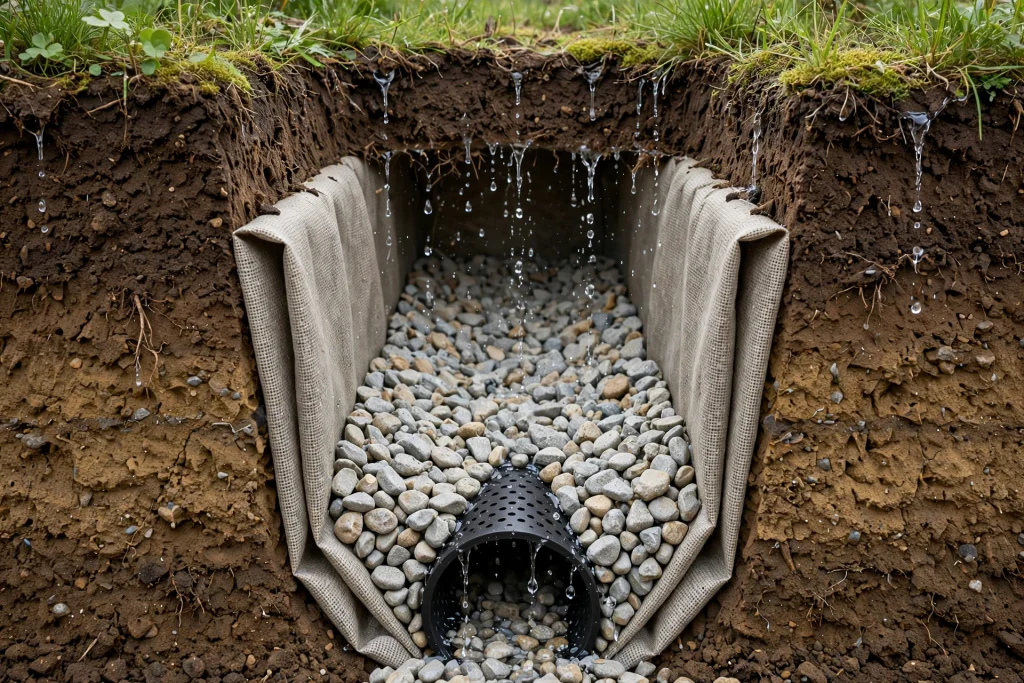
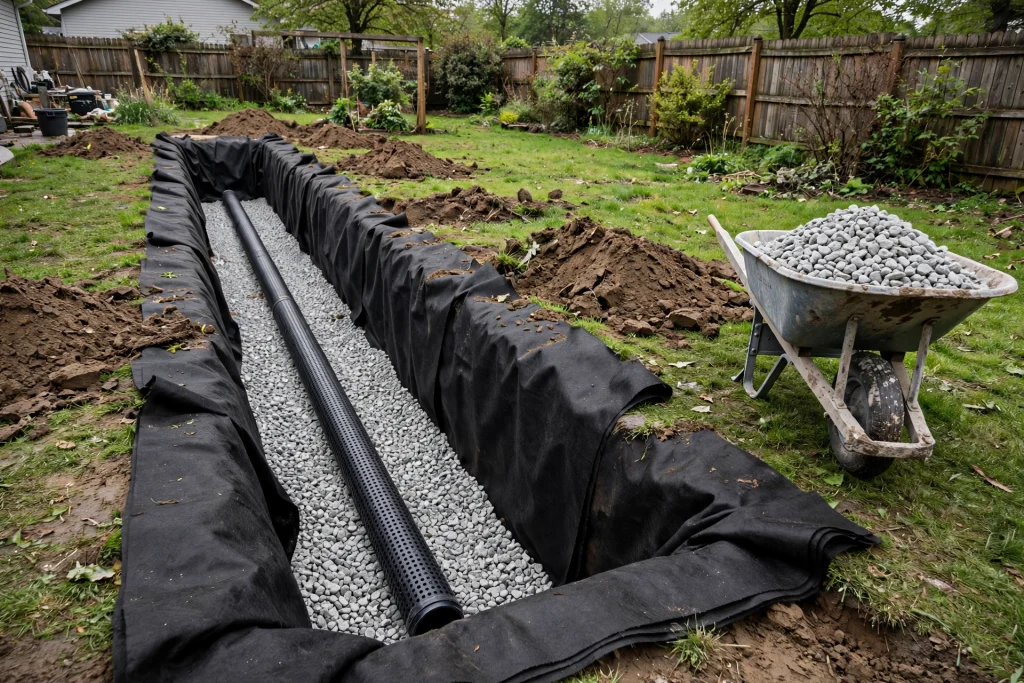
The trench. Typically 12 to 24 inches deep for a yard drain, and down to the base of the footing for a foundation drain. Width is usually 12 to 18 inches, wide enough to work in and to hold a meaningful volume of gravel.
Filter fabric. A non-woven geotextile lining the trench, wrapped up the sides and folded over the top of the gravel before the trench is backfilled. Its job is to let water through while blocking fine silt and clay particles from migrating into the gravel and clogging the void space.
This is the component most often skipped, and skipping it is the single most common reason french drains fail. Without fabric, a drain in silty soil can clog substantially within a decade.
The gravel. Clean, washed, angular stone, typically 3/4 inch, with no fines. The word “clean” is doing real work here: it means the fine dust and sand have been washed out. Pea gravel and crusher run both contain fines and both reduce void space dramatically. Angular stone also locks together and resists settling better than rounded stone.
The pipe. Perforated, 4 inch diameter for most residential applications. Rigid PVC or corrugated HDPE. Rigid PVC costs more, resists crushing, has a smoother interior that carries silt through rather than trapping it, and can be cleaned with a jetter. Corrugated is cheaper and flexible but its ridges catch sediment and it crushes under load. For anything you want to last thirty years, rigid PVC is worth the difference.
The bedding. Two to three inches of gravel beneath the pipe so it is not sitting on soil.
A cleanout. A vertical riser to the surface at the upstream end, capped, allowing a hose or jetter to be run through the line later. Frequently omitted and hugely valuable when the drain silts up in fifteen years.
The outlet. Where the water actually goes. Covered below, because it is the part most likely to be an afterthought.
The four types
1. Surface or yard french drain
Shallow, typically 12 to 18 inches deep, installed in a low area or across a slope to intercept surface water and shallow groundwater before it reaches somewhere you do not want it. Used for soggy lawns, water pooling in a yard, or runoff heading toward a house.
2. Curtain drain
Installed across a slope uphill of a structure, intercepting water moving downhill through the soil before it reaches the foundation. Effectively a defensive line. Very effective on sloped lots where the house sits below higher ground.
3. Exterior footing drain
Runs around the outside perimeter of the foundation at the level of the footing, bedded in gravel against the wall. This is the one most homes are supposed to have, and it collects groundwater before it can build pressure against the walls.
4. Interior drain tile
The same concept, installed inside the basement. A channel is cut through the slab along the footing, perforated pipe is laid in gravel, and it routes to a sump pit. It is the standard retrofit because it does not require excavating the outside of the house. The comparison between the two comes down mostly to cost and disruption.
Where the water goes
A drain that collects water and has nowhere to put it is a very expensive hole.
Daylight. The best option where the site allows. The pipe simply exits at a lower point on the property, often at a slope break, and discharges to the surface. No pump, no maintenance, gravity does everything. Fit a rodent grate at the outlet.
A dry well. A buried gravel-filled pit or a manufactured chamber that holds water and lets it percolate into the soil over hours. Suitable for flat lots with reasonably permeable soil. Useless in dense clay, because the water has nowhere to percolate to.
A sump pit. Where gravity cannot get water off the site, it goes to a pit and a pump lifts it out. This is standard for interior systems and for flat lots.
A storm sewer. Legal in some municipalities and prohibited in others. Never connect a drain to a sanitary sewer, which is prohibited essentially everywhere and causes system-wide backups.
Check local rules before you discharge onto a neighbouring property. Concentrating water onto adjacent land is a genuine source of legal disputes, and some jurisdictions restrict it explicitly.
The seven mistakes that kill french drains
1. No filter fabric. Fines migrate into the gravel, void space fills, the drain stops working. The most common failure by a wide margin.
2. The wrong gravel. Pea gravel, crusher run, or anything containing fines. Use clean washed 3/4 inch angular stone.
3. Insufficient slope. Below 1 percent, silt settles inside the pipe. Check with a level and a string line, not by eye. Ground that looks like it slopes frequently does not.
4. No outlet, or an outlet that is higher than the drain. Water does not run uphill. This sounds obvious and it happens regularly.
5. Connecting downspouts into the perforated pipe. This is a specific and destructive error. A french drain is designed to collect water from soil. Feeding hundreds of gallons of roof runoff into it during a storm overwhelms it and releases that water into the soil exactly where you were trying to remove it. Downspouts need their own solid pipe running to a separate discharge point.
6. Using a fabric sock on the pipe in silty soil. Pipe socks clog quickly in fine-grained soils. Line the trench with fabric instead, so the filtering surface area is large rather than concentrated on the pipe.
7. No cleanout. Every drain silts eventually. Without access, maintenance means excavation.
Cost
| Type | Typical range |
|---|---|
| DIY yard drain, materials only | $10 to $25 per linear foot |
| Professional yard or curtain drain | $25 to $60 per linear foot |
| Interior perimeter drain tile | $60 to $150 per linear foot |
| Exterior footing drain, existing home | $100 to $300 per linear foot |
| Dry well | $500 to $3,000 |
| Cleanout riser | $50 to $150 each |
Exterior footing drain retrofits are expensive because the cost is excavation, not pipe: digging to footing depth around a house, working around utilities and landscaping, and restoring everything afterward.
Does a french drain fix a wet basement?
Sometimes, and it depends entirely on where the water is coming from.
It helps a great deal when: water is moving through soil toward your foundation from a slope, a high water table is putting pressure against the walls, or the original footing drain has failed.
It does very little when: the problem is surface water from a downspout dumping at the wall, gutters overflowing, ground sloping back toward the house, or a window well filling during rain.
That distinction matters financially. A contractor quoting a drainage system before checking your gutters and grading is skipping the cheap fixes. Work through the diagnostic sequence for a leaking basement first, because a surprising share of “you need a drainage system” cases turn out to be a $30 downspout extension.
Maintenance and lifespan
A properly built french drain with filter fabric, clean stone, adequate slope, and rigid pipe should function for 30 to 40 years or more. Poorly built ones fail in 5 to 15.
Annually: check that the outlet is clear of debris, soil, and animal nests. Confirm water actually exits during rain.
Every few years: run a hose into the cleanout and confirm flow reaches the outlet.
When flow declines: hydro-jetting clears accumulated silt, typically $400 to $1,200. This is only possible with rigid pipe and a cleanout, which is the argument for both.
Signs of failure: water pooling above the drain line, the outlet running dry during heavy rain, or a basement that was dry and has started leaking. That last one often means a footing drain has silted up after decades of service.
Frequently asked questions
Can I install a french drain myself? A yard or curtain drain is a realistic DIY project if you are prepared for serious digging and you get the slope right. Rent a trencher. Call 811 or your local utility locate service first, without exception. Interior drain tile and exterior footing drains are professional work involving concrete cutting or deep excavation.
How deep should a french drain be? Yard drains typically 12 to 18 inches. Curtain drains deeper, ideally below the depth water is travelling. Footing drains at the base of the footing, which is the whole point of them.
Do I need the pipe at all, or is gravel enough? Gravel alone works for very short runs and small volumes and is sometimes called a french drain without pipe. Pipe increases capacity enormously for a small added cost, and it allows future cleaning. Include it.
What size gravel? Clean washed 3/4 inch angular stone. Avoid pea gravel and anything with fines. The word “clean” on the delivery ticket matters.
How long does a french drain last? 30 to 40 years when properly built with fabric, clean stone, and rigid pipe. Substantially less when those are skipped.
Will it work in clay soil? Yes, and clay is often exactly why one is needed, since clay drains poorly on its own. But clay produces a lot of fine sediment, so filter fabric becomes even more important, and a dry well outlet will not work because clay cannot absorb the discharge.
Can I plant over a french drain? Grass and shallow perennials, yes. Avoid trees and large shrubs anywhere near the line, because roots seek out the moisture and will enter the pipe.
Does a french drain need a permit? Often yes, particularly if it discharges to a municipal system, crosses a property line, or is part of foundation work. Check with your building department before digging.
Will it freeze in winter? A properly sloped drain empties between events, so there is little standing water to freeze. Problems occur at the outlet, where ice can block the exit. A grate and a clear discharge area help, as does making sure the line drains fully.
The bottom line
A french drain is a trench, clean stone, a perforated pipe, filter fabric, and continuous slope to a real outlet. Get those five right and it works for decades without any attention. Get any one of them wrong and you have buried a problem instead of solving it.
And before you dig anything, be honest about where your water is actually coming from. Drainage systems are the right answer for groundwater moving through soil. They are an expensive answer for a downspout emptying against your wall, and that turns out to be the problem far more often than anyone expects.