
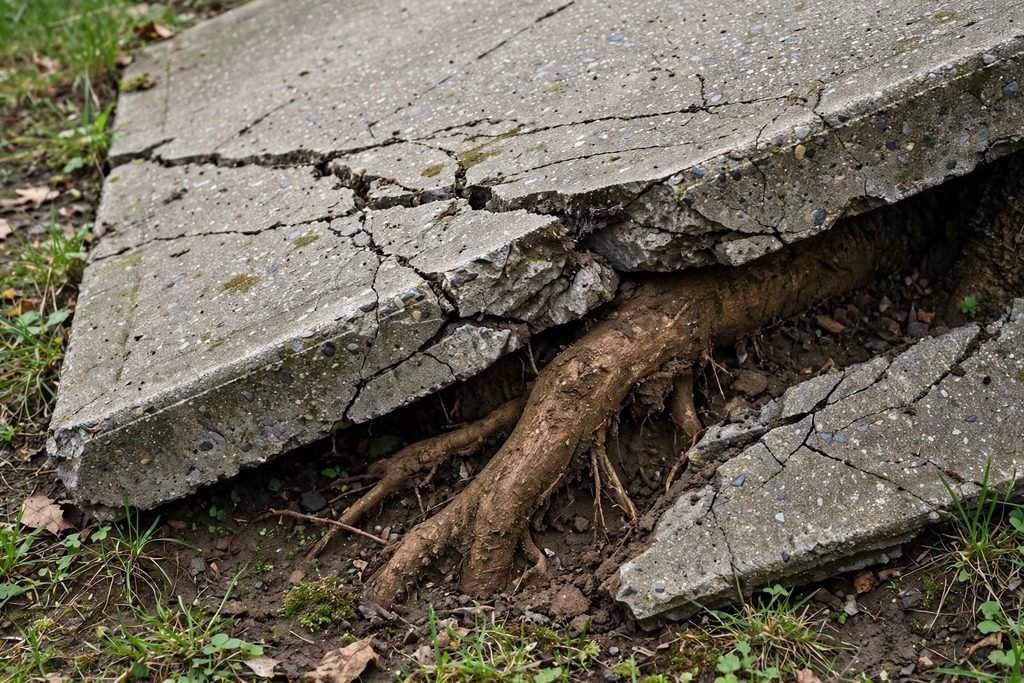
The intuitive picture is a thick root growing against a foundation wall and slowly levering it apart, like a root breaking up a sidewalk.
That does happen, and it is not the main problem. The dominant way trees damage foundations is far less visible and considerably more destructive: they drink. A mature tree withdraws hundreds of gallons of water a day from the soil during the growing season, and in clay soils, removing that water makes the ground shrink. When the ground under one part of your footing shrinks and the ground under another part does not, the house settles unevenly and cracks.
This distinction matters practically, because the two mechanisms call for opposite responses. And because the single most common homeowner reaction, cutting the tree down, can make things dramatically worse.
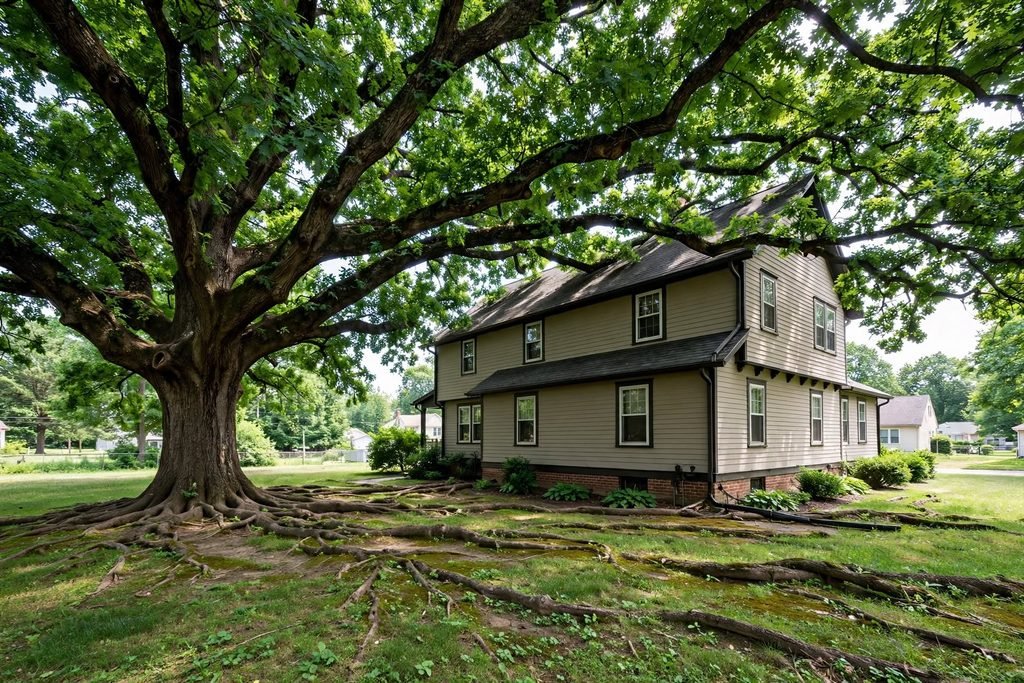
The real mechanism: moisture withdrawal from clay
Why clay is the problem
Clay soils are expansive, meaning they change volume with moisture content. The clay particles are plate-shaped, and water molecules slide between the plates and force them apart. Add water, the soil swells. Remove water, it shrinks.
The volume change is substantial. Highly expansive clays can change volume by 10 percent or more between saturated and desiccated states, which translates to inches of vertical ground movement.
Soils dominated by montmorillonite and smectite clays are the most active. Broad regions of Texas, Colorado, Oklahoma, and parts of the Midwest and Southeast sit on them. Sandy and gravelly soils are essentially unaffected, because sand does not change volume with moisture.
How much water a tree removes
A mature deciduous tree can transpire several hundred gallons of water on a hot summer day. That water comes from the soil within the root zone, and it is removed selectively, from wherever the roots reach.
The result is a cone of drier soil centred on the tree. If a corner of your footing falls inside that cone and the rest of the house does not, that corner sits on shrinking soil while the rest sits on stable soil. That is differential settlement, and differential settlement is what cracks foundations.
Why it is seasonal and cumulative
The cycle runs annually. Soil dries through summer as the tree transpires, shrinking and letting the footing settle. Autumn rains and winter dormancy rehydrate it, and it swells back. The foundation rides up and down.
In a normal year the movement may be tolerable. In a drought, the tree draws harder and deeper, the clay desiccates well below its usual depth, and settlement goes further than the structure can accommodate. This is why foundation damage claims spike during and immediately after drought years in clay regions.
Repeated cycling also fatigues masonry over time, so a house may tolerate the movement for twenty years and then crack.
How far do roots reach?
Further than most people assume. The old rule that roots stop at the drip line is wrong. Root systems commonly extend to two or three times the canopy radius, and in dry conditions further still as roots forage for moisture.
Depth is the opposite of what people picture. The majority of a tree’s absorbing roots sit in the top 12 to 24 inches of soil, spreading laterally rather than plunging down. Deep taproots are the exception rather than the rule in mature landscape trees.
So a tree 30 feet from the house can absolutely be influencing soil beneath your footing.
The secondary mechanism: physical displacement
Roots do exert mechanical force. A growing root increases in diameter and, where it is confined, that expansion pushes.
Where it genuinely causes damage:
- Sidewalks, driveways, and patios. Thin, unreinforced slabs on grade are easy to lift. This is where visible root damage almost always occurs.
- Shallow footings. Porches, steps, garden walls, and old shallow additions.
- Crawl space piers and shallow slabs.
- Retaining walls, and shallow footings vulnerable to frost movement as well.
Where it is less common than people think:
- Deep foundation walls and footings. Roots follow the path of least resistance. Growing directly into and through dense, load-bearing concrete under a house is much harder than growing around it. Roots more often exploit an existing crack or gap than create one.
The practical guide: a root that is visibly wedged into a crack and clearly widening it is a genuine mechanical problem. A crack across the house with a tree somewhere in the yard is more likely a moisture story.
The third mechanism: drain and sewer damage
Frequently overlooked and often the most expensive.
Roots seek water. A sewer lateral or drain line with a hairline crack or a loose joint releases moisture and nutrients into the soil, and roots grow toward it, enter through the defect, and proliferate inside the pipe.
Two consequences follow:
Blockage. Root masses catch solids and cause backups, sometimes into the basement.
Soil washout. A pipe that roots have cracked open leaks continuously beneath your foundation. That leaking water erodes and softens supporting soil, and can cause settlement far more rapidly than moisture withdrawal ever would.
Older clay tile and cast iron laterals are especially vulnerable at their joints. Modern PVC with gasketed joints is much more resistant.
Signs: recurring slow drains or backups, gurgling fixtures, an unexplained lush green patch or soggy area in the lawn, and a sudden increase in settlement with no drought to explain it.
Diagnosis: a plumber’s camera inspection, typically $200 to $500, which is cheap relative to what it can find.
How close is too close?
There is no universally agreed rule, and the honest answer depends heavily on soil type. Common guidance:
On expansive clay: plant large-maturing trees at a distance at least equal to their expected mature height. A tree that will reach 60 feet goes 60 feet away. Some engineering guidance in high-shrinkage clay regions recommends 1.5 times mature height for the most water-hungry species.
On sandy or gravelly soil: distance matters far less for moisture reasons, since these soils do not shrink. Physical displacement of shallow slabs remains a consideration, so keep large trees off driveways and walkways.
Minimum in any soil: roughly 15 to 20 feet from the foundation for anything that will grow large.
High water demand species
These draw the most and are most associated with clay shrinkage problems: willows, poplars and cottonwoods, silver maple, American elm, oaks, ash, and sycamore. Willows and poplars are the most aggressive by a wide margin and are poor choices near any structure or drain line.
Lower risk near structures
Small-maturing ornamentals with modest water demand: dogwood, redbud, Japanese maple, serviceberry, crabapple, magnolia. Still worth keeping a reasonable distance, but far less likely to cause problems.
How to tell if a tree is actually your problem
Correlation is easy to assume and often wrong. Work through these:
Do you have clay soil? If your soil is sandy or gravelly, moisture withdrawal is not causing your foundation movement, and you should be looking at drainage, poor compaction, or other causes. A soil test through your county extension office is inexpensive and definitive.
Is the damage on the tree side? Settlement from moisture withdrawal concentrates on the side of the house nearest the tree. Damage on the opposite corner points elsewhere.
Does it cycle seasonally? Clay shrink-swell peaks in late summer and recovers in winter, the opposite of frost heave’s winter pattern. Note whether cracks open and close with the calendar. Frost heave produces the opposite pattern, worsening in winter, which is a useful way to tell the two apart.
Did it worsen during a drought? A strong indicator. Drought years drive clay desiccation deeper and further.
Is there a visible root at the damage? Straightforward mechanical displacement, which in masonry often shows as stair-step cracking, most likely affecting a slab, walkway, or shallow footing.
Have your drains been behaving? Slow drains, backups, or a soggy lawn patch suggest a root-damaged pipe washing out soil, which is a different problem with a different fix.
Get an engineer, not just an arborist. A structural engineer evaluates the foundation and, at $400 to $800, has no financial stake in either tree removal or foundation repair. A certified arborist evaluates the tree. For a significant decision you want both.
Before you remove the tree
This is the most important section in the article, because the obvious response can cause a worse problem than the one it solves.
Removal can trigger heave
Here is the mechanism. A mature tree has been withdrawing hundreds of gallons a day from the clay beneath and around it for decades. That soil sits in a chronically dried, shrunken state, and your foundation has settled into equilibrium with it.
Remove the tree and the withdrawal stops. Rain and groundwater rehydrate the soil over the following months and years. The clay swells back toward its natural moisture content, and the ground rises.
This is called heave following tree removal, it is well documented in geotechnical practice, and it can lift a foundation more than the original settlement lowered it. Recovery can take several years and produce a fresh set of cracks in the opposite direction from the originals.
The risk is greatest with a large, mature, high-water-demand tree on highly expansive clay that has been in place for a long time. It is negligible on sandy soil or with a small tree.
Get geotechnical or structural engineering advice before removing a large mature tree close to a house on clay soil. Sometimes the correct answer is to keep the tree and manage the moisture instead.
Alternatives to removal
Root barriers. A physical barrier, typically HDPE panels or a geotextile with a root inhibitor, installed vertically in a trench between the tree and the foundation, usually 24 to 36 inches deep. Redirects roots downward and outward. Cost roughly $25 to $60 per linear foot installed. Most effective when installed before serious damage, and it must be deep enough to actually intercept the root zone.
Crown reduction pruning. Reducing canopy volume reduces transpiration demand and therefore water withdrawal. It has to be repeated on a cycle as the canopy regrows, and it must be done properly by a certified arborist. Topping a tree is not crown reduction and it damages the tree while producing dense regrowth that increases demand.
Selective root pruning. Cutting specific roots on the house side, ideally at the same time a root barrier goes in. Genuinely risky, since removing too much root mass destabilizes the tree and creates a windthrow hazard. Never cut structural roots near the trunk. This is arborist work, not homeowner work.
Soil moisture management. In expansive clay regions, maintaining consistent moisture around the foundation perimeter during drought reduces differential movement. Soaker hoses laid several feet out from the wall, run on a modest schedule, are a recognized practice in Texas and similar climates. The objective is stability, not saturation, and running water right against the foundation is counterproductive.
Foundation underpinning. Where movement is ongoing and the tree is staying, helical or push piers transfer the load to soil below the active zone. $1,000 to $3,000 per pier. This addresses the structure rather than the cause, and it is the appropriate answer when the tree has significant value or removal is too risky.
If you do remove it
Do it gradually where feasible, with staged crown reduction over a few seasons to let soil moisture recover slowly rather than all at once. Monitor the foundation carefully afterward with marked and dated cracks, and expect movement for several years. Do not plant a replacement in the same position.
Prevention for new planting
- Check your soil type first. It changes every other decision.
- Place large-maturing trees at least their mature height from the foundation on clay.
- Choose small-maturing, low-water-demand species for anywhere near the house.
- Keep trees well away from the sewer lateral run, and know where that line is.
- Install a root barrier at planting time if you are placing anything sizeable within range. It is far cheaper then than retrofitting.
- Avoid willow, poplar, cottonwood, and silver maple anywhere near structures or drains.
- Maintain drainage regardless. Downspout extensions and correct grading keep soil moisture more even, which reduces the shrink-swell amplitude the tree is contributing to.
Frequently asked questions
Can tree roots really crack a concrete foundation? Directly, rarely. Roots can lift and crack thin slabs, walkways, and shallow footings, and they can widen an existing crack they have grown into. Cracking a deep, load-bearing foundation wall by direct pressure is uncommon. The moisture mechanism causes far more foundation damage than physical pressure does.
How far do tree roots spread? Commonly two to three times the canopy radius, and further in dry conditions. Most absorbing roots sit in the top 12 to 24 inches of soil and spread laterally.
Will removing the tree fix my foundation? It stops further moisture withdrawal. It may also trigger heave as the clay rehydrates, which can cause new damage. On expansive clay with a large mature tree, get engineering advice before removing.
Is my neighbour responsible if their tree damages my foundation? Law varies substantially by jurisdiction, much as insurance coverage does. Broadly, you generally have the right to cut roots and branches encroaching onto your property, subject to not killing the tree, and liability for damage often turns on whether the owner knew or should have known of the risk. This is a genuine legal question rather than a general one, so consult a local attorney rather than relying on a rule of thumb.
How do I know if roots are in my sewer line? A camera inspection by a plumber, typically $200 to $500. Symptoms that justify it: recurring slow drains, backups, gurgling fixtures, or an unexplained lush or soggy patch of lawn.
Do root barriers actually work? When properly installed to adequate depth, yes, they redirect root growth. They are most effective installed preventively. Retrofitting one near an established tree requires careful root cutting and carries some risk to the tree.
Should I water my foundation during a drought? In expansive clay regions this is a recognized practice, using soaker hoses placed several feet from the wall to maintain consistent soil moisture and reduce differential movement. The hoses stay well out from the wall, because water delivered against the foundation causes its own problems. In non-expansive soils it is unnecessary, and adding water close to a foundation is generally counterproductive.
Are shrubs and hedges a problem too? Much less so. Their water demand and root spread are a fraction of a mature tree’s. Very large or dense hedging close to a wall can contribute in highly expansive soils, but ordinary foundation plantings are not a meaningful risk.
The bottom line
Trees damage foundations mostly by drinking, not by pushing. A mature tree pulls hundreds of gallons a day out of the ground, and in expansive clay that shrinks the soil unevenly beneath your footing, which is what produces the cracks.
So the first question is not how close the tree is. It is what your soil is made of. On sand and gravel, a tree near the house is a minor concern. On active clay, it is a genuine structural variable.
And if the answer is clay and the tree is large and mature, resist the instinct to reach for a chainsaw. Removing it can lift your house more than keeping it lowered it. Get an engineer’s opinion, look at root barriers and crown reduction first, and check the sewer line while you are at it, because a root-cracked drain washing soil out from under a footing does more damage faster than any amount of transpiration.