
Nobody thinks of gutters as basement equipment. They are up at the roofline, visibly unconnected to anything below grade, and they get cleaned when someone remembers.
But a gutter system is the first and most important stage of your foundation’s water management. It intercepts everything that lands on your roof and decides where it goes. When it fails, hundreds of gallons stop being routed away and start being delivered in a concentrated stream into the soil immediately against your wall.
This is the cheapest link in the chain to fix and one of the most common to be broken.
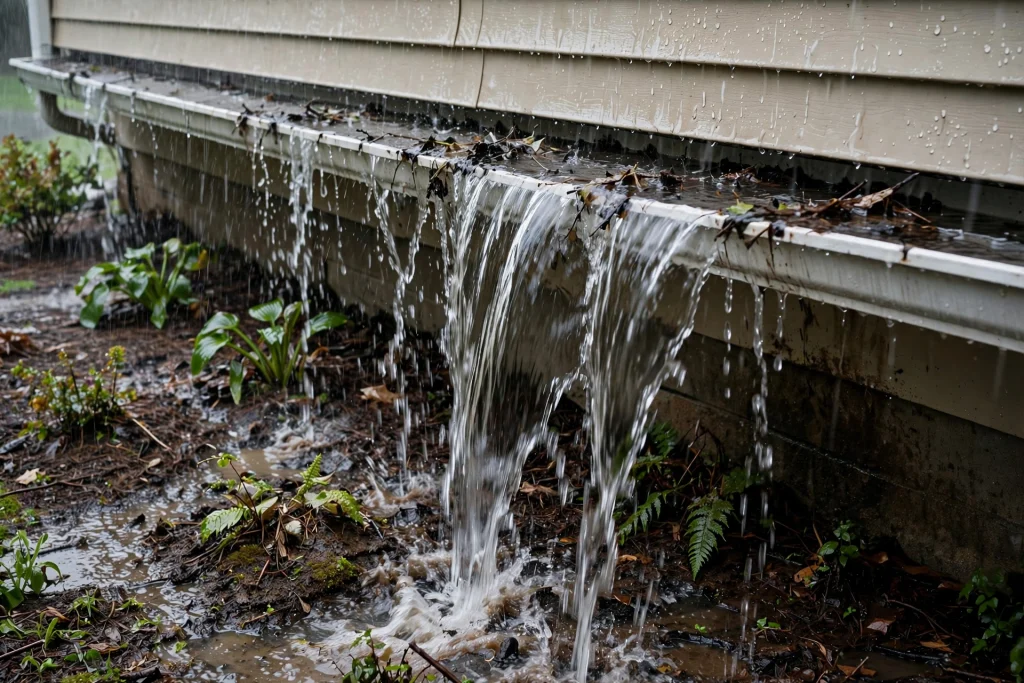
The volume problem
A one-inch rainfall on a 1,500 square foot roof produces about 930 gallons of water. Three inches produces roughly 2,800 gallons.
Your gutters exist to catch all of it and move it to controlled discharge points. When they are working, that water leaves through downspouts and, assuming the downspouts extend far enough, lands well away from the house.
When they overflow, that same volume falls in a curtain along the roofline, landing in a narrow strip of soil directly against the foundation. And that strip is the worst possible place for it, because it sits over the backfill zone: loose soil that was replaced after the foundation was built, which drains faster than the ground around it and channels water straight down the wall.
From there it saturates the soil, builds pressure against the foundation, and eventually moves through the concrete.
The eight failures
1. Clogs
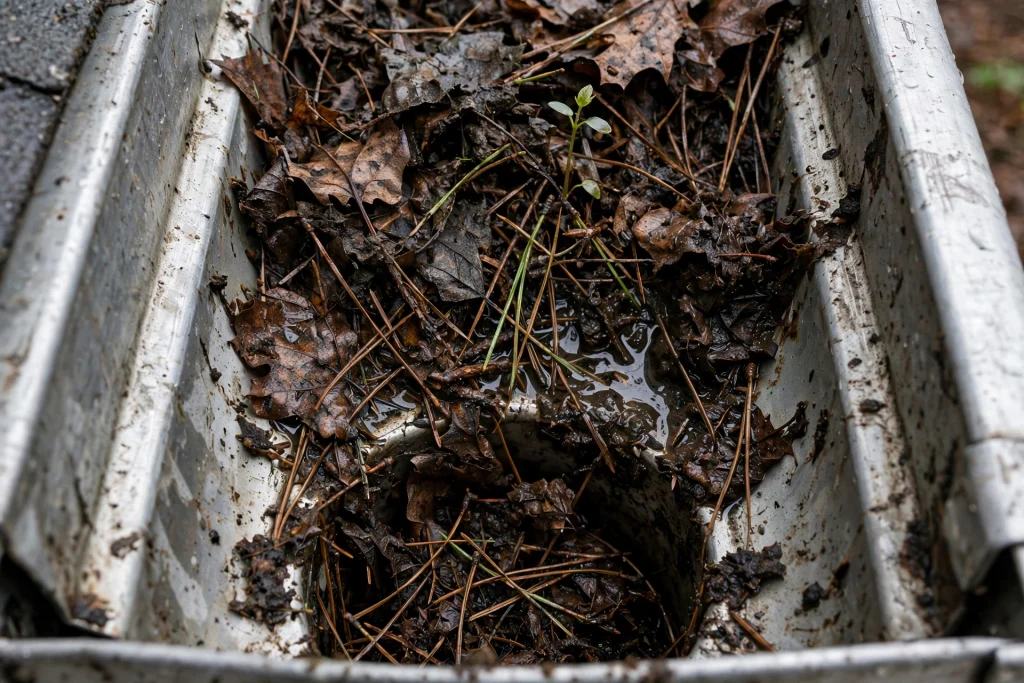
The obvious one. Leaves, pine needles, shingle grit, seed pods, and nests block the trough or the downspout opening.
Note that the downspout outlet clogs before the trough does, and a blocked downspout means the entire gutter run overflows even though it looks clean from the ground.
Signs: plants growing in the gutter, standing water visible after rain, water spilling over the front edge, sagging sections from the weight.
Fix: clean twice a year, more with overhanging trees. $100 to $250 professionally, or an afternoon and a ladder.
2. Undersized gutters and downspouts
Standard residential gutter is 5 inch K-style with 2×3 inch downspouts. On a large roof, a steep roof, or in a region with intense downpours, that is simply not enough capacity.
6 inch gutters carry roughly 40 percent more water than 5 inch. 3×4 inch downspouts carry roughly twice as much as 2×3.
Upsizing the downspouts alone often solves overflow problems, because the downspout is usually the bottleneck rather than the trough.
Signs: overflow only during heavy rain while the gutters are visibly clean.
3. Too few downspouts
General guidance is one downspout per 30 to 40 feet of gutter run. Houses with a single downspout serving a long run overflow at the far end because water cannot travel that far fast enough.
Fix: add downspouts. $150 to $400 each installed, and often more effective than replacing the whole gutter system.
4. Wrong pitch
Gutters need to fall roughly 1/4 inch per 10 feet toward the downspout. Too little and water stands, sediment accumulates, and the section overflows. Too much looks wrong and can overshoot at the outlet.
Pitch also changes over time as hangers loosen and fascia softens.
Signs: standing water in a section after rain has stopped, sediment or plant growth in one spot, staining at one point along the run.
Fix: re-hang the affected section. $5 to $15 per linear foot.
5. Sagging and pulled hangers
Old spike-and-ferrule fasteners work loose over years. The weight of water, ice, and debris pulls sections down, creating a low point that overflows every time it rains.
Rotted fascia makes this worse and often needs addressing first, because new hangers cannot bite into soft wood.
Fix: replace spikes with hidden hangers screwed into solid fascia, at roughly 24 inch spacing.
6. Leaking seams and end caps
Sectional gutters have joints, and joints fail. Sealant dries and cracks, seams separate, and end caps leak.
A leak at a corner or seam delivers a steady drip into one spot for the entire duration of every rain event, which is remarkably effective at eroding soil and saturating one small area beside your wall.
Signs: a persistent drip line, a rust or algae streak below a joint, an erosion channel or dead grass in one spot.
Fix: clean and reseal with gutter sealant, or replace with seamless gutter. Seamless is a genuine improvement on long runs.
7. Overshoot on steep roofs and valleys
On steeply pitched roofs, water moves fast enough to shoot straight over the gutter rather than turning into it. Roof valleys concentrate water from two planes into a narrow stream that can jet clean over the trough.
Signs: the ground below is eroded but the gutter is clean, dry, and correctly pitched. Splash marks on the siding above gutter level.
Fix: a splash guard or diverter at the valley outlet, gutter aprons, or repositioning the gutter slightly higher and outward.
8. Ice dams and winter overflow
Heat escaping into the attic melts snow on the upper roof; the meltwater refreezes at the cold eave and builds a dam. Water backs up behind it, spills over the gutter, and can also work under the shingles.
The gutter itself is not the cause. The cause is attic insulation and ventilation. But the result at ground level is the same, and it is why snowmelt matters to your foundation.
Fix: air seal and insulate the attic floor, improve ventilation. Heat cable is a symptom treatment.
How to inspect
From the ground, after rain. Look for erosion trenches, splash marks on siding, mud spattered on the lower wall, beaten-down plantings, and dead grass in narrow strips. These mark where water has been landing.
During rain, which is the honest test. Put on a coat and walk the perimeter while it is actually raining hard. Note every overflow point, every drip, and where each downspout discharges. Twenty minutes in the rain tells you more than any inspection from a ladder in July.
Check the fascia and soffit for staining, softness, or peeling paint, which indicates chronic overflow.
Look at the basement wall inside at the corresponding location. Damp patches, efflorescence, or peeling paint that lines up with an exterior overflow point is direct confirmation of the connection.
Check the downspout discharge, since a perfect gutter feeding a downspout that empties at the wall achieves nothing.
Are gutter guards worth it?
A fair answer: they reduce cleaning frequency; they do not eliminate it.
Micro-mesh performs best overall, blocking fine debris including pine needles and shingle grit. It still needs occasional brushing because debris accumulates on top of the mesh.
Reverse-curve systems work on surface tension. They can overshoot in heavy downpours and they are difficult to clean once debris gets inside.
Foam and brush inserts are cheap and tend to trap organic material and hold moisture, and they often accelerate the problem within a few years.
Screens are cheap and stop leaves but not needles or grit.
The honest calculation: quality guards run $8 to $30 per linear foot installed, which is $800 to $3,000 on an average house. Twice-yearly cleaning runs $100 to $250 per visit. Guards pay for themselves over many years, and their real value is for tall houses, steep roofs, and homeowners who should not be on a ladder.
Either way, the system still needs inspecting. Guards do not fix pitch, sagging, seams, undersizing, or downspout discharge.
The full chain
Gutters are stage one of four, and a failure at any stage sends water to your foundation.
- Gutters catch the roof water. Clean, correctly pitched, adequately sized, properly hung.
- Downspouts carry it down. Enough of them, adequately sized, unblocked.
- Extensions move it away. Six to ten feet minimum, solid pipe if buried.
- Grading carries it off. Six inches of fall in the first ten feet.
Perfect gutters feeding a two-foot splash block onto ground that slopes back toward the house accomplish nothing. Working through all four in order costs a few hundred dollars and resolves a large share of what gets diagnosed as needing a full drainage system.
Cost
| Job | Typical range |
|---|---|
| Gutter cleaning | $100 to $250 |
| Re-pitching a section | $5 to $15 per ft |
| Reseal seams | $150 to $400 |
| Replace hangers | $3 to $8 per ft |
| Add a downspout | $150 to $400 |
| Upsize downspouts to 3×4 | $200 to $600 |
| New seamless 5″ gutter | $8 to $18 per ft |
| New 6″ seamless gutter | $12 to $25 per ft |
| Gutter guards | $8 to $30 per ft |
| Fascia repair | $10 to $30 per ft |
Frequently asked questions
How often should gutters be cleaned? Twice a year as a baseline, spring and autumn. Three or four times with overhanging trees, particularly pines and oaks.
Can clogged gutters really flood a basement? Yes, and it is one of the most common causes. An overflowing gutter delivers hundreds of gallons into the backfill soil against your wall during a single storm.
Do I need 6 inch gutters? Consider them for large roof areas, steep pitches, valleys concentrating flow, or regions with intense rainfall. Often upgrading only the downspouts to 3×4 solves the problem for less.
My gutters are clean and still overflow. Why? Most likely a blocked downspout outlet, wrong pitch, undersizing, or overshoot on a steep roof or at a valley. Watch during rain to see which.
Should I do gutters or grading first? Both are cheap and both matter. If forced to choose, start with the downspout discharge, then gutters, then grading. In practice, do all three in one weekend.
Will fixing my gutters stop the basement leaking? It might, in combination with downspout extensions and grading. It will not address a high water table, a failed footing drain, or a bowing wall. It is the correct first step because it is cheap and it removes water at the source.
Can I connect downspouts into an underground drain? Yes, with solid pipe, at least 1 percent slope, and a proper outlet. Never route them into perforated pipe or a french drain, which is designed to release water into soil rather than dispose of it.
Do gutters matter if my roof has a large overhang? Less, but still yes. Overhangs reduce splash but concentrate a drip line, which erodes a channel and saturates a strip of soil. Some houses genuinely do fine without gutters given deep overhangs and good grading, but most do not.
The bottom line
A gutter system is the first stage of your foundation’s drainage, and when it overflows it delivers hundreds of gallons into the one strip of soil you least want wet.
Go outside during the next heavy rain and walk the whole perimeter. Every overflow point, every drip from a seam, every downspout discharging at the wall. Twenty minutes and a raincoat will find problems that cost a few hundred dollars to fix and that no amount of work inside the basement would have addressed.