
Almost every explanation of frost heave you will read says the same thing: water expands about 9 percent when it freezes, and that expansion lifts the ground.
That is true, and it is nowhere near enough to explain what actually happens. Nine percent expansion of the water in ordinary soil would produce perhaps half an inch of lift. Real frost heave routinely lifts porches, steps, and slabs four to eight inches, sometimes more.
The extra movement comes from a process most homeowners have never heard of, and understanding it explains why the standard fixes work and why some obvious-seeming fixes do not.
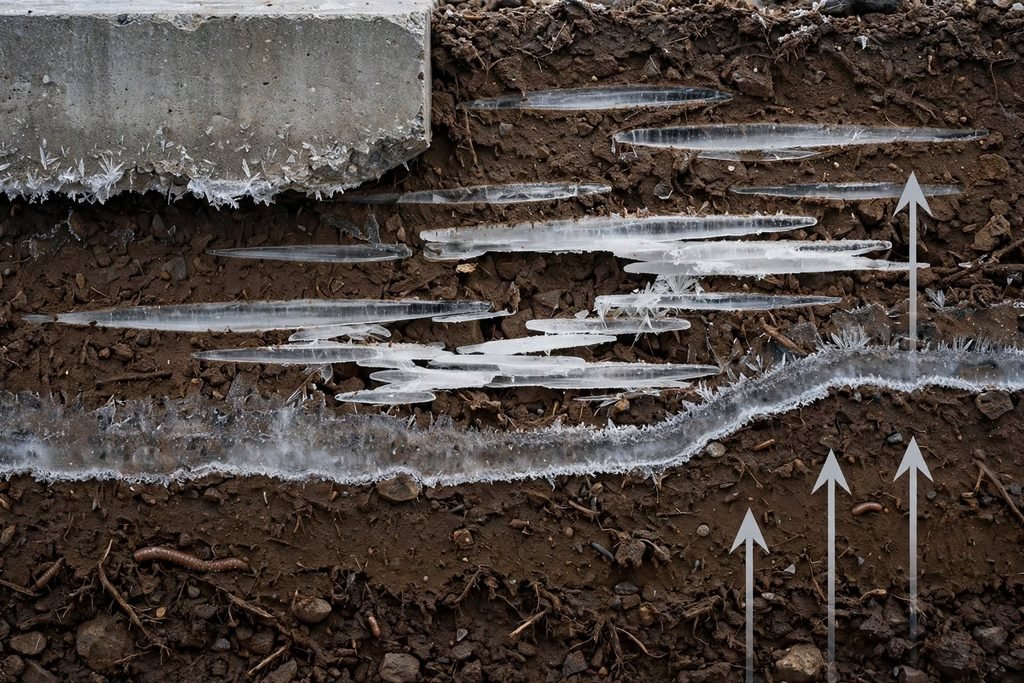
How ice lenses form
The real mechanism is called ice lensing, and it works like this.
When the ground freezes from the surface downward, there is a boundary in the soil called the freezing front where the temperature passes through 0°C. Ice begins forming at that boundary.
Here is the counterintuitive part. As ice forms, it does not simply freeze the water that happens to be sitting there. The growing ice crystal draws additional liquid water up from the unfrozen soil below through capillary action, in the same way a paper towel wicks a spill. That water arrives at the freezing front and adds to the ice.
The result is a lens, a horizontal layer of pure ice that grows thicker as long as three conditions hold:
- Temperatures stay below freezing at that depth
- There is a supply of water below to be drawn upward
- The soil is fine-grained enough to have strong capillary action but permeable enough to let water travel
An ice lens can grow to several inches thick. Multiple lenses stack at different depths through a winter. Everything above them gets lifted, and the lifting force is enormous, capable of exceeding 19 tons per square foot in laboratory conditions.
This is why frost heave can move a concrete porch that weighs several tons. It is not expansion. It is water being pumped to the freezing front and accumulating as ice.
Why soil type decides everything
The capillary requirement explains why frost heave is dramatic in some soils and nearly absent in others.
Silt is the worst. Pore sizes are small enough for powerful capillary suction and large enough for water to travel quickly. Silty soils are the classic frost-susceptible material.
Clay is moderately susceptible. Strong capillary attraction but very low permeability, so water moves to the freezing front slowly. Clay heaves, just more slowly than silt.
Sand and gravel are largely immune. Pores are too large for meaningful capillary rise. Water drains away instead of being drawn upward. There is nothing to feed a lens.
This single fact is behind the most effective frost heave remedy: replace frost-susceptible soil around and beneath a foundation with clean granular fill. No capillary rise, no lens, no heave.
The frost line and why footings sit below it
The frost line, also called frost depth, is the maximum depth to which soil freezes in a given location during a typical winter. It varies enormously:
- Southern states: a few inches to none
- Mid-Atlantic and lower Midwest: roughly 20 to 36 inches
- Northern New England, upper Midwest: 40 to 60 inches
- Northern Minnesota, interior Alaska: 60 inches to well beyond
Building codes require footings to bear below the local frost line. The logic is simple: if the soil beneath the footing never freezes, no ice lens can form beneath it, and the footing cannot be lifted.
Your local building department publishes the required depth, and it is not a suggestion. A footing placed above the frost line will move, every winter, for as long as the structure stands.
Full basements are inherently protected because the floor sits well below frost depth in most climates. The problems show up in the shallow stuff attached to the house.
Adfreezing: the mechanism that gets deep foundations too
There is a second way frost damages foundations, and it affects walls that are correctly founded below the frost line.
Adfreezing happens when soil freezes to the side of a foundation wall. The bond between frozen soil and concrete is genuinely strong. When the surrounding soil then heaves upward, it drags the wall with it, applying vertical uplift to a wall that was designed for downward load.
It also works laterally. Frozen soil against a basement wall transmits enormous horizontal pressure as the freezing zone expands, adding to the soil and water pressure the wall already carries. This is a significant contributor to horizontal cracking and bowing in cold climates, and it is why so many basement walls fail during or shortly after hard winters.
Backfilling with granular material rather than the original clay reduces both effects, because clean gravel neither heaves nor grips.
What gets damaged first
Frost heave attacks shallow-founded elements before it touches the main house.
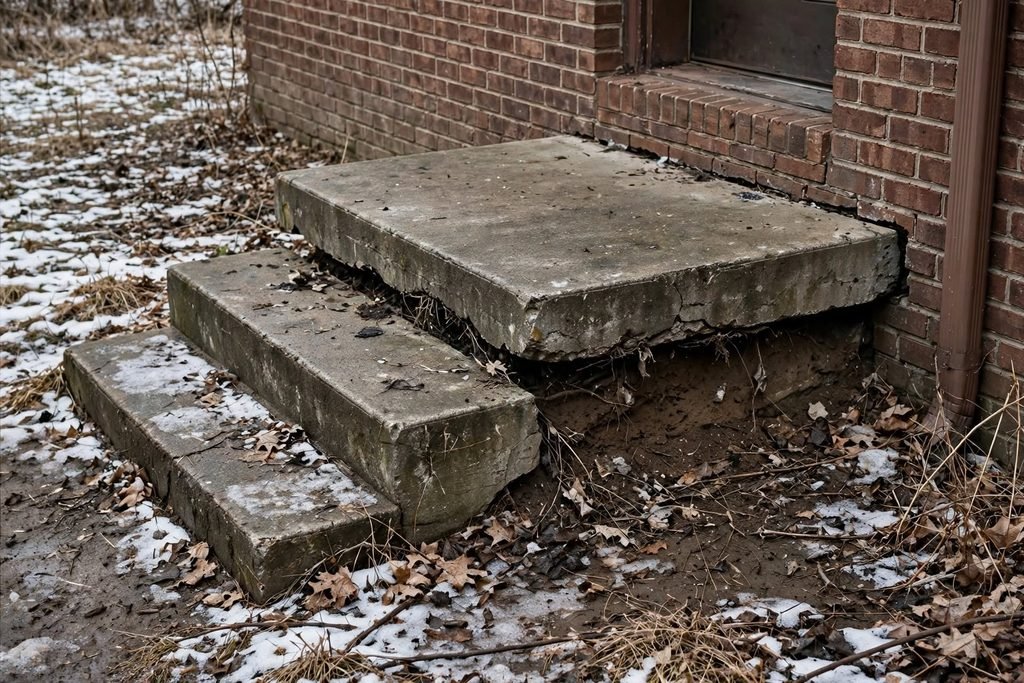
Porches, steps, and stoops. Frequently poured on shallow pads rather than deep footings. Classic symptom: steps that lift in winter and separate from the house, sometimes leaving a visible gap at the doorway, then partially settle back in spring.
Attached garage slabs. Often placed on a shallow thickened edge. Heaving lifts the slab relative to the house, cracking the joint and sometimes the slab itself.
Deck footings. Undersized or shallow piers jack upward year after year, racking the deck frame and pulling the ledger connection.
Driveways and walkways. Slabs tilt and lift at joints, creating trip hazards. Slabs adjacent to the house can tilt back toward it, redirecting meltwater at the foundation and creating a second problem.
Shallow additions and sunrooms. Frequently built on inadequate footings by contractors cutting cost. The addition moves independently of the house, opening a crack at the junction every winter.
Fence posts and lamp posts. Not structural, but a useful early indicator that your soil is frost-susceptible.
Basement walls, via adfreezing and lateral pressure. Horizontal cracks and bowing, particularly in block walls.
Crawl space piers. Interior piers on shallow pads can lift, pushing the floor above out of level.
The signs
Seasonal cycling is the giveaway. Frost heave lifts in winter and settles in spring, so the defining symptom is something that changes with the calendar. A door that binds every January and works fine in June. A crack at the porch that opens and closes. Nothing else produces that pattern so reliably.
Other indicators:
- Concrete steps or slabs visibly higher in winter than summer
- A gap opening between a porch and the house wall in cold months
- Slabs tilted or lifted at joints, with adjacent panels at different heights
- Doors and windows that stick only in winter
- New cracks appearing in late winter or early spring
- Interior floors that feel uneven seasonally
- Fence and deck posts standing progressively higher year over year
- Horizontal cracking in a basement wall that appeared after a hard winter
Ratcheting is worth knowing about. Structures do not always return to their original position after a thaw. Soil can fill the void created during heave, so the element settles onto a slightly higher base. Repeated over many winters, this accumulates into permanent displacement, which is why old decks and fence posts sometimes stand inches above where they started.
Prevention
Foundation depth
The primary defence. Footings must bear below the local frost line. For new construction and additions, verify the required depth with your building department rather than assuming.
Frost-protected shallow foundations are the code-recognized alternative, permitted under IRC provisions. Rigid insulation placed horizontally around the foundation perimeter and vertically against the wall retains geothermal heat in the soil beneath, raising the effective frost line so a shallower footing becomes viable. Common in Scandinavian practice and increasingly used in North America, particularly for slab-on-grade and heated garages.
Drainage: the highest-value fix
Ice lensing requires water. Remove the water supply and you starve the process.
Extend every downspout six to ten feet from the house. A downspout saturating the soil beside a porch footing is manufacturing the exact conditions frost heave needs.
Correct the grading so soil falls at least six inches over the first ten feet.
Install perimeter drainage where groundwater is genuinely high. A functioning footing drain keeps the soil beside and beneath foundations drier through freeze-up.
Fix leaking irrigation and hose bibs before winter. A slow leak beside a slab is a reliable heave generator.
This is the single most cost-effective intervention available, and it is the one homeowners most often skip in favour of structural fixes.
Non-frost-susceptible backfill
Replace clay or silt around and beneath foundations, slabs, and piers with clean, well-graded gravel or coarse sand. No capillary rise means no ice lens. This is standard practice for new work and is worth specifying whenever anything is excavated for other reasons.
Insulation
Rigid foam placed horizontally in the soil around a foundation perimeter, extending outward two to four feet, slows heat loss from the ground and keeps the soil beneath from reaching freezing temperature. Effective for slabs, garage aprons, and shallow footings.
Pier design
For decks, posts, and shallow supports: bell-bottom piers that widen at the base resist uplift because heaving soil cannot pull the flare through the ground above it. Smooth-sided sonotube piers reduce adfreezing grip compared to rough backfilled holes. Helical piers, screwed to depth, bypass the frost zone entirely.
What does not work
Heat tape and ground-thawing cables for anything beyond very small, localized problems. Expensive to run, and they treat a symptom.
Simply adding more concrete mass. Heave forces exceed the weight of the structures they lift by a wide margin. A heavier porch is a heavier thing being lifted.
Sealing the surface. Frost heave is a subsurface water phenomenon. Sealing a slab does not affect it.
Repair once it has happened
Mudjacking or polyurethane slab lifting for sunken or tilted slabs, injecting material beneath to raise them back to level. Polyurethane foam is lighter and cures faster than traditional mudjacking slurry. Cost: roughly $3 to $25 per square foot depending on method and lift required.
Underpinning with helical piers for footings that have moved and will not stabilize, transferring load to soil below the frost zone. $1,000 to $3,000 per pier.
Rebuilding at proper depth. For porches, steps, and small additions that heave every year, excavating and re-founding below the frost line is frequently cheaper over ten years than repeated repairs.
Structural reinforcement for basement walls that have cracked or bowed from lateral frost pressure: carbon fiber straps, steel beams, or wall anchors, combined with drainage correction and ideally granular backfill replacement.
Drainage correction, always. Every one of the above repairs will be tested again next winter if water is still being delivered to the soil around the foundation.
Frequently asked questions
Does frost heave affect houses with full basements? Less directly, since the basement floor sits below frost depth. But adfreezing and lateral frost pressure on the walls are real, and shallow attached elements like porches, steps, garage slabs and decks remain vulnerable regardless of what the main house sits on.
Why did my porch heave this year and never before? Something changed the water supply or the insulation, and a gutter overflowing onto that spot is a common culprit. A downspout disconnected, landscaping altered the drainage, a pipe developed a leak, or the winter had less snow cover. Snow is an effective insulator, and a cold winter with little snow drives the frost line deeper than a colder winter with heavy cover.
Will the damage reverse itself in spring? Partially, usually. Complete recovery is not guaranteed because soil can fill the void created during heave, leaving the element sitting slightly higher. That ratcheting accumulates over years.
Is frost heave the same as expansive clay movement? No, though the symptoms overlap. Frost heave is driven by ice formation in winter, unlike the clay shrink-swell that trees cause. Expansive clay movement is driven by moisture content, swelling when wet and shrinking when dry, and typically peaks in the opposite season. Both cause seasonal cycling, so pay attention to which season your problem appears in.
How deep does my footing need to be? Whatever your local building department specifies for your jurisdiction. It ranges from essentially nothing in the deep South to five feet or more in northern climates, and code is based on historical frost penetration data for your area.
Can I prevent frost heave by covering the ground with mulch or a tarp? Insulation genuinely helps, and snow cover is nature’s version. Mulch provides some benefit for shallow items like plantings and small piers. It is not a substitute for proper footing depth on anything structural.
Does frost heave cause horizontal foundation cracks? It contributes. Frozen soil against a basement wall transmits substantial lateral pressure that adds to the soil and hydrostatic load. In cold climates it is one of several forces behind horizontal cracking and inward bowing, and walls often show new damage in late winter.
Is heave more likely with a heated or unheated space? Unheated attached structures are more vulnerable, because there is no heat loss from the building warming the soil beneath. Detached garages, unheated additions, and porches heave more readily than the heated house they adjoin.
The bottom line
Frost heave is not water expanding. It is water being drawn up through fine-grained soil to a freezing front, where it accumulates as layers of pure ice that lift whatever sits above them with forces measured in tons per square foot.
Which means the three ingredients are freezing temperature, frost-susceptible soil, and a supply of water. You cannot change the weather and you may not want to excavate your soil, but you can absolutely control the water.
Extend the downspouts. Fix the grading. Repair the leaking hose bib before November. It is unglamorous work and it starves the process that lifts porches off houses.