
Usually not, and homeowners find this out at the worst possible moment.
Standard policies are built around sudden and accidental events. Basement water is typically neither — it is groundwater seeping in over hours, surface water arriving during a storm, or a slow leak nobody noticed. All three are standard exclusions.
Two inexpensive add-ons close most of the gap, and one of them cannot be bought once the forecast turns. Here is what is covered, what is not, and what to do about it.
This is general information about how these policies are typically structured. Coverage language varies substantially between insurers and states, so read your own declarations page and endorsements, or ask your agent directly.

What is usually covered
Sudden accidental discharge from plumbing. A burst supply line, a failed water heater tank, an overflowing washing machine hose. This is the classic covered event.
Water damage from a covered peril. Firefighting water, a storm-damaged roof letting rain in, a tree falling and breaching the structure.
Sudden appliance failure. A dishwasher or refrigerator line letting go.
Frozen pipe bursts, generally, provided you maintained heat in the home. Leaving a house unheated in winter can void this.
The common thread is sudden. Gradual is the word insurers use to decline.
What is usually excluded
Groundwater and seepage. Water entering through walls, floors, or the cove joint. This is the single most common basement water problem and it is a standard exclusion in nearly every policy.
Surface water. Rain running across the ground and into your basement, through window wells, or over the foundation.
Flood. Rising water from outside is excluded entirely from homeowners policies and requires a separate flood policy.
Sewer and drain backup, unless you carry the endorsement below.
Sump pump failure or overflow, unless you carry the endorsement below.
Gradual damage. A slow leak that ran for months, chronic humidity, and long-term seepage are treated as maintenance rather than damage.
Mold, generally, unless it results directly from a covered peril, and even then often with a low sublimit of $5,000 to $10,000.
Foundation repair. Cracks, settlement, and earth movement are excluded. So is the drainage work to prevent them. Waterproofing is treated as maintenance, not as a covered loss.
Damage from lack of maintenance, including clogged gutters and neglected pumps.
The cause versus the damage. Even where damage is covered, the cost of fixing the source usually is not. A burst pipe claim may pay for the ruined floor and not for the plumbing repair.
The two endorsements that matter
Water backup and sump pump overflow
Typically $50 to $250 a year, and it is the single best value in this article.
It covers water backing up through sewers or drains, and water overflowing from a sump pit because the pump failed or lost power.
Limits are usually $5,000 to $25,000, sometimes higher for an additional premium. Given that emergency water extraction alone runs $1,000 to $4,000 and a finished basement rebuild can exceed $30,000, choose your limit deliberately rather than defaulting to the minimum.
Watch for: whether it covers pump failure specifically or only sewer backup; whether power outage is included, since some policies exclude it; whether there is a separate deductible; and whether the insurer requires a battery backup to be installed.
That last one is worth asking about, because a battery backup is good practice regardless and some insurers discount for it.
Flood insurance
Separate from homeowners, through the NFIP or a private carrier.
Critical detail: NFIP policies have a 30-day waiting period. You cannot buy it when a storm is forecast. This catches people every hurricane season.
Basement coverage under NFIP is limited. Building coverage generally extends to structural elements and essential equipment — furnace, water heater, electrical panel, sump pump. Finished basement elements are largely excluded: drywall, flooring, cabinetry, and personal property stored below grade. Read the specific limitations before assuming a finished basement is protected.
Cost varies widely by flood zone, from a few hundred dollars a year in low-risk areas to several thousand in high-risk ones.
What actually happens in a claim
Notify promptly. Most policies require prompt notice, and a delayed claim can be denied on that basis alone. Call within 24 hours even if you are unsure about coverage.
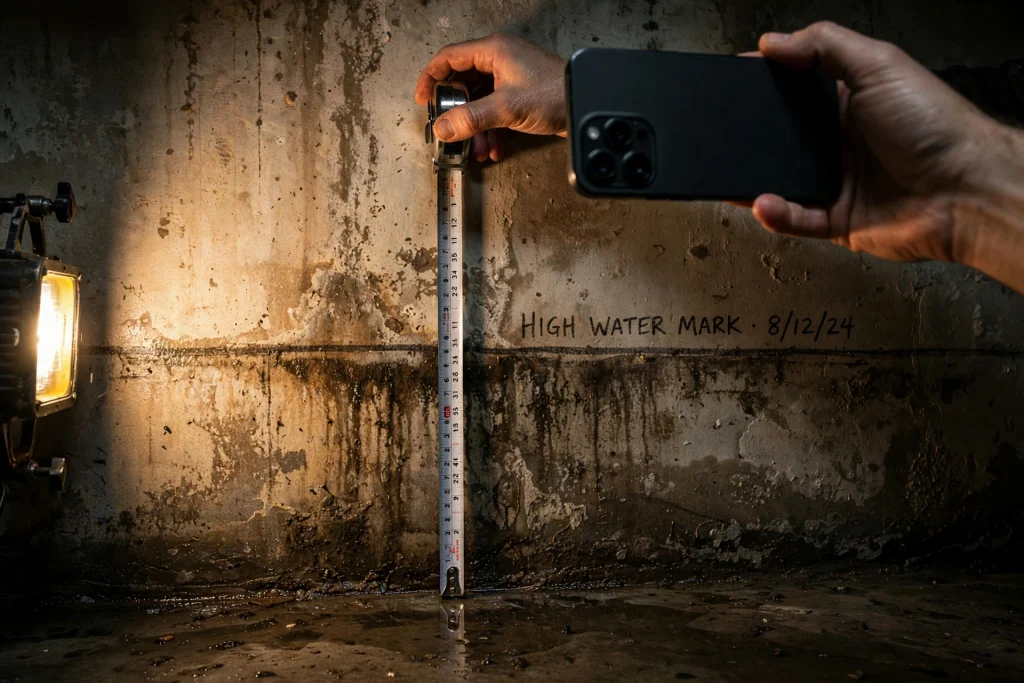
Document before you clean. Wide shots showing the extent, close-ups of the high-water line with a tape measure in frame, close-ups of damaged items, and shots of the cause if visible. Timestamped photos and video.
Mitigate, and keep the receipts. You have a duty to prevent further damage, and most policies reimburse reasonable mitigation costs — pump rental, dehumidifiers, fans, emergency contractors — even where the underlying damage is excluded.
Keep the damaged items, or at least photograph them thoroughly, until an adjuster has seen them.
Make an inventory with approximate purchase dates and values.
Get an independent estimate if the adjuster’s figure seems low. You are entitled to.
Understand actual cash value versus replacement cost. ACV deducts depreciation and pays substantially less. Check which your policy provides; the difference on a finished basement is large.
The full emergency response sequence is here, and documentation is step three in it for exactly this reason.
Why “gradual” gets claims denied
This is the distinction insurers apply most often, so it is worth understanding.
Sudden means a discrete event with a clear moment: a pipe bursts, a tank fails, a hose lets go.
Gradual means ongoing over time: seepage through a wall, a slow drip behind a cabinet, chronic humidity, a footing drain that silted up over fifteen years.
The practical consequences:
- A supply line that bursts today is likely covered.
- The same line that had been weeping for six months, causing rot you only just discovered, is likely denied.
- Efflorescence and long-term seepage are evidence of a pre-existing condition and can be used to support a denial.
Which creates a genuine incentive to find and report problems early rather than watching them.
Reducing the risk yourself
Insurance is the last line, not the first. The cheap work does more.
Extend the downspouts and fix the grading. A few hundred dollars, and it addresses a large share of basement water.
Test the sump pump quarterly and replace it on age rather than failure.
Install a battery backup and a high-water alarm. Some insurers discount for these, and they prevent the claim entirely.
Consider a backwater valve, $1,500 to $5,000, if sewer backup is a known risk in your area. Some municipalities subsidise them.
Keep everything off the floor on shelving or pallets.
Photograph your basement annually. It establishes condition and it makes any future inventory far easier.
Keep records of all maintenance and waterproofing work. It demonstrates you were not neglecting the property, which matters when a claim is assessed.
Frequently asked questions
Does homeowners insurance cover a flooded basement? It depends entirely on the cause. A burst pipe, usually yes. Groundwater, surface water, or flood, usually no without specific coverage.
Does it cover sump pump failure? Only with a water backup and sump pump overflow endorsement. It is not included in a standard policy.
Is a water backup endorsement worth it? For most homes with a basement, yes. At $50 to $250 a year against a $5,000 to $25,000 limit, the arithmetic is straightforward.
Do I need flood insurance if I am not in a flood zone? A significant share of flood claims come from outside high-risk zones, and premiums are much lower there. Worth pricing, particularly given the 30-day waiting period.
Will filing a claim raise my premium? Water claims are viewed unfavourably by insurers and can affect rates or renewal. For small losses, weigh the payout against your deductible and the longer-term cost.
Does insurance pay for waterproofing? No. Waterproofing and foundation drainage are treated as maintenance and property improvement, not as covered damage.
What about mold? Usually excluded, or capped at a low sublimit, and typically only when it results directly from a covered peril. Mold from chronic humidity or seepage is not covered. Identification and remediation here.
Should I tell my insurer about past basement water? Answer application questions truthfully. Misrepresentation can void a policy entirely, which is a far worse outcome than a higher premium. Documented, professionally repaired problems are generally viewed better than concealed ones.
Do I have to disclose water damage when I sell? In most states, yes, as a known material defect. Repaired problems with documentation are far less damaging to a sale than something a buyer’s inspector uncovers.
The bottom line
Standard homeowners insurance is built for sudden events, and most basement water is not sudden. Groundwater, seepage, surface water, and flood are all excluded by default.
Two things close most of the gap. A water backup and sump pump overflow endorsement, at $50 to $250 a year, covers the two failures most likely to flood a finished basement. Flood insurance covers rising water, and it has a 30-day waiting period, so it has to be bought before you need it.
Then read your own declarations page rather than trusting a summary, including this one. And spend the afternoon on the downspouts anyway, because the cheapest claim is the one that never happens.