
If you take one piece of information away from everything written about foundation cracks, make it this: direction matters more than width.
A homeowner will look at a 3/8 inch vertical crack and panic, then walk past a 1/16 inch horizontal crack without a second glance. That is exactly backwards. The wide vertical crack is usually a shrinkage crack that has been sitting there since 1987. The thin horizontal one means the soil outside is currently winning a structural argument with your wall.
This article is the head-to-head comparison: what each direction means mechanically, how urgent each is, and how to judge which one you are looking at.
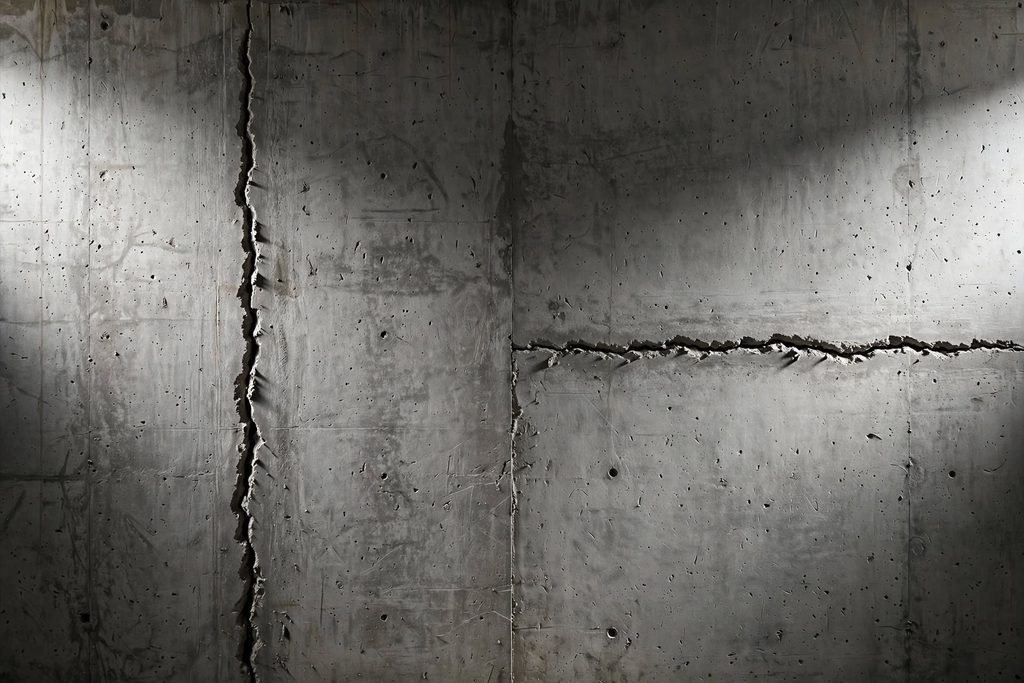
The one-paragraph answer
Vertical cracks usually mean the concrete shrank as it cured, or one section of the footing settled. They are one of several patterns worth learning to read. The wall is intact and doing its job. These are typically water problems, not structural ones.
Horizontal cracks mean soil pressure is pushing the wall inward and the wall has cracked in bending. The wall’s ability to resist further pressure is now permanently reduced, and the process is progressive. These are structural problems.
If you have a horizontal crack, get a structural engineer’s evaluation. If you have a vertical crack, monitor it and seal it if it leaks.
Why direction matters: what the crack is telling you
Concrete has enormous compressive strength and almost no tensile strength. It handles being squeezed extremely well and being pulled apart extremely badly, roughly a tenth as well.
So concrete cracks wherever it is being stretched. And critically, the crack forms perpendicular to the direction of the pull.
That is the whole principle. Read the crack direction, rotate 90 degrees, and you know which way the force was acting.
A vertical crack means the wall was being pulled apart horizontally, side to side. Something made the wall want to get shorter or longer along its length: curing shrinkage, or a portion of the footing dropping and dragging the wall with it.
A horizontal crack means the wall was being pulled apart vertically at that point, which happens when the wall bends inward. Picture the wall as a vertical beam pinned at the floor slab below and the floor framing above. Push on its middle and it bows inward. The outer face at midheight goes into tension, and it cracks in a horizontal line.
That bending force comes from soil, and soil pressure multiplies when the ground is saturated or frozen. The crack is a record of the wall losing.
Vertical cracks in detail
What causes them
Curing shrinkage is by far the most common. Concrete is mixed with roughly twice as much water as the chemical reaction needs, purely so it can be poured. As that excess evaporates over the first year or two, the concrete shrinks about 1/16 inch per 10 feet. Restrained by the footing below and its own corners, it has to crack somewhere. Most poured foundations develop one or more of these within 24 months of construction.
Settlement is the other cause, and nearby trees drawing moisture out of clay soil are a frequent driver. When one part of the footing drops more than another, the wall is bent along its length and cracks vertically. Causes include poorly compacted fill, a soft pocket in the subsoil, a plumbing leak washing out soil, and clay soils shrinking during drought.
How to tell which one you have
Look at the width along the length of the crack.
Uniform width top to bottom points to shrinkage. The wall pulled apart evenly.
Wider at the top than the bottom points to settlement, with the footing dropping at that location. The wall is hinging.
Wider at the bottom can indicate heave, where soil beneath is lifting rather than dropping.
When a vertical crack still matters
Most are benign. Escalate if any of these apply:
- Width beyond 1/4 inch
- Measurable growth over a season
- Offset faces, where one side of the crack protrudes past the other. This means the wall has moved out of plane, which is a different and more serious situation than simply cracking
- Water entering through it during rain
- Sticking doors or windows on the floor above, or new gaps between walls and ceilings
What to do about it
For a stable, non-structural vertical crack that leaks: polyurethane injection. The resin foams on contact with moisture, fills the full depth of the crack, and stays flexible so minor seasonal movement does not simply reopen it. Roughly $400 to $900 per crack professionally, $60 to $150 for a DIY kit.
For a crack that is part of ongoing settlement, injection alone treats the symptom. The footing needs stabilizing with piers, and a structural engineer should specify that rather than a contractor who sells piers.
For a stable, dry hairline crack: mark it, date it, photograph it, and check again after a wet season. Doing nothing is a legitimate answer.
Horizontal cracks in detail
What causes them
Lateral soil pressure, amplified by water.
Saturated soil is dramatically heavier and pushes far harder than dry soil. Hydrostatic pressure from groundwater adds directly to the soil load. Around a typical basement wall, the combined force runs into tens of thousands of pounds.
Expansive clay makes it worse, because clay swells when it takes on water and pushes on its own account. Frost makes it worse, because water expands about 9 percent when it freezes and frozen soil transmits enormous lateral force. Heavy equipment or vehicles parked near the foundation add surcharge load.
Why they are progressive
This is the part homeowners miss. A vertical shrinkage crack is a one-time event; the concrete shrank, it cracked, and it is done. A horizontal crack is the beginning of a process.
Once the wall has cracked in bending, it has a hinge. Its resistance to further inward movement is permanently reduced. Every subsequent wet season pushes it a little further. The deflection accumulates over years, and the repair options narrow and get more expensive as it grows.
This is why the urgency is real even when the crack looks small. You are not judging today’s damage. You are judging a trajectory.
How to measure the damage
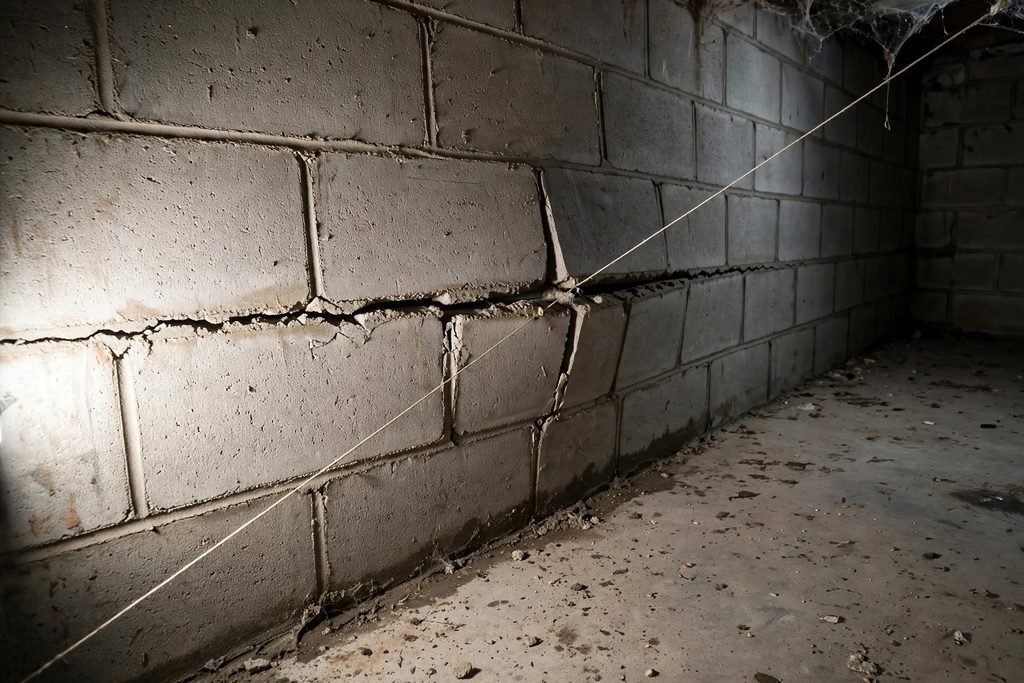
Check for deflection. Hold a long straightedge, or stretch a string tightly, across the wall from one corner to the other at the crack height. Measure the largest gap between the string and the wall. That number is your deflection, and it is the single most important measurement you can take.
- Under 1 inch: early stage. Carbon fiber reinforcement is usually viable.
- 1 to 2 inches: significant. Carbon fiber may still work; steel beams or anchors more likely.
- 2 to 4 inches: serious. Anchors or beams, possibly with straightening over time.
- Over 4 inches, or any shearing: wall replacement territory.
Check for shearing. Look at whether the top portion of the wall has slid inward relative to the bottom along the crack line. In block walls this shows as courses offset horizontally. Shear displacement is more urgent than simple bowing.
Check the top of the wall. Where the sill plate sits on the foundation, look for the wall shifting inward relative to the framing above, or gaps opening up.
Look for debris. Fresh mortar dust or concrete fragments at the base of the wall means active, current movement.
Block walls fail faster
Concrete block is considerably more vulnerable than poured concrete to this failure mode. The mortar joints are the weak link, and horizontal cracks in block walls almost always follow a single bed joint. The hollow cores also mean less material resisting the bending.
A poured wall may resist the same soil pressure for decades longer than a block wall in identical conditions.
Side by side
| Vertical crack | Horizontal crack | |
|---|---|---|
| Force direction | Pulled apart side to side | Bent inward by soil pressure |
| Usual cause | Curing shrinkage, settlement | Lateral soil and water pressure |
| Progressive? | Usually stops on its own | Yes, worsens each wet season |
| Structural risk | Low in most cases | High |
| Typical width that concerns | Over 1/4 inch | Any width |
| Primary problem | Water entry | Wall stability |
| Typical repair | Polyurethane injection, $400 to $900 | Carbon fiber, beams, or anchors, $400 to $1,500 per unit |
| Urgency | Monitor over a season | Evaluate within weeks |
| Common in | Poured walls | Block walls especially |
What about diagonal cracks?
Diagonal cracks sit between the two, and they lean toward the vertical family in meaning.
They are a settlement signature, most often radiating from the corners of windows and doors, which concentrate stress. The direction of the lean indicates which side is dropping. In block and brick they appear as stair-step cracks, because the crack follows the weaker mortar joints rather than running straight.
Treat a diagonal crack like a vertical one unless it comes with horizontal displacement, meaning one section has slid sideways relative to the other. Displacement moves it into the horizontal-crack category of concern, because it indicates lateral pressure rather than simple settlement.
How to monitor either type properly
The free diagnostic that decides whether you need to spend money.
Mark both ends of the crack with a pencil line perpendicular to it, and write the date next to each.
Measure the width at two or three points along the length and record the numbers. A crack comparator card or a set of feeler gauges gives real figures. For reference, a credit card is about 0.03 inches and a nickel about 0.08 inches.
Photograph it with a ruler or coin in frame for scale, and again from an angle to show whether the faces are offset.
Measure deflection with a string line if it is horizontal, and write that number down. This is the measurement that matters most.
Install a crack monitor if you want precision. A two-plate plastic gauge with a printed grid costs about $15 and shows movement in millimeters in both axes at a glance.
Re-check at three months, and again after a full wet spring. Seasonal cycling is normal; net growth is not.
A crack that has not moved through a wet season is dormant and you can plan around it. A crack that has grown needs a professional opinion.
When to call whom
Call a structural engineer for any horizontal crack, any bowing wall, any offset faces, any crack over 1/2 inch, or any repair quote in five figures. An engineer charges $400 to $800 for an evaluation and does not sell the repair, which makes the opinion worth considerably more than a free inspection from a company whose revenue depends on the answer.
Call a waterproofing contractor for a leaking vertical crack, seepage at the wall-floor joint, or drainage work.
Call a foundation repair contractor after you have an engineer’s report specifying what is needed, so you are pricing a defined scope rather than accepting a diagnosis from a salesperson.
Get three quotes for anything structural, and ask each one to explain the mechanism causing the crack, not just the product they install.
Frequently asked questions
Is a horizontal crack always serious? It always warrants professional evaluation. Not every one means imminent failure, and a wall with a horizontal crack and no measurable deflection is in far better shape than one with two inches of bow. But the mechanism behind it is progressive, so “wait and see” is a weaker plan here than with vertical cracks.
Can a vertical crack become horizontal? No, but a wall can develop both. Vertical shrinkage cracks and horizontal pressure cracks have different causes and can coexist in the same wall. Finding a new horizontal crack in a wall that previously only had vertical ones means conditions outside have changed.
My horizontal crack has not changed in five years. Do I still need to fix it? Get it measured properly first, because “has not changed” is often based on memory rather than marks. If deflection is genuinely minimal and stable, monitoring with a crack gauge and fixing the drainage may be a reasonable approach. That is a decision to make with an engineer’s numbers, not a guess.
Which is more expensive to repair? Horizontal, substantially. Vertical crack injection runs several hundred dollars. Structural reinforcement for a bowing wall runs several thousand to tens of thousands, and full wall replacement can exceed $60,000.
Does insurance cover either? Generally neither. Standard homeowners policies exclude earth movement, settlement, and gradual deterioration. Sudden damage from a covered peril, such as a burst pipe washing out supporting soil, may be covered. Read the earth movement exclusion in your policy.
Can I fix a horizontal crack myself? No. Injecting or patching it addresses the appearance and the water while leaving the structural condition entirely unresolved, and the sealed crack hides the movement you need to be watching. Reinforcement requires engineering judgment about spacing, anchorage, and load paths.
Will fixing the drainage stop a horizontal crack getting worse? It removes most of the force driving it, which is the necessary first step and sometimes stabilizes a wall on its own. It does not restore strength the wall has already lost. Reinforcement addresses the wall; drainage addresses the cause. Doing only the reinforcement means the same force goes back to work on your repair.
Why did a horizontal crack appear after a wet spring? Because that is exactly when the load peaks. Saturated soil weighs far more than dry soil and adds hydrostatic pressure on top. Many walls that have quietly carried decades of seasonal loading crack during an unusually wet year.
The bottom line
Rotate the crack 90 degrees and you have found the force. Vertical means the wall was pulled sideways, usually by shrinkage or settlement, and it is usually a water problem you can inject and forget. Horizontal means the soil is bending your wall inward, and that process does not stop by itself.
So before you worry about width, check direction. Then, if it is horizontal, stretch a string across the wall and measure the gap. That single number tells you more about what this is going to cost than anything else you can do in an afternoon.