
Every July the same thing happens. The basement that was perfectly fine in February develops damp walls, a clammy feel, beads of water on the cold water pipes, and a smell that was not there before. Nothing leaked. It has barely rained.
This is condensation, and it is not a foundation problem. It is a physics problem, and the mechanism is worth understanding because the intuitive response — throwing open the windows to air it out — makes it measurably worse.
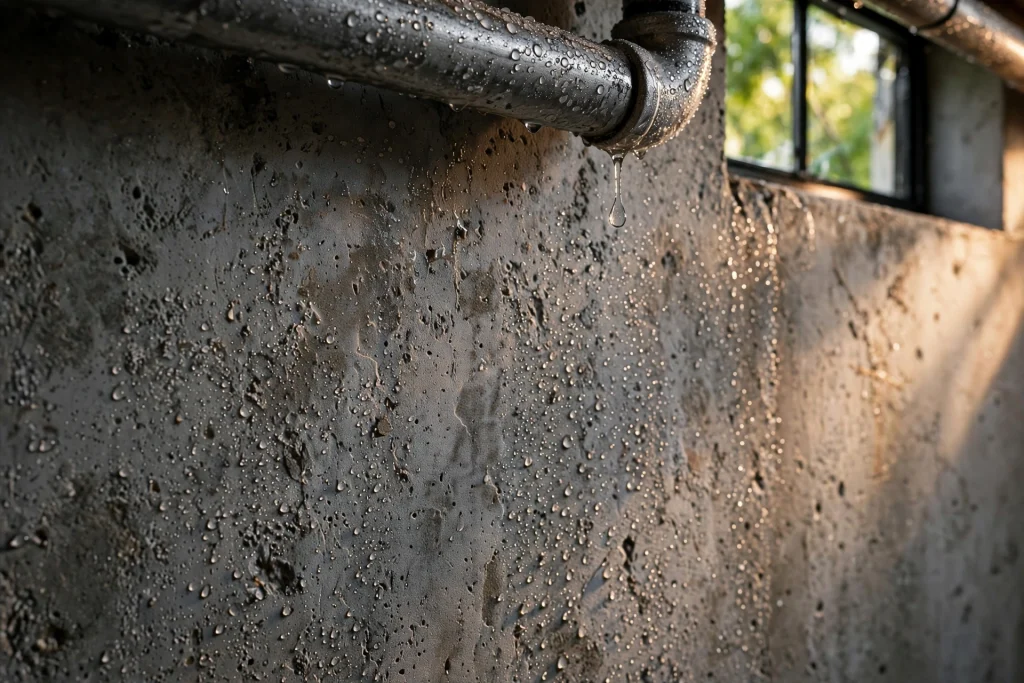
The physics in one paragraph
Warm air holds far more water vapour than cool air. Your basement walls and floor stay cool year-round, typically 60 to 68°F, because they are in contact with soil that holds a stable temperature. When warm, humid summer air enters the basement and touches those cool surfaces, the air immediately adjacent to them cools, its capacity to hold moisture drops, and the excess water condenses out onto the surface.
That is the whole thing. The same reason a glass of iced tea sweats on a summer afternoon, at the scale of a whole room.
Dew point is the number that matters
Dew point is the temperature at which air becomes saturated and water starts condensing out. Unlike relative humidity, it does not change when you move air to a different temperature, so it is a direct measure of how much moisture the air is actually carrying.
The rule: if a surface is colder than the dew point of the air touching it, that surface gets wet. No exceptions, no amount of wiping, no product applied to the wall.
Worked example. A summer day at 85°F and 65 percent relative humidity has a dew point of about 72°F. Your basement walls sit at 64°F. Every square foot of that wall is eight degrees below the dew point, so water condenses on all of it, continuously, for as long as that air is in contact with it.
Note the relative humidity of the outdoor air was only 65 percent, which sounds unremarkable. It is the dew point that does the damage.
Measure it yourself
A hygrometer that displays dew point, $15 to $30. An infrared thermometer for surface temperature, $20 to $40.
Point the thermometer at the wall, read the dew point on the hygrometer, and compare. If the wall is colder, you have your answer and no further diagnosis is needed.
Is it condensation or is it a leak?
Both produce wet walls, and the fixes differ enormously in cost. Settle it before spending anything.
The foil test. Tape a 12-inch square of aluminium foil tightly to the wall, sealing all four edges. Wait 48 hours.
- Moisture on the room-facing side: condensation.
- Moisture on the wall-facing side: water is coming through the masonry.
- Both: you have both, which is common.
Other condensation indicators: cold water pipes and the toilet tank are also beaded; moisture is spread evenly across broad areas rather than concentrated; it is worst in summer; there is no white chalky deposit.
Other seepage indicators: efflorescence, which condensation cannot produce; problems that track rainfall; water at the wall-floor joint; worst in spring rather than summer.
The full side-by-side diagnostic is here.
Why opening the windows backfires
This is the single most common mistake, and it is worth being blunt about.
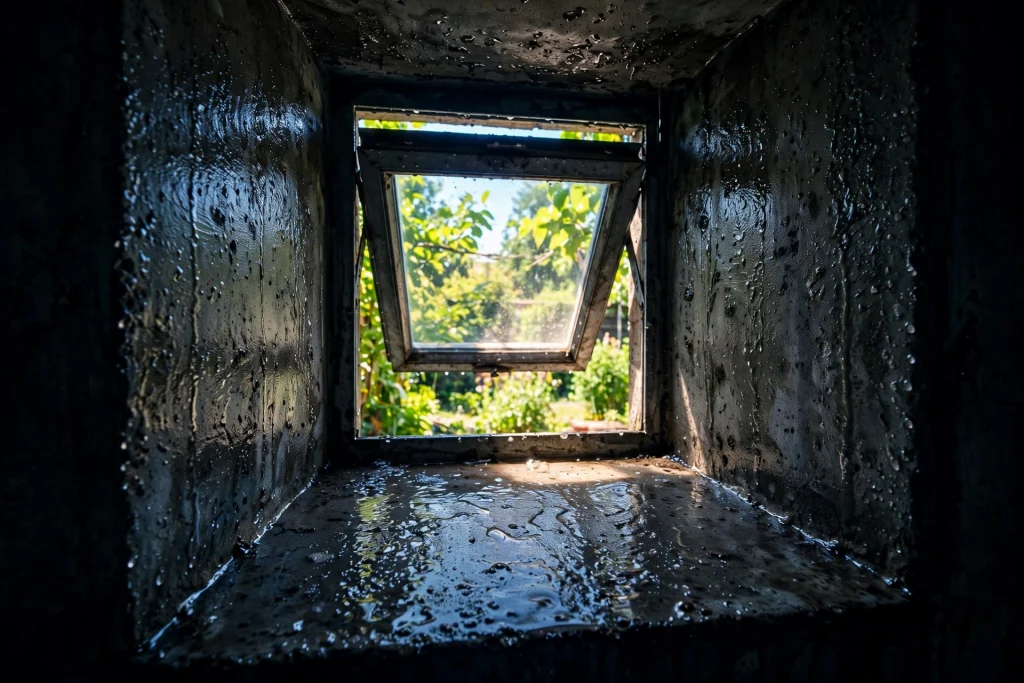
Opening basement windows on a warm summer day brings in air with a high dew point. That air enters a room full of cool surfaces. It condenses on every one of them. You have used ventilation to deliver water onto your walls.
The intuition is understandable, because ventilating a stuffy room usually helps. In a basement in summer, it does the opposite.
The rule: check the outdoor dew point, not the relative humidity.
- Outdoor dew point below about 55°F → ventilating helps
- Outdoor dew point above 60°F → keep it closed and run a dehumidifier
Weather apps show dew point, often under an “expand” or “details” view. It is worth finding.
The same logic applies to a whole-house fan drawing humid outdoor air down through the building, and to leaving the basement door open to a humid stairwell on a bad day.
What actually fixes it
1. Run a dehumidifier continuously
The primary tool. Lowering the dew point of the basement air below the surface temperature of the walls stops condensation at its source.
Target 45 to 50 percent relative humidity. Size generously, usually 50 to 70 pints for a typical basement, and route the drain hose to a floor drain or sump rather than emptying a bucket. Sizing and running cost details here.
2. Keep humid outdoor air out
Windows closed when the dew point is high. Weatherstrip the basement door. Seal obvious air leaks at the rim joist, around windows, and at any bulkhead or walkout.
3. Insulate the walls, if you are finishing
This is the permanent fix, because it addresses the cold surface rather than the humid air.
Rigid foam board applied directly against the foundation raises the interior surface temperature above the dew point, so there is no longer a condensing surface. Two inches of XPS or polyiso is typical, sealed at the seams, with framing built in front of the foam rather than against the concrete.
Do not use fiberglass batts against bare concrete. The batt does not stop warm air reaching the cold wall; it just hides the condensation that then happens behind it, against wood framing, where you cannot see or smell it until there is a real problem.
Do not add a polyethylene sheet on the warm side over foam in most climates. That creates a second vapour barrier and traps moisture inside the assembly. The vapour barrier strategy matters more than the R-value, and getting it backwards is a common and expensive error.
4. Insulate cold water pipes
Foam sleeves, pennies per foot. Stops the dripping that stains ceilings and puddles on the floor, and removes a set of very cold surfaces from the room.
5. Cover the sump pit
An open pit is a continuously evaporating pool feeding humidity into the space. A sealed, gasketed lid is cheap and surprisingly effective.
6. Seal an adjoining crawl space
Exposed soil in a crawl space releases large volumes of water vapour. Encapsulation is often the single biggest improvement available if you have one.
7. Move air
A small fan circulating air along the walls prevents the stagnant boundary layer where condensation forms fastest, and helps the dehumidifier reach the whole space. Circulation only — do not introduce outdoor air.
8. Confirm the dryer vents outside
A disconnected dryer duct puts gallons of water vapour into a basement every week and is easy to miss.
What does not work
Wiping the walls. They will be wet again in an hour.
Waterproof paint. It is applied to the wrong side of the wall for a seepage problem, and for a condensation problem it does nothing at all, because the water is forming on the surface out of the room air.
Opening windows, for the reasons above.
A drainage system. Interior or exterior drainage addresses groundwater. Condensation is an air problem, and spending five figures on drainage will not change your dew point. This is exactly why the foil test is worth doing before accepting a quote.
Space heaters. Warming the air raises its capacity, which lowers relative humidity, but it does not remove moisture and it does not warm the wall surfaces much. Marginal at best.
Why it matters
Condensation is not just uncomfortable.
Sustained humidity above 60 percent allows mold and mildew to establish, which is where the musty smell comes from. Wet cardboard, textiles, and books degrade. Metal corrodes, including furnace and water heater bases. Framing that stays above 20 percent moisture content supports decay fungi.
And because air rises through a building via the stack effect, basement air ends up in your living space. Humidity and any spores it supports do not stay downstairs.
Frequently asked questions
Is basement sweating normal in summer? Common, not normal in the sense of acceptable. It means humidity is high enough for mold to establish. It is fixable with a dehumidifier for a few hundred dollars.
Why is my basement floor wet but not the walls? The slab is usually the coldest surface in the room, so it reaches dew point first. Same mechanism, and the same fix.
Should I use a fan to dry the walls? Circulating indoor air helps. Blowing humid outdoor air in makes it worse. Circulation only.
Does air conditioning help? Yes, indirectly. Cooling removes moisture as a byproduct. But most AC systems do not serve the basement well, and a dehumidifier is the appropriate tool for the space.
Why does it happen in summer and not winter? Winter air is cold and holds very little moisture, so its dew point is low and there is nothing to condense. Summer air carries far more, and basement surfaces stay cool year-round.
Can condensation cause structural damage? Not to the concrete directly. It causes mold, rots framing and sill plates over time, and corrodes metal. Those are real, they just develop slowly.
How do I know if it’s condensation or a leak? The foil test, 48 hours, and it settles the question definitively. Details here.
Can I have both? Frequently, and it is worth expecting. Minor seepage keeps the concrete damp, that dampness evaporates and raises room humidity, and the higher humidity then produces condensation on every cool surface. Fix the water first, then measure again.
The bottom line
Summer sweating is warm humid air meeting cool masonry. If the wall is colder than the dew point of the air touching it, water forms, and no product applied to the wall changes that.
So do the foil test to rule out seepage, then close the windows, run a properly sized dehumidifier at 45 to 50 percent, insulate the pipes, and cover the sump pit. If you are ever finishing the space, rigid foam against the concrete removes the cold surface permanently and ends the problem for good.
[…] hygrometer reading consistently above 60 percent means conditions permit growth, and summer condensation on cool walls is the usual driver whether or not you have found it. 45 to 50 percent is the […]
[…] the wall and behind the plastic. Meanwhile warm interior air reaches the cold concrete surface, and condenses there, on the back of your plastic sheet, where you cannot see it. Now add wood framing and fiberglass […]
[…] is the entire mechanism behind basement walls sweating in summer, and it explains why the intuitive fix, opening the windows on a warm day, makes things […]
[…] is the same mechanism that makes basement walls sweat in summer, except the crawl space version is worse because outdoor air has direct […]