
You wipe the white powder off the basement wall. Three weeks later it is back, in the same place, looking exactly the same.
That is efflorescence, and the frustrating part is that cleaning it will never be a permanent fix, because the powder is not the problem. It is the receipt. Something is delivering water through your foundation wall, and each new bloom of white crystals is evidence of another delivery.
The useful thing about efflorescence is precisely that: it is one of the most reliable diagnostic signals available to a homeowner, and it tells you things that a damp patch alone does not.
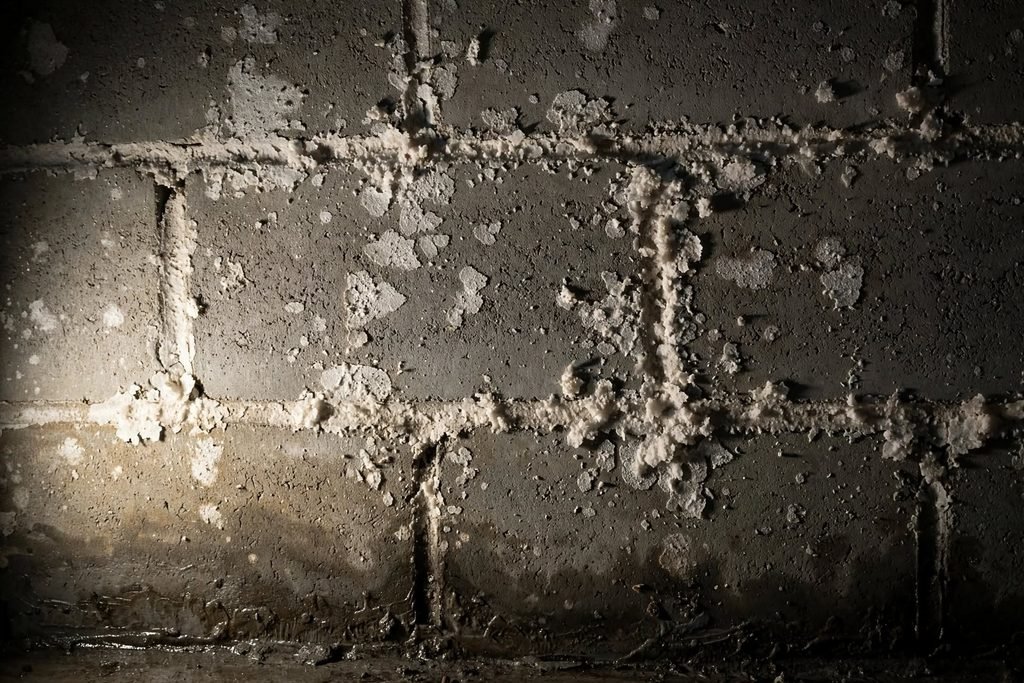
What it actually is
Efflorescence is a deposit of water-soluble mineral salts that have been carried out of masonry by water and left behind on the surface when that water evaporated.
The process has three requirements, and all three must be present:
- Soluble salts inside the material. Concrete, mortar, brick, and block all contain them naturally. Portland cement produces calcium hydroxide as a byproduct of hydration. Aggregates, mixing water, and the clay in bricks contribute sulfates, carbonates, and chlorides.
- Water to dissolve and transport them. Groundwater moving through the wall dissolves the salts and carries them along.
- A surface where evaporation occurs. When the water reaches the interior face of the wall and evaporates into the basement air, it cannot take the dissolved minerals with it. They crystallize and stay.
Take away any one of the three and efflorescence stops. Since you cannot remove the salts from the concrete and you cannot stop evaporation, the only variable you control is the water.
The chemistry, briefly
The most common form is calcium carbonate. Calcium hydroxide dissolved in water reaches the surface, reacts with carbon dioxide in the air, and precipitates as calcium carbonate, which is the same mineral as limestone and chalk.
That reaction matters practically: once it has converted to calcium carbonate, the deposit is no longer water-soluble. Fresh efflorescence wipes off with a damp cloth. Old efflorescence that has been sitting for months has often hardened into a stubborn crust that water alone will not touch.
Sulfate-based efflorescence, common with certain bricks and mortars, behaves similarly and can be harder to remove.
Primary vs secondary efflorescence
Primary efflorescence occurs in new construction, within the first year or so, as excess mixing water leaves the concrete carrying salts with it. It is normal, generally cosmetic, and usually diminishes on its own as the available salts are depleted.
Secondary efflorescence occurs in older concrete and is caused by water entering from outside. This is the kind that matters, because it means there is an external water source. The deposits often keep coming back for years because groundwater continuously supplies fresh salts from the soil and from deeper in the masonry.
If your ten-year-old basement wall has started producing white powder, that is secondary efflorescence and you have a water problem.
Efflorescence vs mold: telling them apart
This confusion sends a lot of people into unnecessary panic and a lot of others into unnecessary complacency. The distinction is easy once you know what to check.
| Characteristic | Efflorescence | Mold |
|---|---|---|
| Color | White, gray, occasionally yellow or brown | Black, green, brown, sometimes white |
| Texture | Gritty, crystalline, powdery | Fuzzy, slimy, or spotty |
| Location | On masonry only | On any surface, including wood, drywall, fabric |
| Water test | Dissolves or disappears when wetted | Unaffected, may smear |
| Smell | None | Musty, earthy |
| Pattern | Follows mortar joints and damp zones | Spreads in irregular colonies |
| Health risk | Minimal by itself | Respiratory irritation, allergies |
The simplest test: spray a small amount of water on the deposit. Fresh efflorescence dissolves and vanishes temporarily. Mold does not.
The important caveat: white mold does exist, and it can look superficially similar on masonry. If the deposit is fuzzy rather than gritty, if it appears on wood or drywall as well as concrete, or if there is a musty smell, treat it as mold.
And critically, the two frequently appear together, because the same moisture that produces efflorescence also raises humidity enough to support mold growth nearby. Finding efflorescence should prompt you to check the surrounding framing, insulation, and stored items.
What efflorescence tells you diagnostically
This is where it earns its usefulness.
It proves liquid water is moving through the wall
Condensation forms on the interior surface from room air. It has not passed through any masonry, so it cannot dissolve and transport internal salts. Condensation cannot produce efflorescence.
Therefore, efflorescence is definitive evidence of seepage at that location, even if you have never once seen the wall actively dripping. This settles a question that homeowners otherwise agonize over.
Its location maps your leak
Efflorescence appears where water evaporates, which is at or near where it exits the wall. A band of deposits two feet up the wall suggests water entering around that level. Deposits concentrated along mortar joints in a block wall suggest the joints are the pathway. Deposits at the base indicate water accumulating at the footing or cove joint.
Photograph the pattern. It is a map of your water intrusion.
Its recurrence rate indicates severity
Wipe the wall completely clean and note the date. If a comparable bloom returns within a few weeks, water movement is substantial and ongoing. If it takes many months to reappear, the intrusion is slow and seasonal.
This is a free severity gauge, and it is more informative than a single snapshot.
Heavy deposits with crumbling masonry indicate a longer-term problem
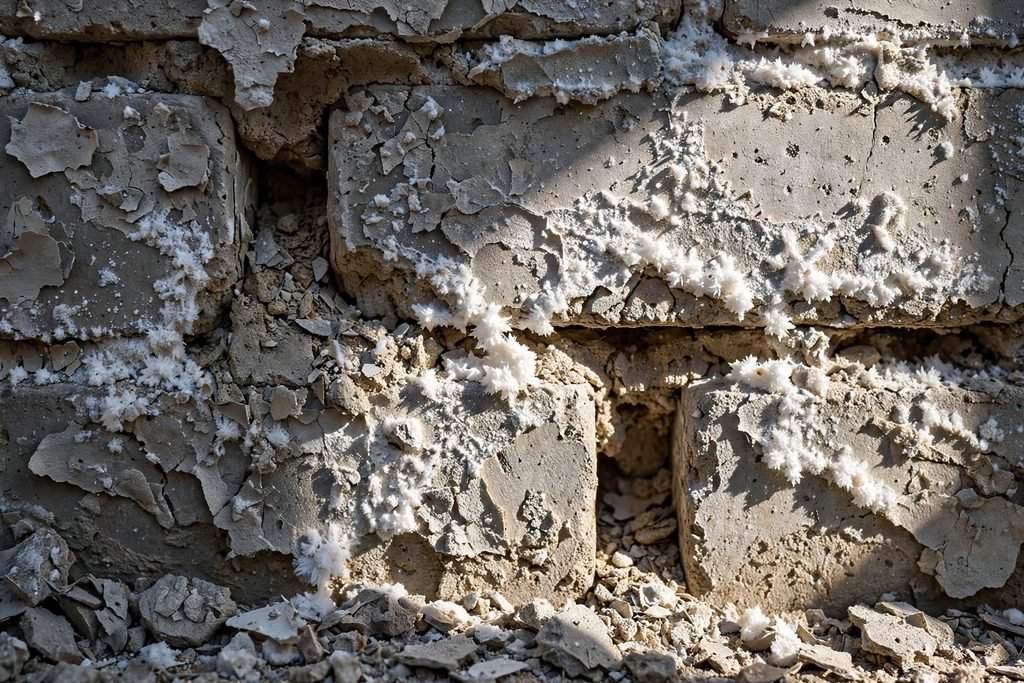
When efflorescence appears alongside spalling concrete, soft or receding mortar, or flaking surfaces, the wall has been saturated for years. Salt crystallizing inside the pores rather than on the surface, which is called subflorescence or cryptoflorescence, exerts pressure that physically breaks the masonry apart from within. That is genuine deterioration, not a cosmetic issue.
Is efflorescence harmful?
The deposit itself is not a health hazard. It is essentially mineral salt, chemically similar to limestone. It is not toxic and it does not produce spores or gases.
What it indicates is the concern. Efflorescence means sustained moisture in the wall, and sustained moisture means mold risk, wood rot in adjacent framing, insulation degradation, elevated humidity throughout the house, and freeze-thaw damage to the masonry.
It also causes physical damage over time. Subflorescence crystallizing within the pore structure generates enough pressure to spall concrete and disintegrate mortar. Over decades this genuinely weakens a wall.
And it interferes with repairs. Paint, sealers, and coatings will not bond properly to a surface with active efflorescence. If you have ever had basement wall paint peel off in sheets, salt deposits under the coating were likely part of the reason.
How to remove it
Removal is worth doing, both to improve appearance and to reset your baseline for monitoring. Just understand that it will return unless the water is addressed.
Work from the gentlest method upward.
Step 1: Dry brushing
Start here, always. Use a stiff-bristled brush or a wire brush and work the deposit off dry.
This matters more than it sounds: adding water to efflorescence redissolves the salts and drives them back into the masonry, where they will reappear later. Dry removal takes them off the wall entirely.
Vacuum up the residue with a HEPA vacuum rather than sweeping it around. Wear a dust mask and eye protection.
Step 2: Water and scrubbing
For what the brush cannot get, use warm water and a stiff brush, then blot the area dry rather than letting it soak in. Fresh, unconverted efflorescence responds well to this.
Step 3: White vinegar
For deposits that have hardened into calcium carbonate. Mix roughly one part household white vinegar to five parts water for a first attempt, working up toward straight vinegar if needed.
Apply, let it work for several minutes, scrub, then rinse thoroughly with clean water and dry the surface. The mild acid dissolves carbonate deposits without the hazards of stronger acids.
Step 4: Commercial efflorescence remover
Purpose-made products, usually mild acid formulations, available at masonry suppliers. Follow the label, test on a small hidden area first, and ventilate.
Step 5: Muriatic acid, as a last resort only
Diluted hydrochloric acid will remove heavy, stubborn deposits. It is also genuinely dangerous and it damages masonry.
If you use it: dilute heavily, typically 1 part acid to 10 or more parts water, always add acid to water and never water to acid, wear acid-resistant gloves, goggles, and a respirator, ventilate aggressively, pre-wet the wall so the acid does not penetrate deeply, neutralize afterward with a baking soda solution, and rinse thoroughly.
It etches concrete, can discolor masonry permanently, damages mortar, and corrodes anything metal nearby. Most homeowners should stop at vinegar or a commercial product and call a professional if that is insufficient.
Why it keeps coming back
Because you removed the crystals, not the water.
As long as groundwater continues to move through the wall, it will continue to dissolve salts from within the masonry and from the surrounding soil, carry them to the interior surface, and deposit them as it evaporates. The supply is effectively endless, since soil contains far more salts than any wall could exhaust.
Preventing recurrence means reducing the water. In rough order of cost:
Clean the gutters and extend the downspouts six to ten feet from the foundation. Cheapest, and it resolves a surprising share of cases.
Correct the grading so soil falls at least six inches over the first ten feet from the house.
Cover the window wells and clear their gravel bases.
Inject any leaking cracks with polyurethane, typically $400 to $900 per crack professionally.
Install interior perimeter drainage if water is genuinely arriving at the footing under pressure. $8,000 to $20,000 for a full perimeter.
Exterior membrane waterproofing for the most complete solution, $15,000 to $40,000 plus landscaping restoration.
Run a dehumidifier at 45 to 50 percent relative humidity, which does not stop efflorescence but manages the humidity that the same moisture is contributing to the room.
What not to do
Do not paint over it. Paint will not bond to salt deposits, and the coating will peel within a season. Worse, it hides the diagnostic signal you need for monitoring, so you lose the ability to tell whether your drainage improvements worked.
Do not seal it in. Applying a waterproof coating over active efflorescence traps the salt crystallization behind the film, where the expanding crystals lift the coating and continue damaging the masonry out of sight.
Do not assume it is mold and pay for remediation. Do the water test first. Remediation companies quoting on a white powdery deposit without testing it deserve a second opinion.
Do not ignore it because it is “just cosmetic.” It is cosmetic in itself and diagnostic in what it means. The wall is telling you something specific.
Frequently asked questions
Will efflorescence eventually stop on its own? Primary efflorescence in new construction usually diminishes within a year or two as the initial salt supply depletes. Secondary efflorescence caused by ongoing groundwater intrusion will not stop, because the water keeps supplying fresh salts.
Does efflorescence mean my foundation is failing? No. It means water is passing through the masonry. That is a moisture problem, not a structural one. Structural concern comes from horizontal cracks, bowing walls, and offset cracks, which are separate signals. Long-term heavy efflorescence with spalling does contribute to deterioration, but it is a slow process.
Can I finish a basement that has efflorescence? Not until the water source is fixed and the wall has stayed clean through a full wet season. Framing and insulating over an actively seeping wall traps moisture in the assembly, and the resulting mold grows where you cannot see or smell it early.
Is efflorescence dangerous to breathe? The deposits are inert mineral salts and not toxic. Disturbing them creates fine dust, so a dust mask during removal is sensible, particularly for anyone with respiratory sensitivity. The bigger air quality concern is any mold growing in the same damp conditions.
Why is it only on one wall? Because water is entering on that side. Usually a downspout, a slope in the yard, a driveway shedding runoff that direction, or a failed section of footing drain. Walk that side of the house after rain and look for pooling.
My efflorescence appears in a horizontal band. What does that mean? It typically marks the height water reaches inside a block wall’s hollow cores, or the level at which it exits the wall. In block walls a band often corresponds to a particular mortar course acting as the pathway.
Does a dehumidifier stop efflorescence? No. A dehumidifier removes moisture from the air, not from the wall. It may slightly change the evaporation rate at the surface but it does not affect water moving through the masonry.
Should I be worried if a house I am buying has efflorescence? It is worth investigating, not walking away over. Ask when it appeared, what has been done, and whether there has been standing water. Have the inspector check the grading, downspouts, and any drainage system. Efflorescence with dry framing and good drainage is a manageable finding. Efflorescence with rotted sill plates and a bowing wall is a different negotiation.
The bottom line
Efflorescence is dissolved minerals left behind by water that traveled through your foundation and evaporated on the inside face. That makes it proof of seepage, which is genuinely useful, because it distinguishes a real water intrusion from mere condensation and shows you where the water is coming out.
Remove it dry with a stiff brush, use vinegar on hardened deposits, and skip the muriatic acid unless you have no alternative. Then treat the cleaning as a reset rather than a repair: note the date, fix the gutters and grading, and watch whether it comes back. A wall that stays clean through the next wet spring is a wall you actually fixed.