
People say “basements just smell like that.” They do not. A musty basement smell is a specific chemical signal produced by living organisms, and those organisms need water to survive. If your basement smells, something down there is wet, or has been.
The tricky part is that the smell often arrives long before anything looks wrong, because the growth producing it is usually behind a wall, under a carpet, inside a box, or in a wall cavity you cannot see. The odor is doing you a favor by showing up early. This guide is about tracking it to its source rather than covering it up.
What the smell actually is
That characteristic odor comes from microbial volatile organic compounds, usually abbreviated mVOCs. They are gases released by mold, mildew, and bacteria as they metabolize the material they are growing on.
Two compounds do most of the heavy lifting. Geosmin is the earthy note, the same compound responsible for the smell of soil after rain and the off-flavor in some beets and freshwater fish. 2-methylisoborneol contributes the damp, cellar-like character. Human noses are extraordinarily sensitive to both, detecting them at concentrations of a few parts per trillion.
This sensitivity is why the smell precedes the visible evidence. You are effectively equipped with a mold detector calibrated far below what your eyes can resolve.
Two practical consequences follow:
A musty smell essentially always means microbial growth. There is no version of this odor that comes from clean, dry concrete.
Where you smell it is not necessarily where it is growing. Air moves, and mVOCs diffuse readily. The source may be several rooms away or inside a wall cavity venting into the space.
The 11 causes
1. Relative humidity above 60 percent
The most common underlying condition, and often the only one.
Mold spores are present in every indoor environment. They are inert until conditions allow germination, and the threshold is roughly 60 percent relative humidity sustained over time. Above that, spores that have settled on dust, on stored cardboard, on the organic film that coats every surface, begin to grow.
Basements run humid for structural reasons. They are cool, so any air entering condenses moisture on their surfaces. They are below grade, so soil moisture continuously diffuses through the concrete as vapor. And they are poorly ventilated.
How to check: A $15 hygrometer. Target 45 to 50 percent.
The fix: A properly sized dehumidifier, 50 to 70 pints for most basements, with the drain hose routed to a floor drain or sump pit.
2. Foundation seepage
Water entering through the walls or floor keeps the concrete permanently damp, and that dampness evaporates into the room, holding humidity up regardless of what the dehumidifier does.
How to check: Look for efflorescence, the white chalky deposits that prove water has moved through the masonry. Look for damp patches after rain, tide lines, peeling paint, and rust at the base of steel columns.
The fix: Address the water at the source. Gutters, downspout extensions, grading, window well covers first. Crack injection or perimeter drainage if it persists.
3. Wet or previously wet carpet and padding
Carpet padding is a sponge that sits directly on a cool slab. Once it has been wet, whether from a flood, a spill, or years of vapor coming up through the concrete, it holds moisture and grows mold underneath where nothing is visible.
Carpet in a basement is a persistent problem even without a flood, because slab vapor keeps the underside damp.
How to check: Lift a corner near a wall. Look and smell at the padding and the slab beneath.
The fix: Remove the padding, always. It is cheap and it is never worth salvaging. Consider replacing carpet with a flooring type appropriate for below grade, such as luxury vinyl plank over a vapor barrier, or sealed concrete.
4. Mold inside wall cavities
The reason so many people cannot find the source. In a finished basement, framing, insulation, and drywall sit against a foundation wall that transmits moisture. Fiberglass batts against bare concrete are a particularly reliable way to grow mold, because the batt holds moisture against wood framing with no drying path.
How to check: A pin-type moisture meter on the drywall, especially the bottom 24 inches. An infrared camera reveals cool wet zones behind finished surfaces, and a professional inspection with one is worth the cost if the smell has no visible source.
The fix: Usually requires opening the wall. Remediation plus a rebuild using a moisture-appropriate assembly, typically rigid foam directly against the concrete rather than fiberglass.
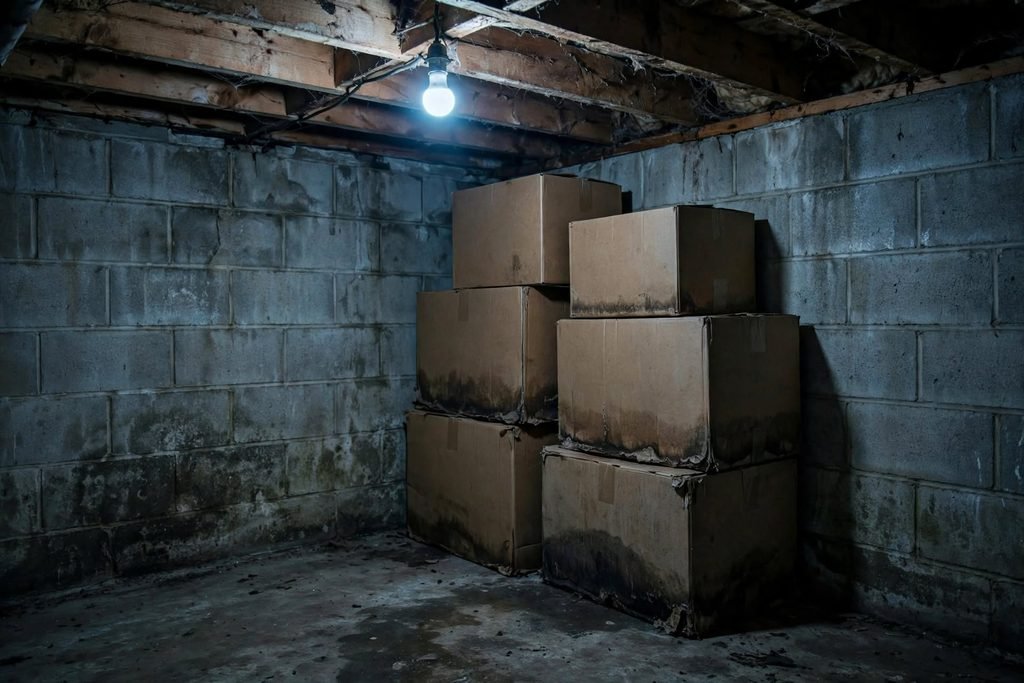
5. Stored cardboard, paper, textiles, and old furniture
Cardboard is cellulose, which is mold food, and it wicks moisture from the slab it sits on. So do books, fabric, upholstered furniture, and particleboard.
A basement full of boxes is a basement full of substrate. It is also, practically speaking, the thing most homeowners can fix in a weekend.
How to check: Sniff individual boxes. The offender is usually obvious once you start.
The fix: Transfer to sealed plastic bins. Get everything off the floor onto shelving or pallets, and keep items several inches off exterior walls so air can circulate.
6. A dry floor drain trap
Every floor drain has a P-trap, a U-shaped bend that holds water and blocks sewer gas from entering the house. If the drain goes unused for weeks, that water evaporates and the barrier disappears.
The result is sewer gas venting directly into your basement. It reads as musty or foul rather than obviously sewage-like at low concentrations.
How to check: Pour a gallon of water down every floor drain and unused fixture. If the smell improves within a day, that was it.
The fix: Pour water down unused drains monthly. Adding a small amount of mineral oil slows evaporation. Trap primers and waterless trap seal inserts are permanent solutions.
7. An uncovered sump pit
An open sump pit is a standing pool of water evaporating continuously into your basement, and the water sitting in it grows bacteria that produce their own odor. It also admits soil gases.
How to check: Look. If your pit has no lid, or just a loose sheet of plywood, this is contributing.
The fix: A sealed, gasketed lid with grommets for the discharge pipe and power cord. Inexpensive and surprisingly effective at reducing basement humidity.
8. Crawl space with exposed soil
If your basement connects to a crawl space with a dirt floor, that dirt is releasing water vapor continuously. A crawl space can put many gallons of moisture into a house each day, and air moves from crawl space to basement to upstairs via the stack effect.
How to check: Lay a two-foot square of clear plastic on the crawl space soil and tape the edges. Condensation underneath within 24 hours confirms significant vapor emission.
The fix: Encapsulation, meaning a heavy polyethylene liner sealed across the floor and up the walls, with dedicated dehumidification. Cost varies widely by size and access, commonly $3,000 to $15,000.
9. HVAC system and ductwork
If the furnace, air handler, or ductwork is in the basement, moisture in the equipment gets distributed throughout the house. Common culprits: a clogged condensate drain pan holding standing water, a damp or dirty air filter, mold growing on the evaporator coil, and duct interiors that got wet at some point.
A smell that is strongest when the system kicks on is a strong indicator.
How to check: Inspect the condensate pan and drain line. Replace the filter and see whether it changes anything.
The fix: Clear the condensate line, replace filters regularly, and have the coil professionally cleaned. Duct cleaning is worthwhile only when there is a documented contamination problem, not as routine maintenance.
10. A dead animal or nest
Mice, rats, squirrels, and birds get into rim joists, wall cavities, and duct chases. A dead one produces a strong, distinct odor that peaks over one to two weeks then gradually fades.
The distinguishing feature is that the smell is sharply localized and different in character from mold, more of a sweet putrid note than an earthy one.
How to check: Follow the intensity gradient. It typically leads to a specific spot in a rim joist bay or wall cavity.
The fix: Remove the carcass, disinfect, and seal the entry points. A pest professional is worth calling if you cannot locate it.
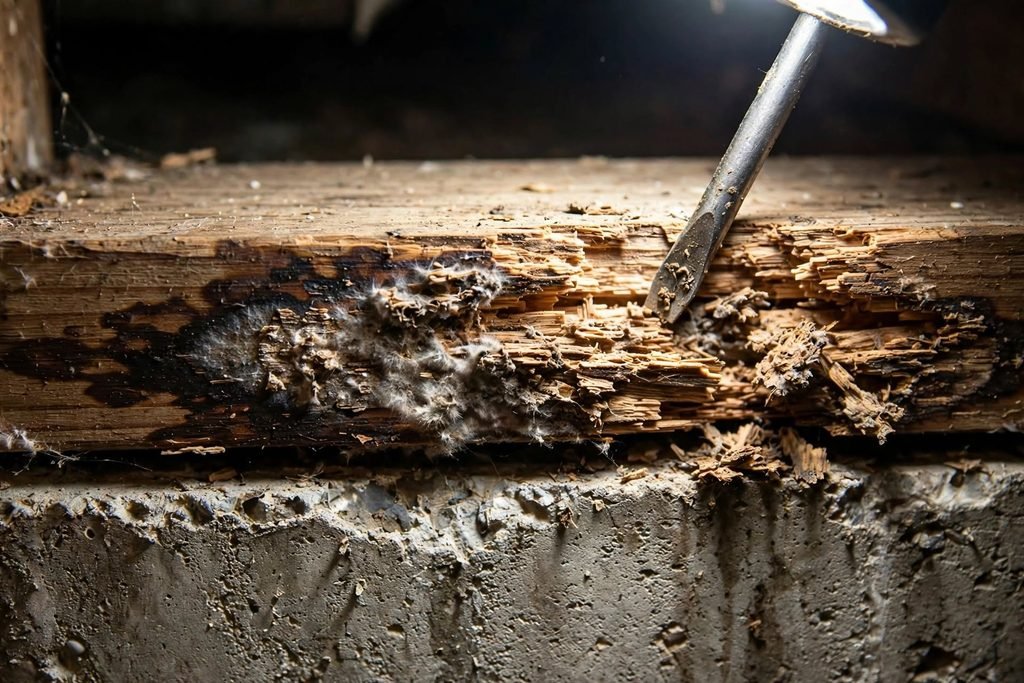
11. Rotting wood: sill plates, joists, and subfloor
The most serious cause on this list. Sustained moisture at the sill plate, where the wood framing sits on the foundation, leads to fungal decay. The fungi produce their own musty odor, and the structural consequence is real.
How to check: Probe the sill plate and joist ends with a screwdriver or awl. Sound wood resists. Rotted wood is soft, spongy, or crumbles. Pay particular attention above any area with a history of water.
The fix: Structural repair, which means sistering joists or replacing sections of sill plate, plus eliminating the moisture source. This is professional work and it does not get cheaper by waiting.
How to track down your source
A systematic hour beats months of guessing.
Measure first. Put a hygrometer in the basement and read it over several days. If it reads above 60 percent, you have a general humidity problem regardless of what else you find, and that alone can produce the smell.
Follow the gradient. Walk slowly through the space and note where the smell intensifies. Get low, since mVOCs and cool damp air both settle. Check behind and under every large object.
Clear the perimeter. Move everything at least two feet off the walls. Most sources are found on the strip of wall hidden behind boxes for a decade.
Smell test individual items. Boxes, furniture, old rugs, stored clothing. Take suspicious items outside and see whether the room improves over a day.
Check the specific hotspots: under and behind the carpet edges, the sill plate all the way around, the rim joist bays, behind the water heater and furnace, inside the sump pit, every floor drain, and the bottom 24 inches of any finished wall.
Use a moisture meter on drywall and framing. Wood above 20 percent moisture content supports decay. Drywall should read low.
Do the isolation test. If you suspect a specific area, seal it off with plastic sheeting for a few days and see whether the rest of the basement improves.
Call for a thermal inspection if the smell is persistent and you cannot find it. An infrared camera in the hands of someone who knows how to read it finds wet wall cavities in minutes.
What actually removes the smell
In order of what does the most work.
Eliminate the moisture source. Nothing else is permanent. Fix seepage, drop humidity below 50 percent, dry out whatever is wet.
Remove the contaminated material. Porous material with established growth does not get cleaned, it gets replaced. Carpet padding, wet insulation, wet drywall, soft cardboard, mold-infested particleboard. This is not negotiable, because cleaning the surface of a porous material leaves the growth inside it.
Run a dehumidifier continuously at 45 to 50 percent. This is a permanent piece of equipment in most below-grade spaces, not a temporary measure.
Clean hard surfaces with detergent and water first, then disinfect. Detergent does the removal; disinfectant only works on an already clean surface.
Increase air circulation. A small fan moving air along walls and a sealed sump lid both help more than they sound like they would.
Consider an air purifier with a genuine HEPA filter plus activated carbon for the residual odor while you work on the source. It is a comfort measure, not a fix.
What does not work
Air fresheners and scented plug-ins mask the odor and change nothing. You are now smelling mold and lavender.
Ozone generators. Marketed aggressively for odor removal, and the EPA has been clear that ozone at concentrations sufficient to affect odors is unsafe to breathe. It also does not kill mold in porous materials, it damages rubber and plastics, and it can produce irritating byproducts. Do not run one in an occupied home.
Bleach on porous surfaces. Bleach does not penetrate wood or drywall, so it kills what is on the surface and leaves what is inside. It also adds water to the material. Bleach is appropriate for hard non-porous surfaces.
Sealing or painting over mold. Mold-blocking primers exist and are used after remediation on cleaned surfaces. Painting over active growth traps it and it continues.
Fogging or “mold bombs.” They deposit chemicals on surfaces without removing the growth or the moisture.
When to call a professional
- Visible mold covering more than roughly 10 square feet, which is the EPA’s commonly cited threshold for professional remediation
- Any occupant with asthma, allergies, immune compromise, or unexplained respiratory symptoms
- Suspected mold behind finished walls
- Soft or crumbling sill plates or joist ends
- Odor that persists after you have genuinely dried the space and removed the obvious material
- Sewage involvement of any kind
Look for IICRC certification. For testing, use a firm that does testing only and does not also sell remediation, so the incentive is clean.
Frequently asked questions
Is a musty basement smell dangerous? The mVOCs themselves are generally present at very low concentrations and are not the main concern. What they indicate is: mold spores and fragments circulating in air that reaches the rest of the house via the stack effect. That can drive allergy and asthma symptoms, particularly in children and sensitive individuals.
Can I get rid of the smell without finding the source? Temporarily, with ventilation and dehumidification. It returns, because the organism producing it is still alive and still fed.
Why does it get worse in summer? Warm humid outdoor air enters the basement, hits cool surfaces, and condenses. Humidity rises, dormant growth becomes active, and mVOC production increases. Warmer temperatures also accelerate microbial metabolism.
Should I open the windows to air it out? Only when the outdoor dew point is low, roughly below 55°F. In humid weather, open windows make a basement wetter and the smell worse.
Does a musty smell mean I have toxic black mold? Not specifically. Dozens of mold species produce mVOCs and most are common environmental molds. Stachybotrys, the species usually meant by “black mold,” requires sustained saturation of cellulose material and is far less common than the coverage suggests. The practical response is the same regardless of species: remove it and fix the water.
How long does it take to clear once I fix the problem? With the moisture eliminated and contaminated material removed, a few days to a few weeks. Persistent odor after that means a source remains.
Do I need mold testing? Visible mold does not need testing. Testing is useful when there is odor without a visible source, when a health issue needs documentation, or for a real estate transaction. Air sampling typically runs $300 to $600.
Can a musty smell affect my home sale? Yes, significantly, and it is one of the first things buyers notice. It also has to be disclosed in most states if it reflects a known moisture problem. Fixing it before listing generally costs less than the concession a buyer will ask for.
The bottom line
The smell is information. It is a gas produced by living organisms that need moisture, which means something in your basement is damp, whether that is the air itself at 65 percent humidity, a foundation wall passing groundwater, or a box of books that has been sitting on the slab since 2011.
Start with a hygrometer, then clear the perimeter and follow your nose. Remove porous material that has grown mold rather than trying to clean it, get humidity to 45 to 50 percent and keep it there, and fix whatever is putting water into the space. Skip the ozone generator and the plug-in air freshener entirely. When the moisture is gone, the smell goes with it, and it stays gone.