
It removes moisture from the air. It does nothing about water coming through your foundation.
That distinction decides whether a dehumidifier is the right purchase or an expensive way to avoid fixing the real problem. Plenty of homeowners run one for years against an active leak, paying every month to remove water they are still letting in.
Used correctly, though, a dehumidifier is one of the most valuable pieces of equipment a basement can have. Most below-grade spaces in humid climates need one permanently, even after every water problem has been solved.
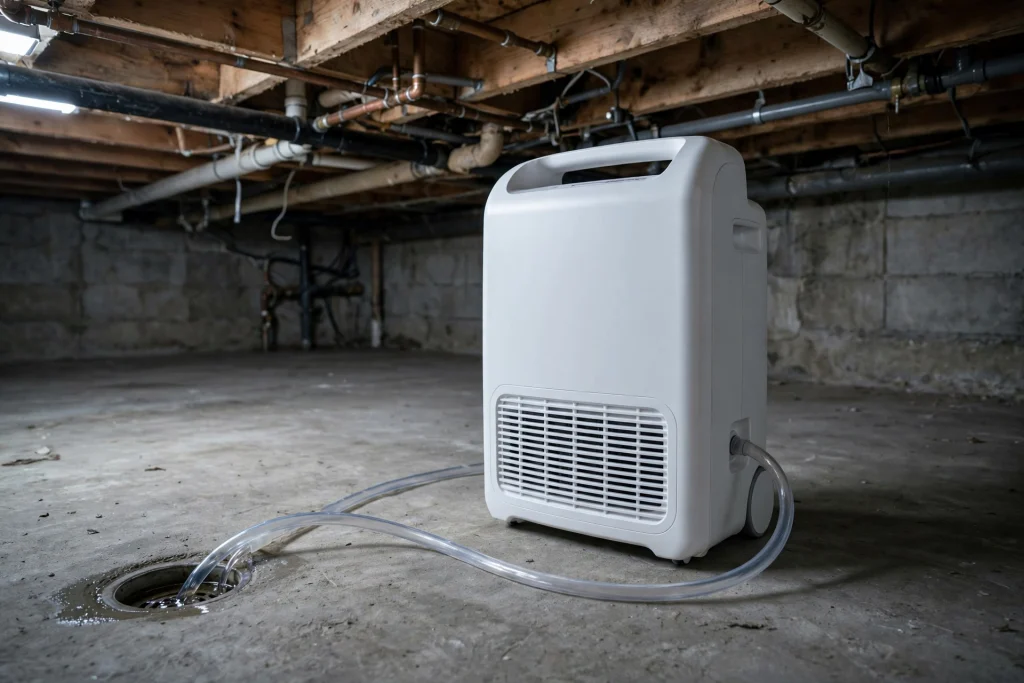
What it does
Warm, moist air is drawn across a refrigerated coil. The air cools below its dew point, water condenses out onto the coil and drips into a reservoir or drain. The now-drier air passes over a warm coil and returns to the room slightly warmer than it arrived.
That last detail matters more than people expect. A dehumidifier is a small heater. It adds roughly 2 to 5°F to a basement over time, which is usually welcome in a cool basement and occasionally not.
The output is measured in pints per day under standard test conditions. Real-world performance in a cool basement is lower than the label, which is why sizing generously matters.
What it genuinely fixes
High relative humidity. Bringing a basement from 70 percent down to 45 to 50 percent is exactly what these machines do.
Condensation on cool surfaces. Lowering the dew point of the air means walls, pipes, and floors stop reaching it. This is the mechanism behind walls sweating in summer.
Musty odour. The smell comes from mold and mildew metabolising. Drop humidity below 60 percent and that growth goes dormant.
Mold prevention. Below 60 percent, spores cannot establish. This is prevention, not remediation — existing growth still has to be physically removed.
Dust mites. They need ambient humidity above roughly 50 percent to survive.
Protecting stored belongings and slowing corrosion on mechanical equipment.
Vapour diffusion through concrete. Moisture arrives through the slab and walls as vapour continuously, even with no leak at all. A dehumidifier is the correct and only practical answer to that.
What it cannot do
Stop liquid water entering. Seepage through a crack, at the cove joint, or up through the floor is unaffected. The dehumidifier will remove what evaporates and the source keeps supplying more.
Fix the cause. Downspouts emptying against the wall, ground sloping toward the house, a clogged footing drain — none of these care that you bought a machine.
Dry out a wall. Concrete saturated from the outside stays saturated as long as the soil is wet.
Remove existing mold. It stops growth spreading. Established colonies have to be physically removed, and porous materials that grew mold get replaced rather than dried.
Relieve hydrostatic pressure. The force pushing water through your foundation is a drainage matter.
Work efficiently in cold. Standard compressor units lose capacity below roughly 65°F and can frost up below 60°F unless they have auto-defrost.
The test that tells you which situation you are in
Tape a square of aluminium foil tightly to the wall, sealing all four edges, and wait 48 hours.
Moisture on the room side means condensation — a dehumidifier is the right tool. Moisture on the wall side means water is coming through the masonry, and you have a drainage problem that a dehumidifier will only manage. The full diagnostic is here.
Sizing
Undersizing is the most common mistake. A 30-pint unit in a large or damp basement runs constantly and never reaches target.
| Space | Moderately damp | Very damp or wet |
|---|---|---|
| Up to 500 sq ft | 30 pint | 40 to 50 pint |
| 500 to 1,000 sq ft | 40 to 50 pint | 50 to 70 pint |
| 1,000 to 1,500 sq ft | 50 to 70 pint | 70 pint or more |
| 1,500 to 2,500 sq ft | 70 pint | 70 pint plus a second unit |
Adjust upward for: cool basement temperatures, an adjoining crawl space, laundry in the space, any history of water, and hot humid climates.
Note that pint ratings were redefined in 2019 under a cooler, drier DOE test standard. A unit labelled 50-pint today is roughly equivalent to a 70-pint unit under the old rating. Compare current models against each other rather than against a decade-old unit.
Buy one size up from your calculation. An oversized unit cycles off sooner and runs less; an undersized one runs continuously and still loses.
Types
Compressor (refrigerant). The standard choice. Efficient in warm conditions, loses capacity below about 65°F. Get one with auto-defrost if your basement runs cool.
Desiccant. Uses a moisture-absorbing wheel rather than a cold coil, so performance holds in cool spaces. Quieter, lighter, and generally uses more electricity per pint removed. Worth considering for an unheated basement or a crawl space.
Whole-house, ducted. Integrated with the HVAC system, serving the whole house. Higher upfront cost, better efficiency, no bucket, and no appliance sitting in the room. $1,500 to $3,500 installed.
LGR (low grain refrigerant). Commercial restoration units that pull air to much lower moisture content. Overkill for maintenance, exactly right for drying out a basement after a flood. Rent rather than buy, $50 to $100 a day.
Running it properly
Set it to 45 to 50 percent and leave it. Do not chase 35 percent; you are paying for nothing and risking wood shrinkage.
Run it continuously, not on a schedule. Humidity does not keep office hours.
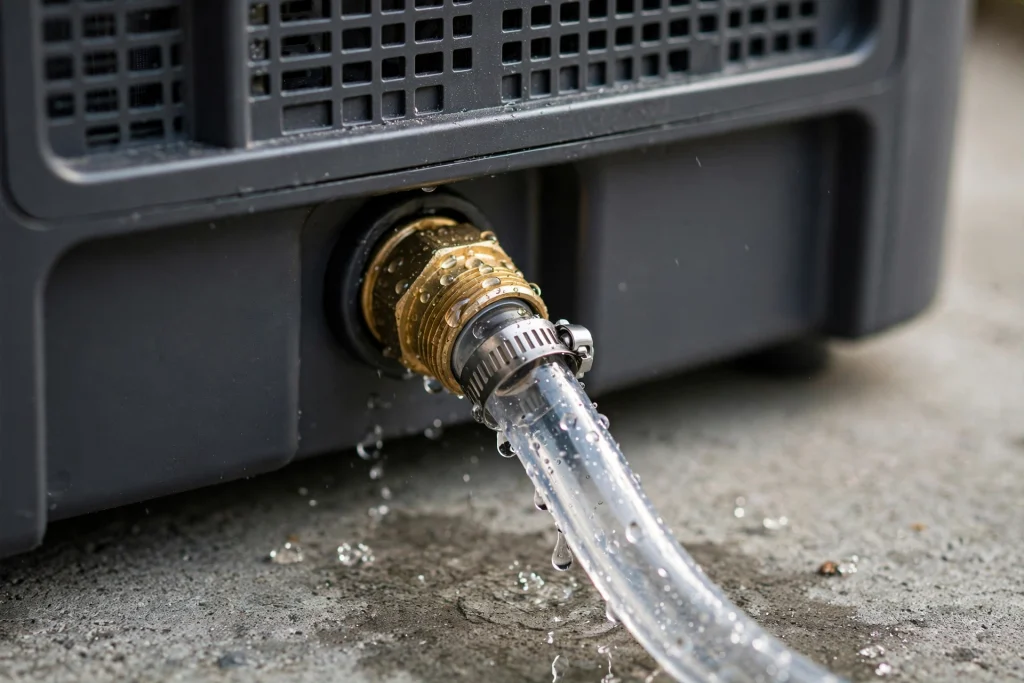
Use the continuous drain. Every unit has a hose port. Route it to a floor drain, a sump pit, or a condensate pump. A unit that shuts off with a full bucket at 2 a.m. is doing nothing until you notice.
Position it centrally, with clearance around the intake and exhaust. Most modern units do not need clearance on all sides, but check the manual.
Keep doors and windows closed. Dehumidifying with a window open means processing outdoor air indefinitely.
Clean the filter monthly. A clogged filter cuts capacity substantially and is the most common reason a working unit seems to have failed.
Check the coils annually for dust buildup.
Do not put it in an unheated space in winter unless it is a desiccant model or rated for low temperature.
Running cost
A typical 50-pint compressor unit draws roughly 500 to 700 watts.
At 600 watts, running 12 hours a day at $0.16 per kWh, that is about $35 a month. Running continuously in a damp summer, closer to $70.
Ways to reduce it:
- Fix the water sources so the unit works less
- Look for an Energy Star rated model, which uses meaningfully less per pint removed
- Size correctly, since an undersized unit running 24/7 costs more than a correct one cycling
- Seal the sump pit and any crawl space access, so you are not dehumidifying the soil
The heat it adds slightly offsets winter heating and slightly increases summer cooling load.
When a dehumidifier is not enough
Humidity will not drop below 60 percent despite a correctly sized unit running continuously. Something is supplying moisture faster than it can remove it.
The unit runs constantly and the bucket fills daily. That volume of water is coming from somewhere.
Visible water on the floor or walls. Liquid water is a drainage problem.
Efflorescence keeps returning. Proof that liquid water is moving through the masonry.
Musty odour persists at 45 percent humidity, which suggests existing growth that needs physical removal rather than prevention.
In each case, the answer is upstream: fix the water. Start cheap with gutters, downspouts, and grading, and only escalate to a drainage system once those are genuinely done.
Frequently asked questions
Should I run a dehumidifier all the time? In humid climates, yes, from spring through autumn at minimum. Set it to 45 to 50 percent and let it cycle. Many basements need one year-round.
Will a dehumidifier dry out a wet basement? It will remove water from the air and help dry surfaces after an event. It will not stop water still entering. Fix the source first.
Can a dehumidifier make a basement too dry? Below 30 percent causes wood shrinkage and discomfort. Uncommon with a thermostat set to 45 or 50.
Is a dehumidifier cheaper than waterproofing? Vastly, and they solve different problems. If your issue is genuinely humidity, a $250 dehumidifier is the correct purchase. If liquid water is entering, no dehumidifier will substitute for drainage.
Do I still need one after waterproofing? Usually yes. Vapour continues to diffuse through concrete regardless, and outdoor summer air is humid. A dry foundation and a dehumidifier are complementary, not alternatives.
Where should I put it? Centrally, off the floor if you can, with clearance around it, and with the drain hose routed to a drain or sump. Not tucked in a corner behind boxes.
Why is my dehumidifier running but humidity is not dropping? Clogged filter, undersized unit, an open door or window, temperature too low for a compressor model, or an untreated moisture source. Check the filter first.
Will it help with mold I already have? It stops it spreading. Existing growth needs physical removal, and porous materials that grew mold get replaced rather than dried. More on identifying and handling it here.
Does it help before finishing a basement? Yes, and so does testing. Run it for a season and confirm humidity holds, then do a concrete moisture test before installing any flooring.
The bottom line
A dehumidifier is the right answer to humid air and the wrong answer to a leaking wall. It removes vapour, holds humidity at 45 to 50 percent, prevents mold from establishing, and stops the condensation that makes basements feel clammy.
What it cannot do is turn off a source. So tape foil to your wall for two days first. Moisture on the room side means buy the dehumidifier. Moisture on the wall side means the machine is a $250 way to postpone a conversation about drainage.
[…] Run a correctly sized dehumidifier continuously. For most basements that means a 50 to 70 pint unit, not a 30. Route the drain hose to a floor drain or sump so you are not emptying a bucket daily. More on what a dehumidifier can and cannot do here. […]
[…] and dry. Run a dehumidifier at 45 to 50 percent with air circulation, and retest in a few months. Effective for a slab that is simply still curing. […]
[…] humidity at 45 to 50 percent with a properly sized dehumidifier running […]
[…] Humidity. A dry basement in a humid climate can still sit above 60 percent relative humidity from vapour diffusion alone. You will still want a dehumidifier holding 45 to 50 percent. […]
[…] dehumidifier. If the actual complaint is a damp, musty feel rather than water, holding 45 to 50 percent humidity may solve it for […]
[…] liquid water is handled, holding 45 to 50 percent humidity deals with the vapour that continues to diffuse through concrete regardless. Most basements need […]
[…] No. It manages liquid groundwater. Vapour still moves through concrete, and most basements need a dehumidifier at 45 to 50 percent […]
[…] Run a properly sized dehumidifier. Target 45 to 50 percent relative humidity. Sizing matters: a 30-pint unit will struggle in a large or very damp basement where a 50 to 70 pint unit works comfortably. Route the drain hose to a floor drain or sump pit so you are not emptying a bucket daily. Cost: $200 to $400. […]
[…] some moisture arrives as vapor no matter what you do, a dehumidifier holding 45 to 50 percent relative humidity handles the remainder. Most basements in humid climates need one permanently regardless of how dry […]