
A wet basement wall looks the same whether water came through it or formed on it. But those are two entirely different problems with two entirely different solutions, and the cost difference between them is enormous.
Condensation is an air problem. It is usually fixed for a few hundred dollars with a dehumidifier and some insulation. Seepage is a water problem. Fixing it properly can mean drainage work running into five figures.
Getting the diagnosis wrong is expensive in both directions. People install $12,000 drainage systems for what turned out to be a humidity issue. Other people run a dehumidifier for three years while groundwater quietly rots the framing behind their finished wall. Twenty minutes of testing prevents both.
The short answer
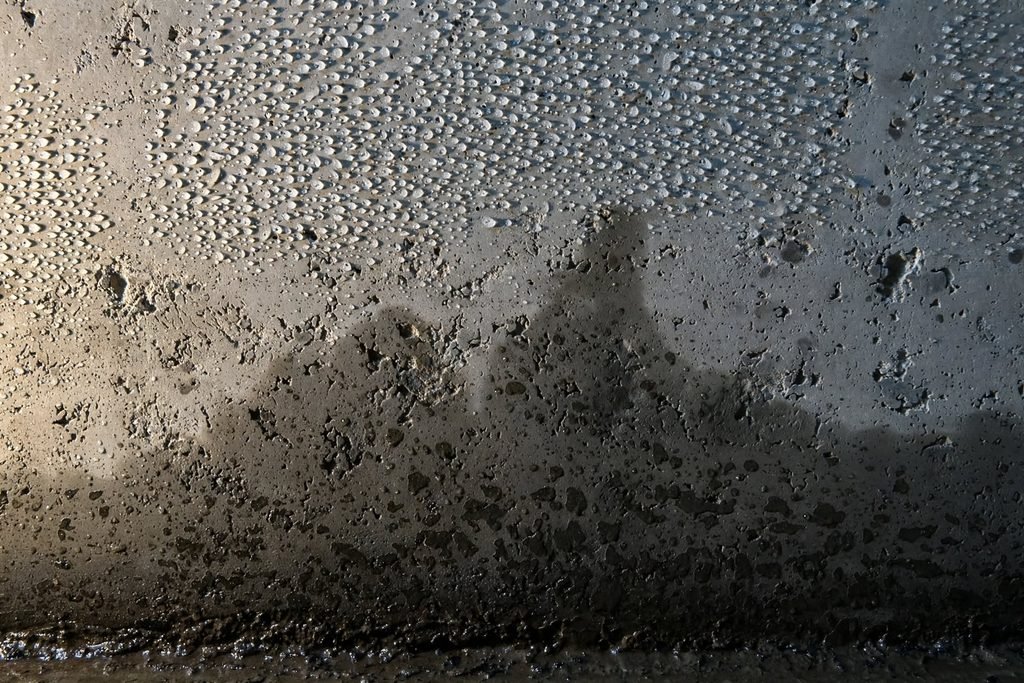
Condensation forms when warm humid air touches a cool surface. It appears on the room-facing side of walls, floors, cold water pipes, and ductwork. It is worst in summer, it covers broad areas evenly, and it is often accompanied by droplets on pipes and a general clamminess in the air.
Seepage is water moving through the foundation from outside. It appears in specific locations, it correlates with rainfall and snowmelt, it is worst in spring, and it usually leaves mineral deposits behind.
The rest of this article is how to prove which one you have.
Test 1: The foil test
This is the definitive test, it costs nothing, and it settles the question in 48 hours.
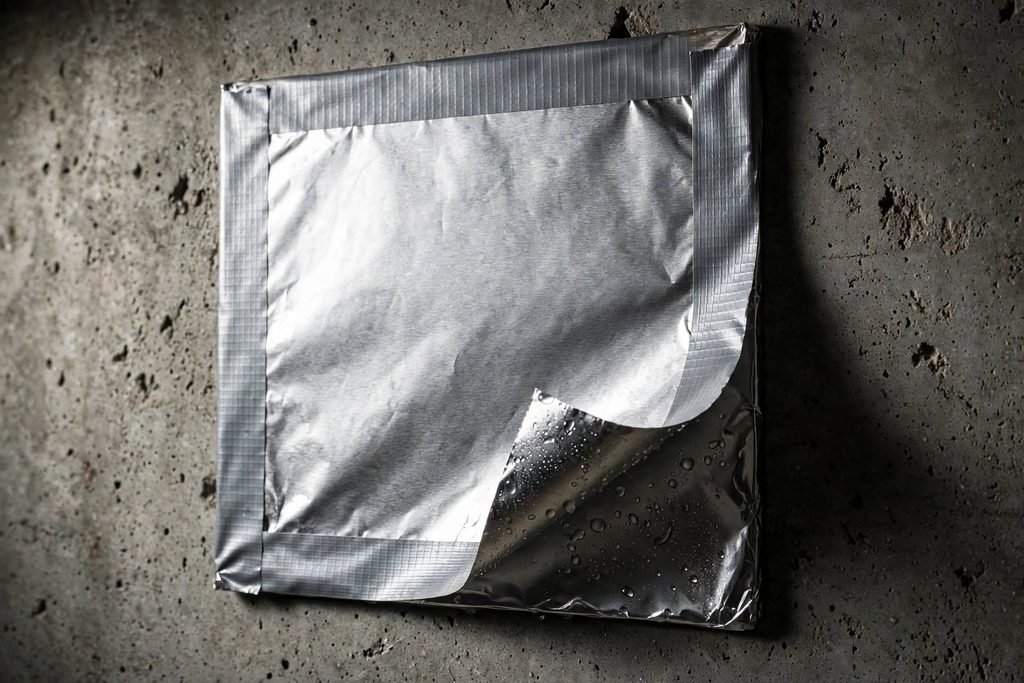
What you need: Aluminum foil, duct tape or foil tape.
How to do it:
- Choose the wall area that gets wet. Wipe it completely dry with a towel.
- Cut a square of foil roughly 12 by 12 inches.
- Tape it flat against the wall, sealing all four edges completely. The seal matters. Air must not get behind it.
- Wait 24 to 48 hours. Longer is better if conditions have been dry.
- Peel the foil off and look at both sides.
Reading the result:
- Moisture on the room-facing side of the foil means humid basement air condensed on the cool foil, exactly as it was condensing on the cool wall. You have condensation.
- Moisture on the wall-facing side of the foil, or the wall beneath is damp, means water moved through the concrete and got trapped. You have seepage.
- Both sides wet means you have both problems at once, which is more common than people expect.
- Both sides dry means test again after a heavy rain, or test a different spot.
Run the test in two or three locations rather than one. Basements frequently have condensation in the middle of a wall and seepage at the base of the same wall.
Test 2: Timing and seasonality
Different causes follow different calendars, and this is often diagnostic on its own.
Condensation peaks in summer
Warm, humid outdoor air enters the basement through open windows, stairwells, and air leaks. Basement walls and floors stay cool year-round because they are in contact with soil that holds a steady temperature. When that warm air hits those cool surfaces, moisture condenses out of it.
This is why so many people notice a “damp basement” in July and assume they have a leak, when what they actually have is physics.
Seepage peaks in spring and after rain
Groundwater problems track precipitation and the water table. Spring is the worst season in most climates because snowmelt cannot soak into frozen ground and the water table peaks. Seepage also shows up 12 to 48 hours after a heavy storm as soil saturates.
Quick reference
| Observation | Condensation | Seepage |
|---|---|---|
| Worst season | Summer | Spring, and after rain |
| Correlates with rain | No | Yes |
| Correlates with humidity | Yes | No |
| Location | Broad, even, upper walls and pipes | Specific spots, lower walls, floor joint |
| Pipes also wet | Yes | No |
| Mineral deposits | No | Yes |
| Water on floor | Thin sheen or damp feel | Puddles, sometimes flowing |
Test 3: Look for efflorescence
Efflorescence is the white, chalky, sometimes crystalline deposit found on basement walls. It is dissolved salts and minerals that were carried out of the concrete by water and left behind when that water evaporated.
Its presence is proof that liquid water has traveled through the wall. Condensation cannot produce it, because condensation forms on the outside surface from air and has not passed through any masonry.
If you see efflorescence, you have or have had seepage at that location, full stop. It can coexist with a condensation problem, but the efflorescence itself is a seepage signature.
Do not confuse it with mold. Efflorescence is white to grayish, gritty, and dissolves when you dab it with water. Mold is typically black, green, or brown, has a fuzzy or spotty texture, and smells.
Test 4: Check the pipes and the cold surfaces
Walk the basement and look at cold water supply pipes, the outside of the toilet tank if there is one, and any exposed ductwork carrying air conditioning.
If those surfaces are beaded with water, the air in your basement is above the dew point of those surfaces, which means condensation is occurring throughout the space, not just on your wall. That is a strong indicator that at least part of your wall moisture is condensation.
If pipes are bone dry while the wall is wet, condensation is unlikely to be the explanation.
Test 5: Use a hygrometer and understand dew point
A $15 digital hygrometer removes most of the guesswork and is worth owning permanently.
Relative humidity tells you how saturated the air is at its current temperature. Above roughly 60 percent, condensation and mold growth both become likely on cool surfaces.
Dew point is the more useful number. It is the temperature at which air becomes saturated and water starts condensing out. If your basement air has a dew point of 65°F and your wall surface is 62°F, that wall will get wet. It has nothing to do with leaks.
Measure the wall surface temperature with an infrared thermometer, which runs $20 to $40, and compare it to the dew point shown on your hygrometer. Wall temperature below the dew point means condensation is guaranteed.
This also explains the single most common homeowner mistake, covered next.
Why opening the windows makes it worse
The instinct when a basement feels damp is to open the windows and air it out. In summer, this makes the problem substantially worse.
Warm outdoor air holds far more moisture than cool air. When you bring 85°F air at 70 percent humidity into a basement with 62°F walls, that air cools, cannot hold its moisture, and deposits it on every cool surface in the room. You have effectively pumped water onto your walls.
The rule: check the outdoor dew point, not the relative humidity. If the outdoor dew point is below about 55°F, ventilating helps. If it is above that, keep the basement closed and run a dehumidifier instead.
How to fix condensation
Condensation problems are solved by managing air, and the fixes are comparatively cheap.
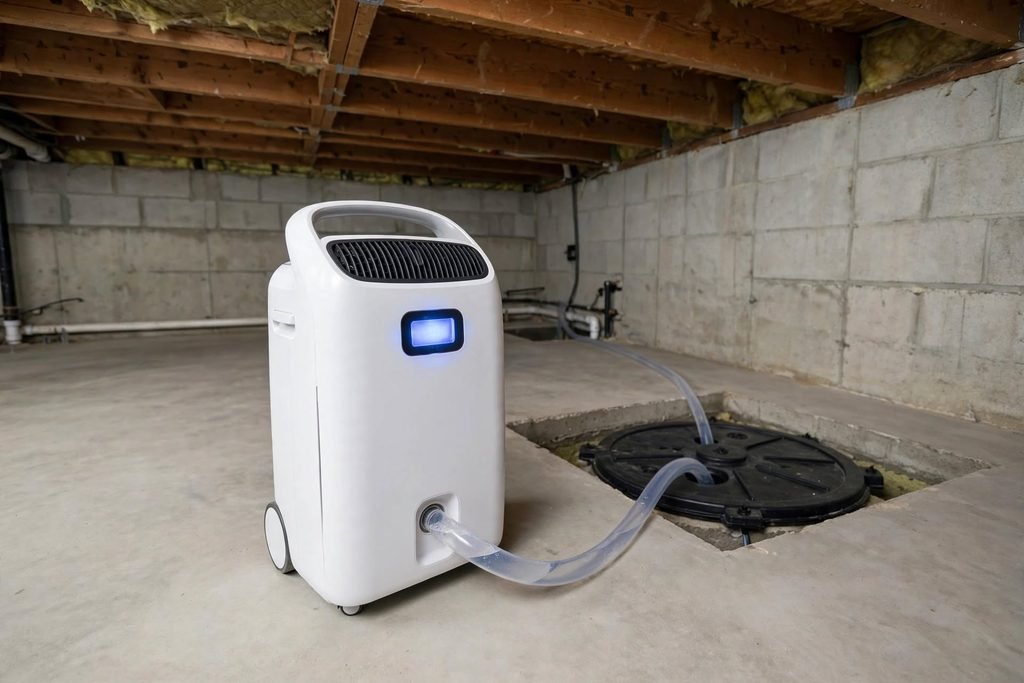
Run a properly sized dehumidifier. Target 45 to 50 percent relative humidity. Sizing matters: a 30-pint unit will struggle in a large or very damp basement where a 50 to 70 pint unit works comfortably. Route the drain hose to a floor drain or sump pit so you are not emptying a bucket daily. Cost: $200 to $400.
Keep the basement closed in humid weather. No open windows when the outdoor dew point is high.
Insulate cold water pipes. Foam pipe sleeves cost pennies per foot and eliminate the drip that stains ceilings and floors.
Insulate the walls correctly, if finishing. Rigid foam board applied directly to the foundation wall keeps the interior surface above the dew point and eliminates the condensing surface. This must be done with a vapor-permeable strategy appropriate to your climate, and getting it wrong traps moisture inside the assembly. Fiberglass batts against bare concrete are a classic mistake that produces mold behind the wall.
Cover the sump pit. An open sump pit is a continuously evaporating pool of water feeding humidity into the room. A sealed, gasketed lid is a cheap and surprisingly effective improvement.
Seal the crawl space, if you have one adjoining. Exposed dirt in a crawl space releases enormous quantities of water vapor into the house.
Vent the dryer outside, and confirm it actually is. A disconnected dryer vent dumps gallons of water vapor into a basement every week.
How to fix seepage
Seepage is a water problem, and it is solved from the outside in.
Start with gutters and downspouts. Clean the gutters. Extend every downspout six to ten feet from the house. This alone resolves a large share of seepage cases and costs under $200.
Correct the grading. Soil should fall at least six inches over the first ten feet from the foundation. Settled backfill that now slopes toward the house is extremely common in older homes.
Cover and drain window wells. Clear polycarbonate covers prevent the well from filling during rain.
Inject individual cracks. A single vertical crack leaking during rain is a straightforward polyurethane injection repair, typically $400 to $900 professionally.
Install interior drainage for genuine hydrostatic pressure. If water arrives at the wall-floor joint or up through floor cracks, and it persists after the exterior work is done, a perimeter drain routed to a sump is the durable answer. Cost: $8,000 to $20,000.
Do not lead with waterproof paint. Masonry sealer paints handle mild dampness on a wall with no pressure behind it. Against actual seepage they peel off in sheets, often taking a layer of concrete with them, and they hide the evidence you need for diagnosis.
When you have both
This is the most common real-world scenario, and it is why single-cause thinking leads people astray.
A typical pattern: minor seepage keeps the concrete permanently damp, that dampness evaporates into the room, the room humidity rises above 60 percent, and now condensation forms on every cool surface including the walls that were only slightly wet to begin with. The condensation is a symptom of the seepage, but it also has its own momentum.
Treating only the humidity means running a dehumidifier forever against a source you never turned off. Treating only the seepage may still leave you above 60 percent humidity in summer, because basements in humid climates often need dehumidification regardless.
The practical sequence: fix the water intrusion first, then measure. Run the dehumidifier for a season and see what the humidity does once the source is reduced. Most basements end up needing both a dry foundation and a dehumidifier, and that is a normal outcome, not a failure.
Frequently asked questions
Can a basement have condensation in winter? It is uncommon but possible, usually near cold air leaks around rim joists or windows where a very cold surface meets heated indoor air. Most winter basement moisture comes from other sources.
My walls are wet but my floor is dry. What does that mean? Wet walls with a dry floor points toward condensation, since air condenses on vertical cool surfaces first. Seepage more often shows at the base of walls and at the wall-floor joint.
My floor is wet but the walls are dry. What does that mean? That is a strong indicator of groundwater rising from beneath the slab under hydrostatic pressure. It is also occasionally condensation on a very cold slab in summer, which the foil test taped to the floor will distinguish.
What humidity level should a basement be at? 45 to 50 percent is the usual target. Below 60 percent prevents mold growth. Below 40 percent is unnecessary and wastes energy.
Does a dehumidifier fix a leaking basement? No. It manages the consequences. Running a dehumidifier against an active leak means paying electricity to remove water you are still letting in. It is useful as part of the solution, not as the solution.
Why does my basement smell musty even though it looks dry? Musty odor comes from microbial volatile organic compounds produced by mold and mildew, and those can grow behind walls, under carpet, and inside stored cardboard where you cannot see them. Persistent odor with no visible source usually means humidity has been above 60 percent for an extended period, or there is hidden moisture in a wall cavity.
Is condensation dangerous? Not immediately, but sustained high humidity leads to mold, dust mites, rusting mechanical equipment, and damage to stored belongings. It also makes a basement uncomfortable and unusable as living space.
Can I test for this myself or do I need a professional? The foil test, a hygrometer, and an infrared thermometer will resolve the question for most homeowners for under $60 total. Bring in a professional once you know which problem you are solving and the fix involves drainage work or wall structure.
The bottom line
Tape foil to the wall and wait two days. That single test answers a question that homeowners otherwise spend thousands of dollars guessing at.
Moisture on the room side means air. Moisture on the wall side means water. White chalky deposits mean water has been moving through the concrete regardless of what else is going on. And if you find both, treat the water first and the air second, because dehumidifying a foundation that is still leaking is a bill that never stops arriving.