
This question means two different things, and the answers are very different.
Per outage: typically 4 to 12 hours of realistic intermittent pumping from a single quality battery, though it can be much less under heavy demand and considerably more under light demand.
Before replacement: 3 to 5 years for most batteries, sometimes 6 to 7 for a good AGM in favourable conditions.
Both numbers depend on things you control. This article covers the math for runtime, the factors that stretch or shrink it, how to choose a battery, and how to know when yours has quietly stopped being able to do its job.
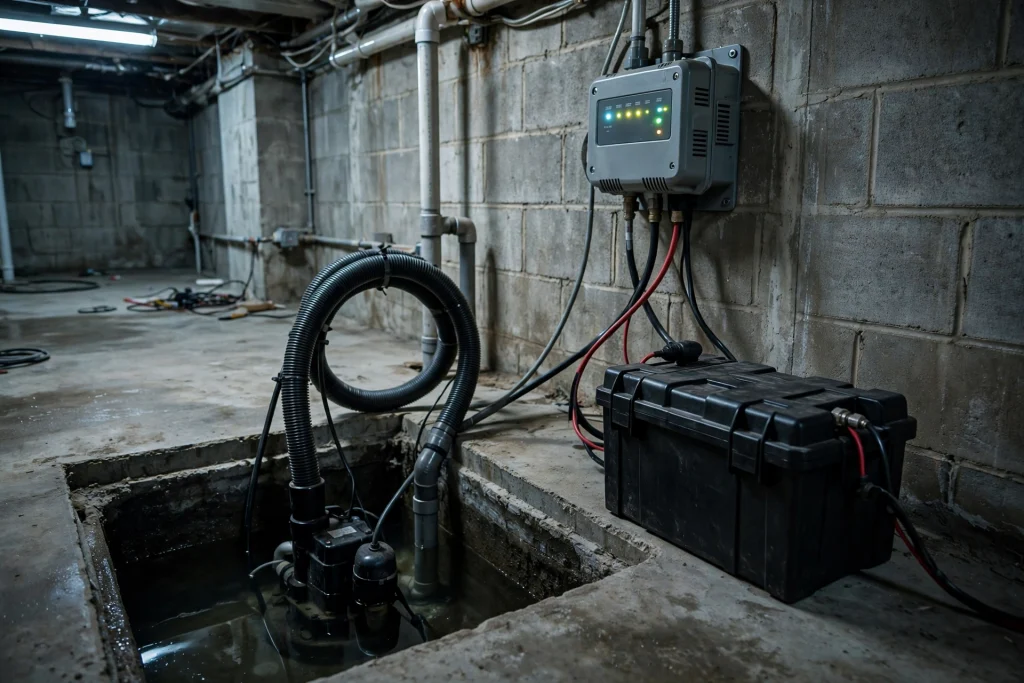
Why you need one at all
The failure mode a backup addresses is not subtle: the storm that maximises the demand on your sump pump is the same storm that cuts your power.
Heavy rain saturates the soil and raises the water table, which is exactly when the pump must work hardest. High winds and lightning take down lines. A primary pump running on grid power alone has a single, entirely predictable point of failure, and it fails at the worst possible moment.
A backup also covers the other failure modes: a burned-out primary motor, a stuck float, a tripped breaker. Most backup systems activate when water rises above the primary’s normal cutoff regardless of why the primary did not handle it.
If you have a finished basement, stored valuables, or mechanical equipment down there, this is not an optional accessory.
Runtime: the math
Runtime is a straightforward calculation, and doing it yourself gives a far more useful answer than any manufacturer’s headline number.
The formula
Usable battery capacity (amp-hours) ÷ pump current draw (amps) = hours of continuous pumping
Then multiply by your duty cycle, the fraction of time the pump is actually running.
A worked example
Take a common setup: a 100 amp-hour deep-cycle battery and a 12V backup pump drawing 25 amps while running.
Continuous pumping: 100 Ah ÷ 25 A = 4 hours in theory.
But two corrections apply.
Correction 1: usable capacity. Discharging a lead-acid battery below about 50 percent dramatically shortens its life, and inverter systems often cut out before full depletion anyway. Realistic usable capacity is roughly 50 to 70 percent of rated. So call it 60 Ah usable, giving 2.4 hours of continuous running.
Correction 2: duty cycle. Backup pumps almost never run continuously. During a typical outage the pump might run 20 seconds out of every 5 minutes, a duty cycle of about 7 percent. At that rate, 2.4 hours of pumping stretches across roughly 34 hours of elapsed time.
Under heavy inflow at a 33 percent duty cycle, the same battery gives around 7 hours.
Under severe conditions at a 50 percent duty cycle, roughly 5 hours.
That range is why manufacturers quote such wide figures, and why “how long will it last” genuinely depends on your house and your storm.
Realistic expectations
| Conditions | Duty cycle | Typical runtime, 100Ah battery |
|---|---|---|
| Light inflow, dry-ish soil | Under 10% | 24 to 40 hours |
| Moderate rain | 15 to 25% | 10 to 16 hours |
| Heavy sustained rain | 30 to 50% | 5 to 8 hours |
| Severe, near-continuous demand | 70%+ | 3 to 4 hours |
Most homeowners in a typical outage land somewhere in the 8 to 20 hour range.
What shrinks your runtime
Battery age. Capacity declines steadily. A four-year-old battery may retain only 60 to 70 percent of its rated capacity, and it will not warn you.
Cold temperatures. Lead-acid capacity drops substantially in cold, roughly 20 percent at freezing and more below. An unheated basement in January is a meaningfully worse environment than the same basement in June.
Undersized battery. A 40 Ah battery in a system that needs 100 Ah gives you a couple of hours.
Higher head height. A pump lifting water 12 feet works harder and draws more current than one lifting 6 feet.
High water table. More inflow means a higher duty cycle, which is the biggest single variable in the equation.
Deep discharges. Every full discharge damages a lead-acid battery. A backup that has run to depletion two or three times has lost real capacity permanently.
A failing primary pump. If the primary is weak, the backup carries more of the load even when power is on, quietly cycling the battery. This is worth ruling out with a proper pump test.
Battery types
Flooded lead-acid (wet cell)
The traditional deep-cycle marine battery.
Pros: cheapest, widely available, good capacity per dollar. Cons: requires topping up with distilled water, must be in a ventilated location because it off-gasses hydrogen during charging, can spill, needs periodic terminal cleaning. Lifespan: 3 to 5 years with maintenance. Cost: $100 to $200.
AGM (absorbed glass mat)
Sealed lead-acid with the electrolyte held in fibreglass mats.
Pros: maintenance-free, sealed and spill-proof, tolerates deeper discharge better, lower self-discharge, no ventilation requirement. Cons: more expensive, more sensitive to overcharging. Lifespan: 4 to 7 years. Cost: $200 to $400.
For most basements, AGM is the better choice. No watering, no venting requirement, and better tolerance of the deep discharges that backup service inevitably produces. The extra cost is recovered in longer life and no maintenance.
Lithium (LiFePO4)
Pros: far longer cycle life, often 8 to 10 years or more, much lighter, holds voltage better through discharge so pump output stays consistent, usable capacity closer to 90 percent of rated. Cons: substantially more expensive, and the charging controller must be compatible. Not all sump backup systems support lithium chemistry. Cost: $500 to $1,200.
Worth considering if your system supports it and you want to stop thinking about battery replacement for a decade.
Sizing
Group 27 or Group 31 deep-cycle batteries, typically 90 to 115 amp-hours, are the common choice for residential sump backup.
Do not use an automotive starting battery. Car batteries are built to deliver a large current for a few seconds and are damaged by the deep, sustained discharge that backup service demands. They fail rapidly in this role.
Dual-battery systems are available and roughly double runtime. If you live somewhere with frequent multi-day outages or a high water table, this is the straightforward upgrade.
Battery lifespan and knowing when to replace
The trap
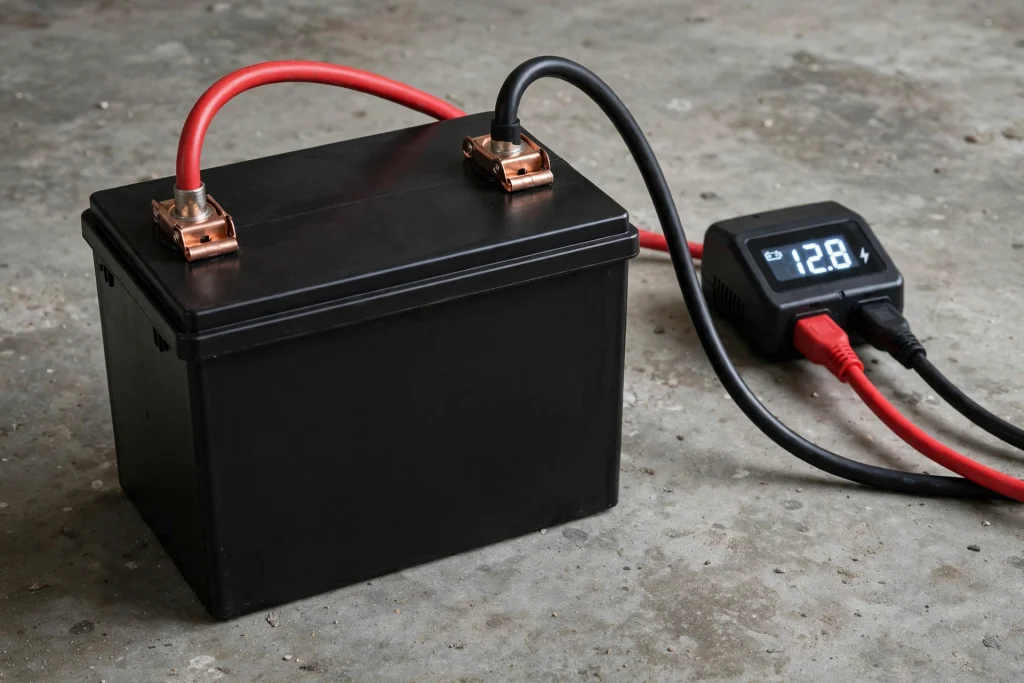
Nearly every backup system has a charger indicator light. A green light means the battery is receiving charge. It does not mean the battery can still hold charge or deliver current under load.
This is why so many homeowners discover a dead backup during the outage. The light was green for two years while the battery quietly lost most of its capacity.
Replacement intervals
- Flooded lead-acid: every 3 to 4 years
- AGM: every 4 to 6 years
- Lithium: every 8 to 10 years
Replace on schedule, not on failure. Write the installation date directly on the battery case with a permanent marker.
Signs a battery is finished
- Age past its interval, regardless of appearance
- Swollen or bulging case, which means replace immediately
- Corrosion buildup on terminals that returns quickly after cleaning
- Resting voltage below 12.4V on a fully charged battery
- Runtime noticeably shorter than it used to be during a test
- Charger cycling on and off frequently, or reporting a fault
- For flooded types, needing water far more often than before
How to actually test capacity
Resting voltage is the quick check. Disconnect the charger, wait several hours, and measure with a multimeter. Roughly 12.7V is full, 12.4V is about 75 percent, 12.2V is about 50 percent, and below 12V means replace.
A load test is the real answer. Auto parts stores usually perform them free. It measures whether the battery can deliver current under demand, which voltage alone does not reveal.
A functional runtime test is the most honest. Unplug the primary pump and the charger, then run the backup on a real cycle and see how long it holds up. Do this annually as part of your service routine, and restore everything afterward.
Extending runtime and lifespan
Keep the battery on its charger continuously. A quality smart charger maintains float voltage without overcharging.
Keep it warm. An unheated corner costs you real capacity in winter. A battery in a heated part of the basement performs meaningfully better.
Clean the terminals annually. Corrosion adds resistance, which reduces delivered current and wastes capacity.
Avoid deep discharges. After any outage that ran the battery hard, allow a full recharge before relying on it again, and consider a load test if it went very low.
Add a second battery if outages in your area routinely exceed your runtime.
Reduce the demand. This is the underrated one. Every gallon that never reaches your pit is a gallon the backup does not have to lift. Extending downspouts and correcting the grading around the foundation lower your duty cycle directly, which stretches runtime more than any battery upgrade.
The alternatives
Water-powered backup. Uses municipal water pressure to create suction that removes sump water. No electricity, no battery, unlimited runtime as long as city water flows. The trade-offs: it consumes roughly one to two gallons of city water for every gallon removed, it is unavailable on well systems, and some jurisdictions restrict them. Cost $800 to $2,000 installed.
Standby or portable generator. Solves the outage problem for the whole house. Requires a transfer switch and, for portables, someone home to start it.
A second AC pump in the pit. Protects against primary pump failure but not against a power outage. Useful in addition to, not instead of, a battery backup.
Whatever you choose, add a high-water alarm. Basic units are under $30 and Wi-Fi models that push a phone alert run $80 to $200. Knowing the backup has engaged, or that the water is still rising, is worth a great deal during a storm. That knowledge is also central to what to do if your sump pump fails during a storm.
Frequently asked questions
How long will a battery backup run during a power outage? Typically 8 to 20 hours for a healthy 100 Ah battery under moderate conditions, dropping to 4 to 8 hours under heavy inflow. Do the duty-cycle math for your own situation rather than relying on a headline figure.
Can I use a car battery? No. Automotive starting batteries are designed for brief high-current bursts and are damaged rapidly by the deep, sustained discharge of backup service. Use a deep-cycle battery.
How do I know if my battery is still good? Age first, then a load test. The charger’s green light tells you nothing useful about remaining capacity. Test annually and replace on schedule.
Should I get AGM or flooded? AGM for most basements. Sealed, maintenance-free, no ventilation requirement, better deep-discharge tolerance, and longer life for a modest premium.
Will the backup pump keep up with heavy rain? Backup pumps generally move less water than primaries, often 1,000 to 2,000 gallons per hour versus 2,500 to 4,000. They are designed to keep the water below floor level, not to match the primary. Under extreme inflow they may fall behind.
Does the backup pump wear out too? Yes, though far more slowly since it runs rarely. Include it in your quarterly pump testing by unplugging the primary and confirming the backup handles a full cycle.
Can I install one myself? The pump and plumbing are within reach for a competent DIYer. The electrical connection and the charging system should be done correctly, and some jurisdictions require permits. Professional installation runs $600 to $1,500 including the unit.
Is a water-powered backup better? It has unlimited runtime, which is a genuine advantage for long outages. It also uses a lot of municipal water and is unavailable on wells. Neither option is universally better; it depends on your water source and your typical outage duration.
Does the backup run if the primary fails but power is on? Yes, in most designs. The backup float sits above the primary’s cutoff level, so if water rises past that point for any reason, including a dead primary or a pump that is running without moving water, the backup engages.
The bottom line
Runtime is a calculation, not a fixed number. Usable amp-hours divided by pump draw, multiplied by how much of the time the pump actually runs. Most homes land between 8 and 20 hours per outage with a healthy 100 Ah battery.
Lifespan is the number people get wrong more often. Batteries die quietly, the charger light stays green, and nobody finds out until the basement floods. Write the install date on the case, load-test annually, and replace at 3 to 5 years whether it looks fine or not.
And remember which variable moves the most: the duty cycle. Cutting the water arriving at your pit lengthens every outage you will ever ride out, and a downspout extension costs thirty dollars.
[…] operation during a major storm is within design intent. What you should have in place is a battery backup, because the same storm that maximises demand is the one most likely to cut […]
[…] systems depend on a pump. No power, no pumping, unless you have a battery backup. Exterior systems that discharge to daylight need […]
[…] last one is worth asking about, because a battery backup is good practice regardless and some insurers discount for […]
[…] above. A pit, a pump, a check valve, a discharge line running well away from the house, and a battery backup, because the storm that floods your basement is the one that cuts the […]
[…] Test the battery backup under load, not by looking at the charger light. Unplug the primary, pour water in, and confirm the backup handles a full cycle. Replace batteries every 3 to 5 years. Runtime and lifespan. […]
[…] Check the battery’s age. Most need replacement every 3 to 5 years, and a charger light that reads green tells you the battery is receiving charge, not that it can still hold one under load. There is more on this in how long a sump pump battery backup lasts. […]
[…] Battery backup pumps: 5 to 10 years for the pump, though they run rarely so the limiting factor is usually the battery. Batteries need replacement every 3 to 5 years for flooded types and 4 to 6 for AGM. […]
[…] that has quietly lost capacity is the most common reason it does not run when needed, which is why testing the battery under load annually matters more than watching the charger […]