
You have decided to inject the crack rather than trowel something over it. Good. Now a contractor has quoted you for one resin and a forum post insists the other one is better, and the two materials cost roughly the same, so price does not settle it.
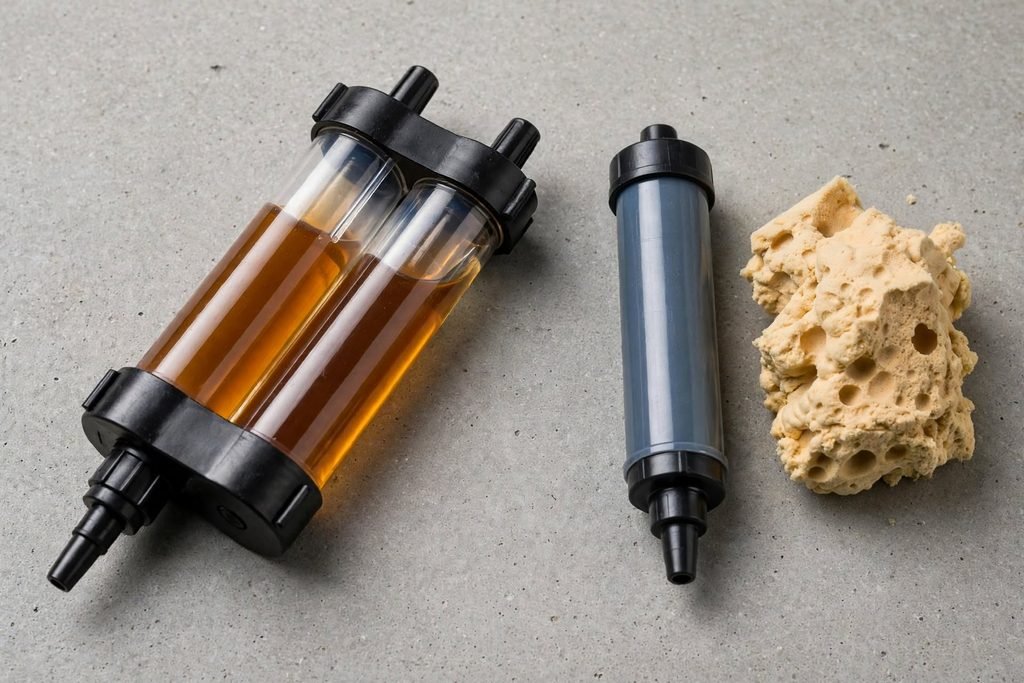
They are not competing versions of the same product. They do different jobs. Epoxy is structural adhesive; it glues the two sides of a crack back together into a single piece of concrete. Polyurethane is a water-stopping foam; it expands to fill the void and stays rubbery.
Pick the wrong one and the repair fails in a predictable way. Epoxy in a moving crack cracks again next spring. Polyurethane in a crack that needed structural restoration stops the water and leaves the wall exactly as weak as it was.
The one-sentence rule
Is the crack dry, dormant, and does the wall need its strength restored? Epoxy.
Is the crack wet, or does it move seasonally, and is your goal to stop water? Polyurethane.
For the typical leaking vertical crack in a residential basement, that resolves to polyurethane the large majority of the time. Basement cracks are wet almost by definition, and residential walls cycle seasonally with soil moisture.
The rest of this article is why, and the cases where the rule bends.
Epoxy injection
What it is
A two-part thermosetting resin, base and hardener, mixed at the nozzle as it is dispensed. It cures through a chemical reaction between the components, not by reacting with anything in the environment.
Structural injection epoxies are formulated at low viscosity, often in the 200 to 600 centipoise range, roughly comparable to a light oil, so they can penetrate narrow cracks by capillary action assisted by injection pressure.
What it does
Epoxy bonds to the concrete faces on both sides of the crack with a tensile strength greater than the concrete itself. Cured properly, a laboratory specimen broken again will typically fracture through the parent concrete beside the repair rather than at the bond line.
That is the defining property. Epoxy does not merely fill the crack; it restores structural continuity, effectively welding the wall back into one monolithic element. Compressive strengths on the order of 12,000 psi are typical, well above ordinary residential concrete.
When epoxy is the right choice
Structural cracks in a wall that needs its load path restored. If a crack has genuinely separated a wall into two pieces that need to act as one again, epoxy is the material that does that. Polyurethane does not.
Dormant cracks that will not move again. Curing shrinkage cracks in a wall with stable soil conditions are the classic case.
Dry cracks. Epoxy requires clean, dry substrate for a proper bond.
Where an engineer has specified it. Structural repair drawings frequently call for epoxy injection to specific standards, and that is not a place to substitute.
Above-grade concrete and columns. Beams, columns, slabs, and parking structures, where water is not the issue and strength is.
Where epoxy fails
Wet cracks. This is the big one. Water on the concrete surface prevents the bond from developing. Standard epoxies will not adhere properly to a damp crack face, and the repair delaminates. Moisture-tolerant epoxies exist and perform better, but “moisture tolerant” is not the same as “works in running water.”
Moving cracks. Cured epoxy is rigid, harder than the concrete around it. When the wall moves seasonally, the epoxy does not flex. The concrete cracks instead, usually a fraction of an inch beside the repair. You have a new crack and an intact epoxy line.
Slow cure with active leaks. Epoxy cures over hours. Water flowing through the crack during that window carries it away or prevents the fill.
Fine hairline cracks in some cases. Very narrow cracks can be difficult to penetrate fully, though low-viscosity formulations handle surprisingly tight cracks.
Cure and working characteristics
Working time typically 20 to 45 minutes depending on formulation and temperature. Initial set in several hours, full structural cure in 24 to 72 hours. Cold temperatures slow it considerably; most products specify a minimum substrate temperature around 40 to 50°F.
Because it cures slowly and does not expand, epoxy must be injected until the crack is genuinely full, which requires patience and attention to resin appearing at successive ports.
Polyurethane injection
What it is
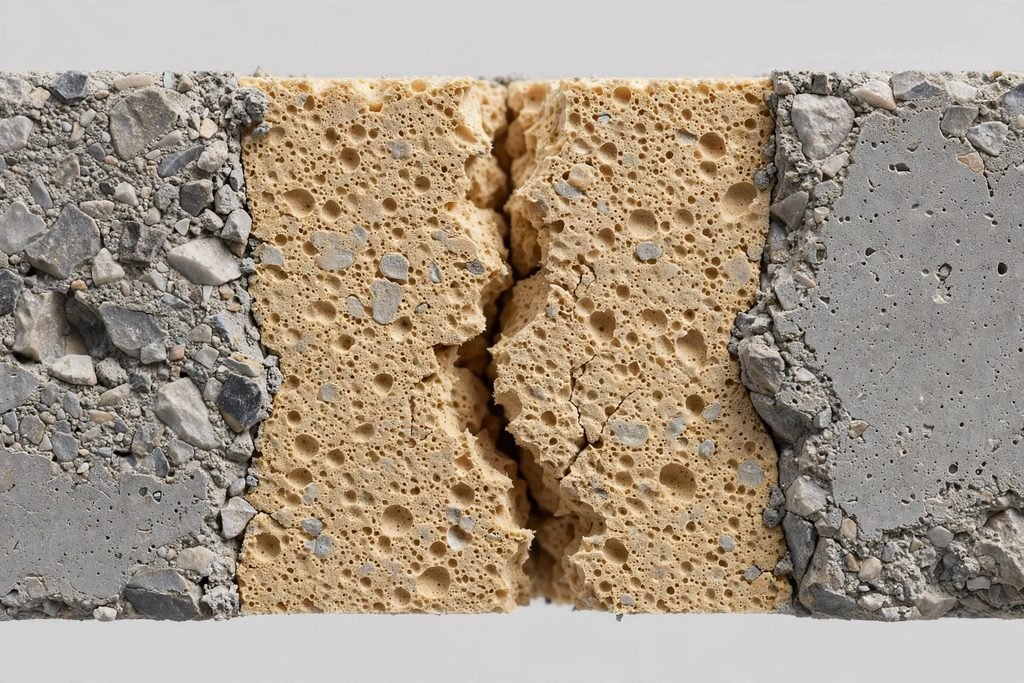
A resin that reacts with water to cure. Contact with moisture triggers a reaction that releases carbon dioxide, causing the resin to foam and expand, typically to several times its liquid volume, with some formulations expanding far more.
Two families exist. Hydrophobic polyurethanes repel water, cure into a dense closed-cell foam, and are dimensionally stable once cured. Hydrophilic polyurethanes absorb water into the cured foam, expand more aggressively, and conform tightly to irregular surfaces, but they can shrink if the crack later dries out completely. Hydrophobic is the more common choice for basement walls.
Viscosities are generally lower than epoxy, often under 200 centipoise, which helps penetration.
What it does
Polyurethane fills the crack and, because it expands, pushes into every irregularity, void, and side branch that a non-expanding resin would bridge over. In a foundation wall, the foam frequently extrudes slightly past the exterior face into the surrounding soil, forming a seal on the positive-pressure side of the wall.
That exterior-side seal is a genuinely valuable outcome. It is the closest thing to exterior waterproofing achievable without excavating.
Cured polyurethane remains flexible, with elongation capability typically in the tens of percent. It moves with the wall.
When polyurethane is the right choice
Any crack that is actively leaking. Water accelerates the cure rather than preventing it. This is the practical advantage that decides most basement jobs.
Cracks that move seasonally. Flexibility means the repair survives the soil moisture cycling that shears rigid repairs.
Cracks of irregular width or with voids. The foam fills what it finds.
When the objective is watertightness rather than strength. Which describes most residential basement crack repairs.
Emergency situations. Cure begins in minutes, and some formulations stop flowing water almost immediately.
Where polyurethane falls short
It provides no structural bond. The foam has low compressive and tensile strength and contributes nothing to the wall’s load-carrying capacity. If the crack needed structural restoration, polyurethane has not delivered it.
Hydrophilic formulations can shrink if the crack dries out for extended periods, potentially reopening a path.
Expansion needs control. Over-injection can waste large volumes of resin into voids behind the wall, and aggressive expansion in a confined crack can theoretically exert pressure. In practice this is a workmanship issue rather than a material flaw.
It is not a fix for the cause. Neither resin is, but the speed and ease of polyurethane makes it tempting to treat symptoms repeatedly.
Side by side
| Epoxy | Polyurethane | |
|---|---|---|
| Cure mechanism | Two-part chemical reaction | Reacts with water |
| Cured state | Rigid, harder than concrete | Flexible foam |
| Expands? | No | Yes, several times its volume |
| Works in a wet crack | Poorly | Yes, water aids the cure |
| Works in an actively leaking crack | No | Yes |
| Tolerates wall movement | No, concrete cracks beside it | Yes |
| Restores structural strength | Yes | No |
| Cure time | Hours to days | Minutes to hours |
| Seals the exterior face | No | Often, via foam extrusion |
| Typical use | Structural repair, dry dormant cracks | Water stopping, moving cracks |
| Cold weather performance | Slows significantly | Better tolerance |
| DIY friendly | Less, timing and dryness critical | More, forgiving of moisture |
Common scenarios and the right answer
Leaking vertical crack in a poured basement wall, house 30 years old. Polyurethane. Wet, likely to cycle seasonally, and the objective is water.
Dry shrinkage crack in a two-year-old foundation, builder warranty repair. Epoxy is defensible here since it is dry and dormant, though many contractors still use polyurethane for the flexibility margin. Either works.
Crack in a wall that an engineer has assessed as structurally compromised. Epoxy, to the engineer’s specification, and usually combined with carbon fiber or another reinforcement. The resin restores continuity; the reinforcement carries the ongoing load.
Horizontal crack with the wall bowing inward. Neither, not yet. Reinforcement comes first. Injecting a horizontal crack seals the water, hides the movement you should be measuring, and leaves the structural problem entirely unaddressed. Once the wall is stabilized, polyurethane can handle the water.
Crack in a concrete block wall. Neither. Injection is for solid poured concrete. In hollow block, resin disappears into the cores. Block leaks are handled with interior drainage, weep holes drilled into the bottom course, and exterior treatment.
Water at the wall-floor cove joint, driven by hydrostatic pressure. Neither. That water is under the slab and under pressure. Injecting the joint typically relocates the leak. Interior perimeter drainage is the answer.
Crack that reopened after a previous epoxy repair. The movement diagnosis was wrong. Investigate why the wall is moving, then repair with polyurethane once the cause is addressed.
Application quality matters more than resin choice
A well-executed polyurethane job outperforms a rushed epoxy job and vice versa. The variables that decide outcomes:
Surface preparation. Loose material, old caulk, paint, and previous hydraulic cement patches all have to come out first. Resin cannot travel through a crack that is plugged at the face.
Port spacing. Generally six to eight inches, roughly matched to wall thickness. Too far apart and resin does not bridge between them.
Surface sealing. The face of the crack between ports is sealed with a fast-setting paste so resin travels into the wall rather than out onto the floor. Inadequate surface sealing is the most common DIY failure.
Injection sequence. Start at the lowest port. Inject until resin appears at the next port up, which confirms travel. Cap and move up. Skipping this confirmation means you do not know whether the crack filled.
Injection speed. Slow. Pressure needs time to drive resin through the full depth. Fast injection blows resin out the face or into a void without filling the crack.
Temperature. Both resins slow in cold. Check the product’s minimum substrate temperature before working in an unheated basement in January.
Cost
Materials are broadly comparable, with epoxy typically slightly more expensive per unit volume, though polyurethane’s expansion means less material fills the same crack.
DIY kits: $60 to $150 for either, containing resin, ports, surface sealer, and a dispensing gun.
Professional: $400 to $900 per crack for either resin, varying with length, width, and access. Most of that is labour and warranty. Most reputable contractors warranty their injection work against that specific crack leaking again, often for the life of the structure, and that warranty is a substantial part of what you are buying.
A contractor quoting materially more for one resin than the other on the same crack is worth questioning.
Frequently asked questions
Can I use both on the same crack? Some structural repairs use polyurethane first to stop active water flow, then epoxy once the crack is dry, to restore strength. It is a legitimate two-stage approach but it doubles the labour and it is uncommon in residential work.
Which lasts longer? Both are essentially permanent when correctly applied to the right situation. Failures come from choosing the wrong resin for the conditions or from poor application, not from the materials degrading.
Is polyurethane a “lesser” repair? No, it is a different repair. For a leaking basement crack in a wall that moves with the seasons, it is the technically superior choice, and epoxy in that situation is the inferior one. The hierarchy people assume, that structural equals better, does not apply when the problem is water.
How do I know if my crack moves? Mark both ends with a pencil and the date, measure the width at two or three points, photograph it with a coin for scale, and re-check after three months and after a full wet spring. A $15 plastic crack monitor gauge gives precise readings. This costs nothing and it is the observation that determines the resin.
Does injection work on cracks in a basement floor slab? Yes, and polyurethane is usually the choice for stopping water coming up through the slab. Be aware that water entering through floor cracks means the water table is above your slab, and sealing individual cracks under pressure tends to relocate the leak. Drainage is often the more durable answer.
What about the low-cost injection kits sold in hardware stores? The paste-and-port kits are usually epoxy and are aimed at dry cracks. They can work on the right crack. Read whether the product tolerates moisture before using one on a basement wall that has ever been wet.
Does either resin fix the cause of the crack? No. Both seal a crack. Neither addresses saturated soil pressing on the wall, a settling footing, or a downspout dumping at the foundation. Fixing the drainage is what stops the next crack.
Can injection be done in winter? Yes, with attention to product temperature limits. Both resins slow substantially in cold, and most specify a minimum substrate temperature. Polyurethane generally tolerates cold conditions better.
The bottom line
Epoxy is glue. It welds a dry, dormant crack back into solid concrete and restores strength. Polyurethane is a gasket. It foams to fill a wet, moving crack, seals it through the full wall thickness, and flexes with the seasons.
Ask two questions about your crack. Is it wet, and does it move? Two yeses, or even one, points to polyurethane. Two noes, plus a genuine need to restore structural continuity, points to epoxy.
And whichever you inject, the crack got wet because water reached it from outside. Extend the downspouts and check the grading, or you will be reading this article again about the next crack over.