
You noticed a thin line in the basement wall. It is barely wide enough to catch a fingernail. You have now spent forty minutes reading about foundation failure and you are considerably more worried than you were an hour ago.
Here is the reassuring part: the large majority of hairline cracks in residential foundations are curing shrinkage, they appeared within the first two years of the building’s life, and they will not do anything for the next fifty years. They are so common that a poured concrete foundation without any is the unusual case.
Here is the part that requires actual attention: a small number of hairline cracks are early-stage evidence of something progressive, and width is a poor guide to which is which. This article gives you the five checks that separate them, and they take about twenty minutes.
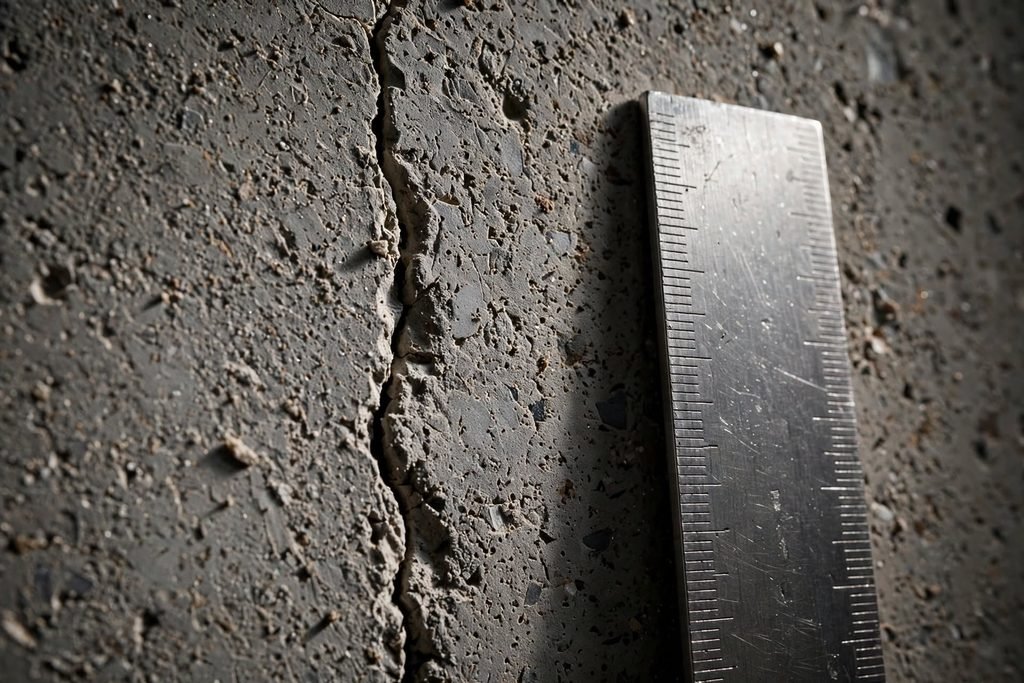
What counts as hairline
Roughly anything under 1/16 inch, which is about 1.5 millimetres. For reference points you already own:
- A sheet of paper is about 0.004 inches
- A credit card is about 0.03 inches
- A dime is about 0.05 inches
- A nickel is about 0.08 inches
If you cannot slide a credit card into it, it is comfortably hairline. If a nickel goes in, it is no longer hairline and it belongs in a different conversation.
A crack comparator card costs about $5 and removes the guesswork entirely. Feeler gauges work too.
Why most hairline cracks exist
Concrete is mixed with roughly twice as much water as the chemical curing reaction actually requires. The extra water is there purely for workability, so the mix can be poured, pumped, and worked around rebar.
As that excess water leaves over the following months and years, the concrete shrinks, on the order of 1/16 inch per 10 feet of length. But the wall cannot shrink freely. It is locked to the footing below and restrained by its own corners. Something has to relieve the stress, and the result is fine vertical cracks.
This is normal, expected, and understood by every structural engineer. It is not a defect in the sense of something having gone wrong. It is the material behaving as the material behaves.
Two consequences follow. Shrinkage cracks are usually vertical, because the shrinking happens along the wall’s length. And they are one-time events that stabilize once curing is complete, which is why a crack from 1994 is generally still the same size today.
The five checks
Work through these in order. Any single failure moves the crack from “monitor” to “get an opinion.”
Check 1: Which direction does it run?
This is the highest-value question and it takes two seconds.
Vertical or near-vertical: consistent with shrinkage or settlement. Usually benign.
Diagonal, especially from a window or door corner: settlement signature. Worth monitoring more carefully.
Horizontal: this is the one that matters. A horizontal crack, at any width including hairline, means soil pressure is bending the wall inward. The mechanism is progressive and the width today does not predict the width in five years. A hairline horizontal crack warrants a professional evaluation.
Stair-stepped through mortar joints in block: the masonry version of a diagonal crack. Check whether the courses are offset sideways.
Check 2: Are the faces offset?
Run a finger across the crack. Both sides should feel flush.
If one side protrudes past the other, the wall has moved out of plane rather than simply pulling apart. Offset means displacement, and displacement in a hairline crack is more concerning than width in a crack with no offset.
Also sight along the wall from a corner with your eye near the surface. Bulging or waviness that you would not notice head-on becomes obvious from that angle.
Check 3: Is it changing?
The single most useful thing you can do, and it costs nothing but patience.
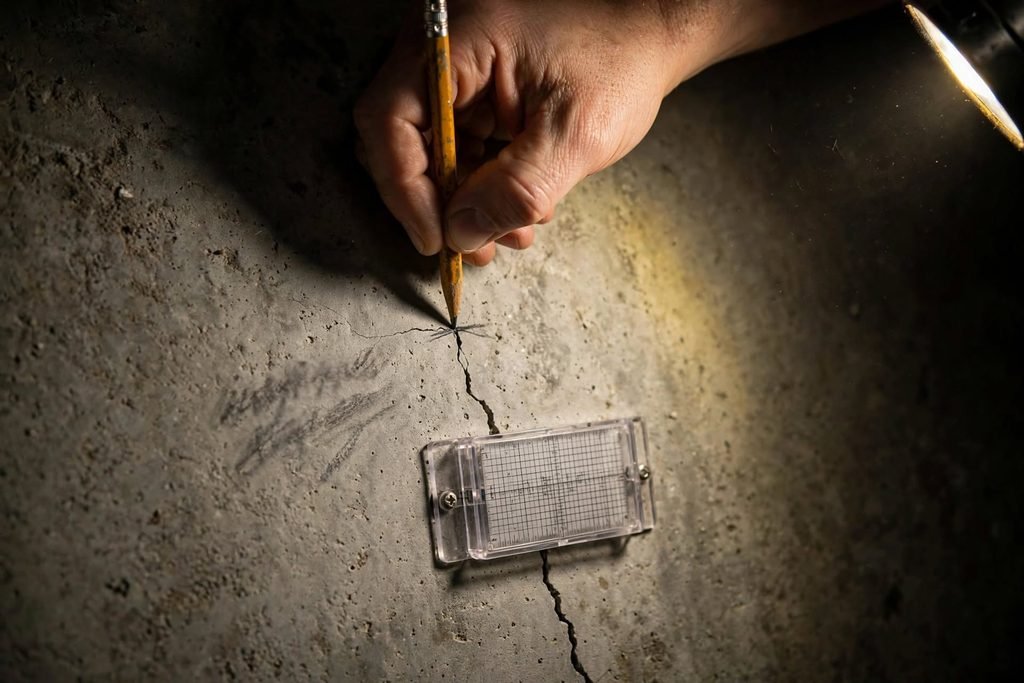
Mark both ends of the crack with a pencil line perpendicular to it and write the date. Measure and record the width at two or three points. Photograph it with a ruler or a coin in frame.
Then check again in three months, and again after a full wet spring, which is when foundations are under maximum load.
A crack that has not extended past your marks and has not widened is dormant. Dormant hairline cracks are not a problem. A crack that has grown is active, and active is what justifies spending money.
For precision, a plastic crack monitor gauge costs about $15, epoxies across the crack, and displays movement in millimetres on a printed grid.
Check 4: Does water come through it?
A hairline crack that stays dry is a cosmetic issue. A hairline crack that weeps during rain is a water problem, even if it will never be a structural one.
Look for a mineral trail, a rust-coloured or white streak running down from the crack, or efflorescence, the white chalky deposit that proves liquid water has moved through the masonry. Both mean water is using the crack as a pathway whether or not you have caught it in the act.
This does not make the crack dangerous. It makes it worth sealing, because chronic seepage causes mold, damages stored belongings, and over decades contributes to freeze-thaw deterioration of the concrete.
Check 5: What is happening elsewhere in the house?
Foundation movement rarely shows up in only one place. Walk the house and look for corroborating evidence:
- Doors or windows that have recently started sticking or failing to latch
- New gaps between walls and ceilings, or between baseboards and floors
- Floors that slope, testable with a marble or a long level
- Drywall cracks radiating from door and window corners upstairs
- A chimney separating from the exterior wall
- Cracked tile grout in a consistent line
A hairline crack alone is weak evidence. A hairline crack plus three sticking doors that started this year is a pattern.
Hairline cracks in new construction
If your house is under two years old, expect them. Primary shrinkage cracking during the first curing period is standard, and it is one of the more common warranty items.
Two things to do while you still have coverage:
Document and report it in writing. Photograph with dates, note the location, and send it to the builder before the warranty window closes. Most structural warranties run one to ten years depending on the item and jurisdiction, and water intrusion is typically covered in the shorter tier.
Do not let it be dismissed if it leaks. A dry shrinkage crack is normal. A shrinkage crack that admits water during rain is a legitimate defect claim, because the wall is not performing its function.
Builders will often say cracks under a certain width are within tolerance, and for dry cracks that is a fair position. Water changes the analysis.
When a hairline crack is not fine
Escalate to a structural engineer if any of these apply:
- It runs horizontally, regardless of width
- The faces are offset
- It has measurably grown across a season
- It appeared suddenly rather than gradually
- It is one of many cracks in a pattern across the wall
- It comes with sticking doors, sloping floors, or new drywall cracks upstairs
- It is in a block wall and stair-steps with horizontal displacement
- There is fresh debris or mortar dust at the base of the wall
- Water enters under noticeable pressure rather than seeping
An engineer’s evaluation runs $400 to $800 and comes with no financial interest in the repair, which is exactly why it is worth paying for before accepting a five-figure quote from a company that sells the solution.
What to do with a benign hairline crack
If it is dry and stable
Nothing is a legitimate answer. Mark it, date it, photograph it, and check it once a year. Cosmetic filling with a flexible masonry crack filler is optional if the appearance bothers you.
If it leaks
Seal it, and the method matters.
Polyurethane injection is the appropriate repair for a hairline crack that admits water. The resin foams on contact with moisture, penetrates the full depth of the wall, and stays flexible so seasonal movement does not immediately reopen it. Professionally, $400 to $900. DIY kits run $60 to $150 and work reasonably on straightforward vertical cracks, though achieving full-depth fill takes patience.
Epoxy injection creates a rigid bond stronger than the surrounding concrete. It is the right choice where structural continuity needs restoring, but it requires a genuinely dry crack and it will crack again alongside the repair if the wall moves.
What not to use: surface caulk, which bonds to only the outer fraction of an inch and peels off from behind under water pressure. Hydraulic cement troweled over the face, which is rigid and simply cracks alongside the patch on any moving crack, though it is excellent for stopping an actively gushing leak in an emergency. Waterproof paint over the crack, which hides the evidence you need for monitoring and fails under pressure.
Fix the drainage regardless
Whatever you do to the crack, water is what turns benign cracks into leaking ones and what drives the soil pressure behind serious ones. Clean the gutters, extend every downspout six to ten feet, and check that soil slopes away from the house at least six inches over the first ten feet. That work costs a few hundred dollars and reduces the load on your foundation more than any repair to the wall itself.
The cost of waiting versus the cost of overreacting
Both errors are real, and both are common.
Overreacting means paying $12,000 for drainage and reinforcement because a salesperson looked concerned about a dormant shrinkage crack. This happens frequently, and the industry has a documented problem with high-pressure sales on exactly this anxiety.
Waiting too long means letting an active crack grow from a $600 injection into a $25,000 structural repair, or letting chronic seepage rot a sill plate.
The monitoring protocol resolves both. Marking a crack and watching it through one wet season costs nothing and gives you actual evidence rather than a guess. Very few foundation situations get meaningfully worse in three months, with the exception of an actively bowing wall, which the string-line test will reveal immediately.
Frequently asked questions
How common are hairline foundation cracks? Extremely. Shrinkage cracking is essentially universal in poured concrete foundations, and most homes have several. Inspectors note them routinely without flagging them as defects.
Will a hairline crack get bigger over time? A shrinkage crack typically stabilizes once curing completes and stays the same for decades. A crack caused by ongoing settlement or soil pressure will grow. Monitoring is how you tell them apart.
Should I fill a hairline crack that is not leaking? Not necessarily. Filling it prevents you from seeing whether it moves, which is diagnostic information worth keeping. If appearance matters, use a flexible filler and keep your dated photographs.
Does a hairline crack affect my home’s value or sale? A dormant, dry hairline crack is a routine inspection finding that rarely affects a sale. Active cracking, water intrusion, or evidence of structural movement does, and past water problems must be disclosed in most states. Documented repairs with transferable warranties are generally accepted well by buyers.
Can I ignore a hairline crack in a block wall? Block deserves closer attention than poured concrete, because mortar joints fail before the units do and block walls resist lateral pressure less effectively. A hairline crack following a horizontal mortar joint in a block wall is worth an evaluation.
My foundation crack changes with the seasons. Is that normal? Some seasonal opening and closing is common, particularly in expansive clay soils that swell when wet and shrink when dry. What matters is the net trend over years, not the seasonal cycling. This is where a crack monitor gauge earns its cost.
Is a hairline crack in a concrete floor slab a problem? Basement slabs are usually non-structural, poured over gravel as a wearing surface rather than as a load-bearing element. Shrinkage cracks in them are near-universal and generally cosmetic. The exception is a crack with vertical displacement, where one side sits higher than the other, which indicates soil movement beneath.
How long should I monitor before deciding? A minimum of one full seasonal cycle, including a wet spring, because that is when foundations are under maximum load. Three months of dry summer proves very little.
The bottom line
Most hairline foundation cracks are the concrete telling you it finished curing. They are vertical, they are dormant, they appeared decades ago, and they will still be exactly that width when you sell the house.
Run the five checks anyway. Direction first, because a horizontal hairline crack is a different animal entirely. Then offset, then movement over a season, then water, then the rest of the house. Twenty minutes with a pencil and a phone camera gives you real evidence, and real evidence is what protects you from both spending five figures you did not need to and ignoring the one crack that mattered.