
Concrete looks permanent. It is not, and in cold climates the thing dismantling it is not weight or age but a repeated cycle of water freezing inside it.
Water expands about 9 percent when it turns to ice. Concrete is full of microscopic pores, those pores fill with water, and each freeze drives the pore walls apart from within. One cycle does nothing measurable. Sixty cycles a year for thirty years takes the surface off.
Understanding the mechanism matters because it explains why some concrete lasts eighty years and some fails in twelve, and why the most common “fix” — a film-forming sealer — sometimes accelerates the damage.
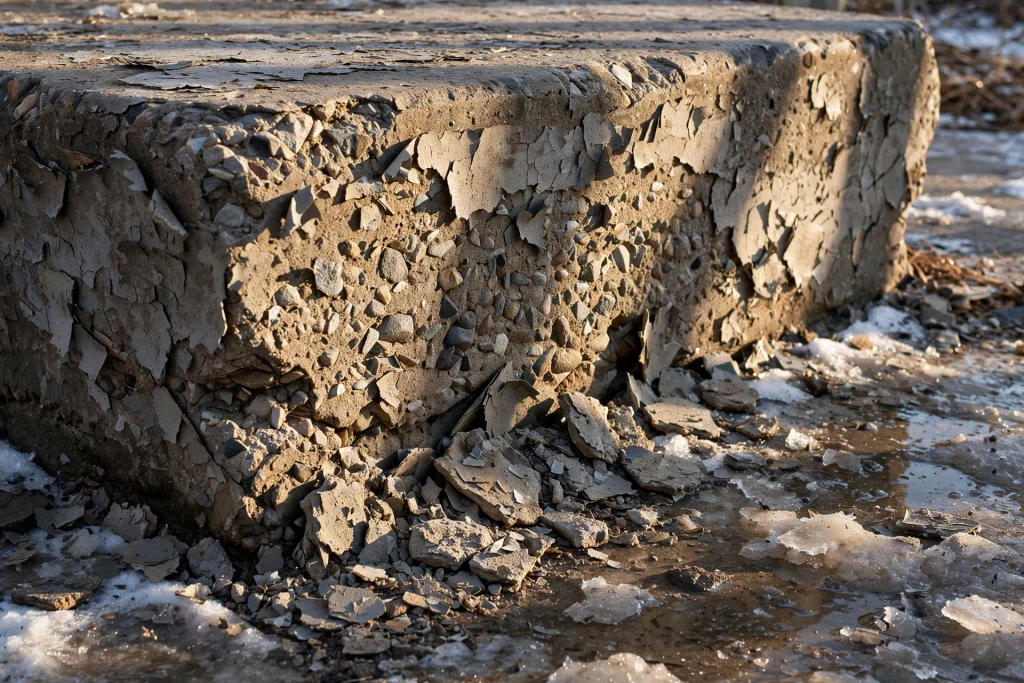
The mechanism
Why the pores are there
Concrete is mixed with roughly twice as much water as the curing reaction needs, purely so it can be poured and worked. As that excess evaporates over months and years, it leaves behind a network of interconnected capillary pores.
Those pores fill with water from rain, snowmelt, and ground moisture wicking up through the slab.
What happens at freezing
The simple version is that the water expands and pushes. The more accurate version is that as ice forms in the larger pores, it forces the remaining unfrozen water out ahead of it through the narrow capillaries. That forced flow generates hydraulic pressure inside the concrete, and it is that pressure — more than the raw expansion — that fractures the paste.
The critical saturation threshold
Concrete only suffers freeze-thaw damage when the pores are more than roughly 91 percent saturated. Below that, there is enough empty pore space for expanding ice and displaced water to move into.
This is the single most important practical fact in this article. Concrete that stays reasonably dry survives freezing indefinitely. Concrete that stays wet does not.
Which reframes freeze-thaw as a drainage problem more than a temperature problem.
Air entrainment
Modern concrete for exterior use in cold climates contains entrained air — deliberately introduced microscopic bubbles, typically 4 to 8 percent by volume, spaced closely enough that pressurised water always has a nearby void to escape into.
Properly air-entrained concrete is dramatically more freeze-thaw resistant. Concrete without it, which includes most older residential flatwork and a good deal of poorly specified newer work, is not.
You cannot add air entrainment after the fact. It is decided at the batch plant.
Damage types
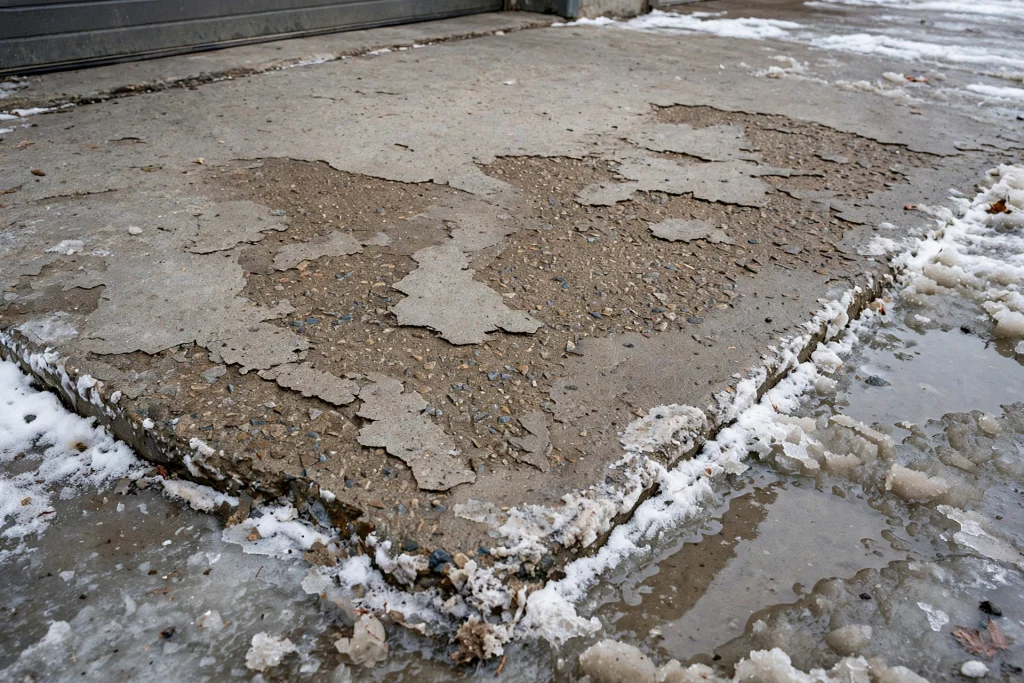
Scaling. The surface flakes away in thin layers, exposing sand and then aggregate. Usually starts as small patches and spreads. Strongly associated with de-icing salts.
Spalling. Larger chunks break away, often around edges, joints, and corners. Deeper than scaling.
Pop-outs. Small conical craters where a single porous aggregate particle near the surface absorbed water, froze, and blew out.
D-cracking. A pattern of fine cracks paralleling joints and edges, caused by aggregate itself failing under freeze-thaw. Difficult and expensive to address.
Mortar deterioration. In block and brick, mortar joints soften, powder, and recede before the units themselves fail. This is why block foundations show damage earlier than poured walls.
Crack widening. Existing cracks fill with water, which freezes and levers them wider each winter. This is one route by which a stable hairline crack becomes a leaking crack that needs injection.
The de-icing salt problem
Salt makes freeze-thaw damage substantially worse, by more than one mechanism.
It increases the number of cycles. Salt lowers the freezing point, so concrete that would have stayed frozen instead thaws and refreezes repeatedly.
Salt crystallisation. Salt drawn into the pores crystallises and exerts its own pressure, independent of ice.
Osmotic pressure. Salt concentration gradients within the pore structure drive additional water movement and pressure.
Rebar corrosion. Chloride penetrating to reinforcing steel causes it to rust, and rust occupies several times the volume of the original steel. That expansion cracks the concrete from within. This is the mechanism that destroys bridge decks and parking structures, and it operates on garage slabs and steps as well.
Practical guidance:
- Never use de-icing salt on concrete less than one year old. New concrete has not finished curing and is far more vulnerable.
- Use sand for traction rather than salt where possible.
- Where melting is genuinely needed, calcium magnesium acetate (CMA) is far less damaging than sodium or calcium chloride, though more expensive.
- Avoid ammonium sulfate and ammonium nitrate entirely; they chemically attack concrete.
- Keep salt off anything within a few feet of the foundation.
Where it shows up
Steps and stoops. Horizontal surfaces that collect water and snow, often poured with poor drainage and heavily salted.
Garage aprons and driveways. Salt-laden snow drips off vehicles and pools.
The top of the foundation wall, where it is exposed above grade and takes direct precipitation.
Patios and walkways, especially where they slope back toward the house and hold water.
Basement window wells, which collect water at concrete level.
Retaining walls.
Anywhere with poor drainage. The pattern is consistent: damage tracks wetness, not temperature.
The number of freeze-thaw cycles per year varies enormously by region — from a handful in the Deep South to well over 100 in parts of the mountain west and northern plains, where daily temperature swings cross freezing repeatedly.
Prevention
1. Keep the concrete dry — the biggest lever
Since damage requires roughly 91 percent saturation, drainage does more than any product.
Extend downspouts six to ten feet so roof runoff is not soaking the concrete beside the house.
Pitch flatwork away from the house at about 1/4 inch per foot, and eliminate low spots that pond.
Keep snow piled well back from concrete surfaces, and away from the foundation generally.
Fill joints and cracks so water is not being funnelled into the interior of the slab.
2. Use a penetrating sealer, not a film-forming one
This distinction matters and it is frequently gotten wrong.
Penetrating sealers — silane and siloxane based — soak into the concrete and line the pores, making them water-repellent while still allowing vapour to escape. They do not change the appearance. Reapply every 3 to 5 years. This is the right choice for exterior concrete in a freeze-thaw climate.
Film-forming sealers — acrylics, epoxies, urethanes — sit on the surface as a coating. They look glossy and they can trap moisture beneath the film. On exterior concrete that is being wetted from below by ground moisture, that trapped water then freezes under a sealed surface, and the sealer can accelerate scaling rather than prevent it.
Cost for penetrating sealer: roughly $0.25 to $1 per square foot for materials, DIY.
3. Specify correctly for new work
If you are pouring: air-entrained concrete at 4 to 8 percent for exterior use, a low water-to-cement ratio around 0.45 or lower, minimum 4,000 psi for flatwork in cold climates, proper curing for at least seven days, and adequate slope for drainage. And no salt for the first winter.
Repair
Surface scaling, minor. Clean, then apply a polymer-modified overlay or resurfacer, $3 to $8 per square foot. Adhesion depends entirely on preparation, so the surface must be sound and properly profiled.
Spalling, localised. Saw-cut the perimeter of the damaged area, remove to sound concrete, and patch with a bonding agent and repair mortar. $10 to $30 per square foot.
Extensive damage. Replacement is often more economical than repeated patching. Steps in particular are frequently better replaced than resurfaced.
Cracks. Polyurethane injection for cracks that leak, flexible sealant for movement joints. Rigid patching on a moving crack simply cracks alongside the repair.
Mortar joints. Tuckpointing, $10 to $25 per square foot. Use mortar matched in strength to the original — mortar harder than the surrounding units transfers stress into the units, which then crack instead.
In every case, correct the drainage first. Repairing concrete while it stays saturated means repairing it again.
Frequently asked questions
How many freeze-thaw cycles does it take? There is no fixed number. Air-entrained concrete kept reasonably dry can survive hundreds of cycles. Non-air-entrained concrete kept saturated can show damage within a few winters.
Why is my neighbour’s driveway fine and mine is flaking? Most likely a difference in air entrainment, water-cement ratio, curing quality, or drainage. Concrete quality varies enormously between pours.
Will sealing stop existing damage? It slows further deterioration by keeping water out. It does not restore what has already gone, and applied over a badly scaled surface it will not adhere well.
Is spalling a structural problem? On flatwork, usually cosmetic and progressive. On a foundation wall, extensive spalling reduces effective thickness and warrants a professional look, particularly alongside cracking or bowing.
Can I use salt on my driveway? Not on concrete under a year old, and preferably not at all. Sand for traction, or CMA where you must melt. Chloride salts do real, cumulative damage.
Does freeze-thaw affect basement walls? Below grade, less, because the soil moderates temperature and the wall rarely freezes. The top portion above grade is exposed and does suffer, and saturated block walls are notably vulnerable.
What is air-entrained concrete and do I have it? Concrete with deliberately introduced microscopic air bubbles that give pressurised water somewhere to go. You cannot tell by looking; check the original pour documentation if it exists, or assume older residential flatwork does not have it.
When should I seal new concrete? After it has fully cured, typically 28 days, and check the specific product’s requirements. Then reapply penetrating sealer every 3 to 5 years.
The bottom line
Freeze-thaw damage needs three things: porous concrete, water filling those pores past about 91 percent saturation, and temperatures crossing freezing. You cannot change the concrete you already have and you cannot change the weather.
You can change how wet it stays. Drainage, slope, downspout extensions, and keeping snow piles off the concrete do more than any product on a shelf.
Then use a penetrating silane or siloxane sealer rather than a glossy film-forming one, and keep chloride de-icers off entirely. Concrete that stays dry survives winters more or less indefinitely. Concrete that stays wet does not survive many.