
Snow does not look like water, which is exactly the problem. It sits around a house all winter looking inert, and homeowners pile more of it against the walls without a second thought.
Then it melts, and a season’s worth of precipitation is released into the soil over a few days — much of it exactly where the shovel put it.
This article is about snow as a material: how much water it holds, where it collects, what it does to a foundation, and the handful of decisions during winter that determine how much of it ends up inside.
The water in snow
The measure is snow water equivalent (SWE) — how much liquid water a given depth of snow contains.
| Snow type | Ratio | 24 inches of snow equals |
|---|---|---|
| Light, dry, cold powder | 15:1 to 20:1 | 1.2 to 1.6 inches of water |
| Typical winter snow | 10:1 | 2.4 inches of water |
| Wet, heavy spring snow | 4:1 to 6:1 | 4 to 6 inches of water |
Put that in gallons. A 5,000 square foot yard under two feet of typical snow holds roughly 7,500 gallons of water. Wet spring snow at the same depth can hold double that.
An inch of rain rarely causes problems because it falls over hours and spreads across the whole property. A snowpack releases the equivalent of several inches over a few days, concentrated wherever the snow happened to be sitting.
Where snow accumulates, and why it matters
Drifts on the lee side
Wind deposits snow on the sheltered side of a building. Whichever side that is on your house consistently receives more than its share, and it melts into the same soil every year.
Roof shed
Snow sliding off a pitched roof lands in a line a few feet from the wall — directly in the backfill zone, the loose soil that was replaced when the house was built and that drains faster than the ground around it.
Metal roofs shed dramatically and can deposit the entire roof plane’s snow load in one place.
Shovelled and plowed piles
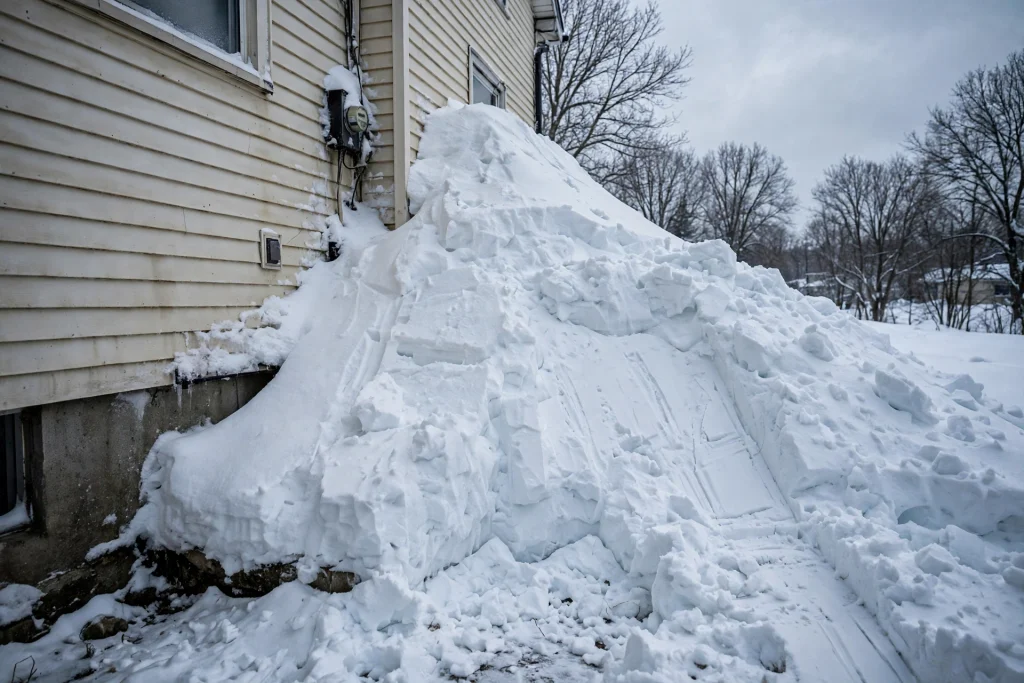
The one you control, and the one most often gotten wrong. Snow cleared from walkways and driveways gets pushed to the nearest convenient spot, which is frequently against the house.
A plowed pile against a foundation wall is thousands of gallons queued up to enter your backfill.
Ice dams at the eaves
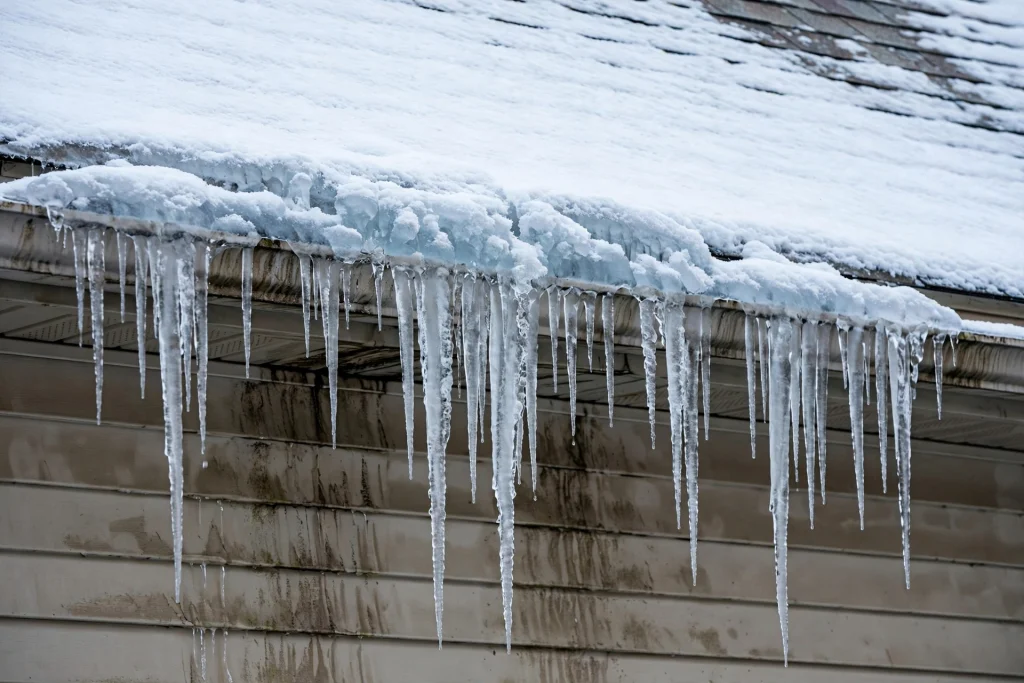
Heat escaping into the attic melts roof snow. The meltwater runs down to the cold eave and refreezes, forming a dam. Water backs up behind it, overflows the gutter, and pours down the wall in a concentrated stream.
The root cause is attic insulation and ventilation, not the gutter. The consequence at ground level is roof runoff delivered exactly where gutters exist to prevent it.
Window wells
Wells fill with drifted snow all winter. During a thaw, that snow melts into a well whose drain may still be frozen. Covers solve this for $40 to $200.
What melting snow does to a foundation
It saturates the backfill. Water enters the loose soil beside the wall, builds hydrostatic pressure, and finds any crack, pore, or joint available.
It runs across frozen ground instead of soaking in. Frozen soil absorbs almost nothing, so meltwater travels the surface toward the lowest point, which is often the settled soil against your house. This is the central mechanism behind spring thaw flooding.
It refreezes and expands. Meltwater that soaks into concrete during the day and freezes at night drives freeze-thaw damage — spalling, scaling, and mortar deterioration.
It contributes to frost heave. Water in the soil is what feeds the ice lenses that lift porches, steps, and slabs. The mechanism is here.
It erodes. Repeated meltwater channels cut grooves in the soil beside the wall, gradually undoing your grading.
It carries de-icing salt into the soil and onto the concrete. Chloride salts accelerate concrete scaling and corrode any reinforcing steel they reach.
The one thing snow does that helps
Snow insulates. A consistent snow cover moderates soil temperature and reduces frost penetration. A cold winter with heavy snow often produces less frost damage than a milder winter with bare ground, because the bare ground freezes deeper.
So snow is not purely a liability. It is a liability where it sits against the house and where it melts faster than the ground can take it.
Snow management during winter
Keep three to six feet of clearance around the perimeter
The highest-value action available, and it costs nothing but time. After each significant snowfall, clear a band around the foundation. Meltwater then has somewhere to go other than straight down your wall.
Pile snow downhill and well away
At least 10 feet from the house, and on the downhill side where possible. Tell whoever plows your driveway where to put it — plow operators default to the nearest edge, and that is frequently the house.
Rake roof snow at the eaves
A roof rake used from the ground clears the lower few feet of the roof, which is where ice dams form. Do not climb onto a snowy or icy roof. Falls are the real hazard here, not the ice dam.
Keep the sump discharge outlet clear
Check it after every snowfall and every thaw. A pump discharging into a blocked or frozen line overheats and can burn out, and it is the most common spring pump failure.
Clear window wells and keep covers on
Watch for ice dams forming
Icicles along the eaves are the warning sign. The permanent fix is air sealing and insulating the attic floor, not heat cable.
Do not use rock salt near the foundation
Sodium chloride accelerates concrete scaling and corrodes rebar. Use sand for traction, or calcium magnesium acetate (CMA) where melting is genuinely required, particularly on newer concrete and anywhere adjacent to the foundation.
Autumn preparation
Everything is easier before the ground freezes.
Clean the gutters after leaf fall, so ice does not form in packed debris.
Use rigid downspout extensions with continuous fall so they drain fully rather than holding water that freezes. Six to ten feet minimum.
Fix the grading while the soil is workable. Six inches of fall in the first ten feet.
Fit an ice guard on the sump discharge — a slotted section near the exit that lets water escape if the downstream line ices up.
Test the sump pump and add a battery backup if you do not have one.
Air seal and insulate the attic floor if you get ice dams. This is the actual fix.
Install window well covers.
The complete list is in how to prepare a basement for winter.
Frequently asked questions
How much water is in a foot of snow? Roughly 1.2 inches for typical snow at a 10:1 ratio. Wet spring snow can be 2 to 3 inches per foot.
Is snow against the house actually a problem? Yes, when it melts. It delivers a concentrated volume of water into the loose backfill soil beside your wall, at the time of year when frozen ground can absorb the least.
Where should I pile shovelled snow? At least 10 feet from the foundation, downhill where possible, and away from window wells and the sump discharge outlet.
Does snow on the roof damage the foundation? Not directly, but roof snow shedding or melting into gutters concentrates a large volume of water near the wall. Roof snow load is a separate structural concern on flat or low-slope roofs.
Should I remove all the snow from around my house? A three to six foot clear band around the perimeter is the practical target. Snow further out is largely fine and provides useful soil insulation.
Do ice dams cause basement water? Indirectly and reliably. Water backing up behind the dam overflows the gutter and pours down the wall into the soil at the foundation.
Is rock salt bad for my foundation? Yes. Chloride accelerates concrete scaling and corrodes reinforcing steel. Sand for traction, or CMA where melting is required. Keep salt off newer concrete entirely.
Why is my basement wetter in a mild winter than a cold one? Mild winters produce repeated thaw cycles, each releasing meltwater onto ground that is still frozen underneath. A consistently cold winter locks the water up until one melt event.
The bottom line
Snow is water in storage, and a typical yard holds thousands of gallons of it. What determines whether that ends up in your basement is largely where it was sitting when it melted.
So the winter version of foundation maintenance is simple and physical: keep a three to six foot band clear around the walls, pile everything at least ten feet away and downhill, tell the plow driver the same, check the sump discharge after every storm, and keep salt off the concrete.
None of that costs money. It just has to happen before March, when the ground is frozen solid and every gallon runs to the lowest point it can find.