
The usual answer is 7 to 10 years, and it is roughly right. But it hides an enormous range. Some pumps die at three. Others run for fifteen.
The difference is almost never the brand. It comes down to how many times the pump starts, how much water it moves, whether a failed check valve has been quietly short-cycling it for two years, and whether anyone has cleaned the pit since it was installed.
More usefully: age is the single best predictor of failure, and a pump that fails on your schedule costs a few hundred dollars while a pump that fails on its own schedule costs a basement.
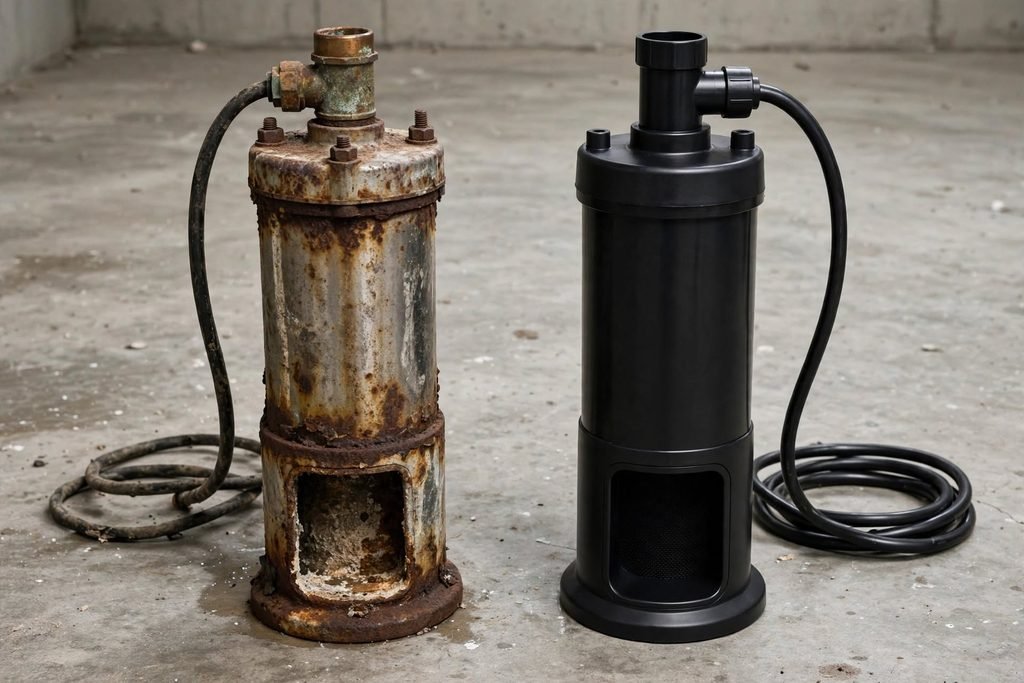
Typical lifespans by type
Submersible pumps: 7 to 10 years. The motor sits sealed in an oil-filled housing underwater. Quieter and more compact, but the motor operates in a harsher environment and seals eventually fail.
Pedestal pumps: 10 to 15 years. The motor sits on a column above the pit with only the intake submerged. Noisier and more visible, but the motor never sits in water, which is a genuine longevity advantage. Their weakness is that they handle debris poorly and do not suit narrow pits.
Battery backup pumps: 5 to 10 years for the pump, though they run rarely so the limiting factor is usually the battery. Batteries need replacement every 3 to 5 years for flooded types and 4 to 6 for AGM.
Water-powered backups: 10 to 15 years. No motor, no electrical components, very few wearing parts.
Combination units: 7 to 10 years, limited by the primary pump inside them.
Note that manufacturers rate pumps by cycles, not years. A typical residential pump is designed for somewhere in the range of 30,000 to 100,000 cycles. A pump cycling four times a day reaches 30,000 cycles in about twenty years. A pump cycling every three minutes during a wet season burns through them far faster.
What actually determines lifespan
Cycle count, not runtime
This is the point most homeowners get backwards. Motors are not worn out by running; they are worn out by starting.
Every start draws a current surge several times the running current and generates heat in the windings. A pump that runs for 20 seconds forty times an hour experiences dramatically more stress than one that runs for ten minutes twice an hour, even though total runtime is comparable.
Which makes short-cycling the leading preventable cause of early failure. The usual culprits are a failed check valve returning water to the pit, a discharge line terminating too close to the house so water recirculates, or a float set for too short a draw-down. All three are cheap to fix and all three quietly halve the life of a pump. If yours cycles frequently in dry weather, work through the causes before you accept it as normal.
Water volume and water table
A pump in a house with a high water table and clay soil may cycle thousands of times a season. The same model in a well-drained lot may cycle a few hundred times a year. The first will fail years earlier and there is nothing wrong with it.
Build quality
Cast iron housings dissipate heat far better than plastic and hold up substantially longer under frequent cycling. This is one of the few specification differences that reliably correlates with lifespan.
Stainless steel or cast iron impellers outlast plastic ones in gritty water.
Switch type matters more than people expect. Float switches are the most commonly failing component in the whole system. Electronic and diaphragm switches generally outlast mechanical floats. Tethered floats snag; vertical floats cycle more often.
Sediment and debris
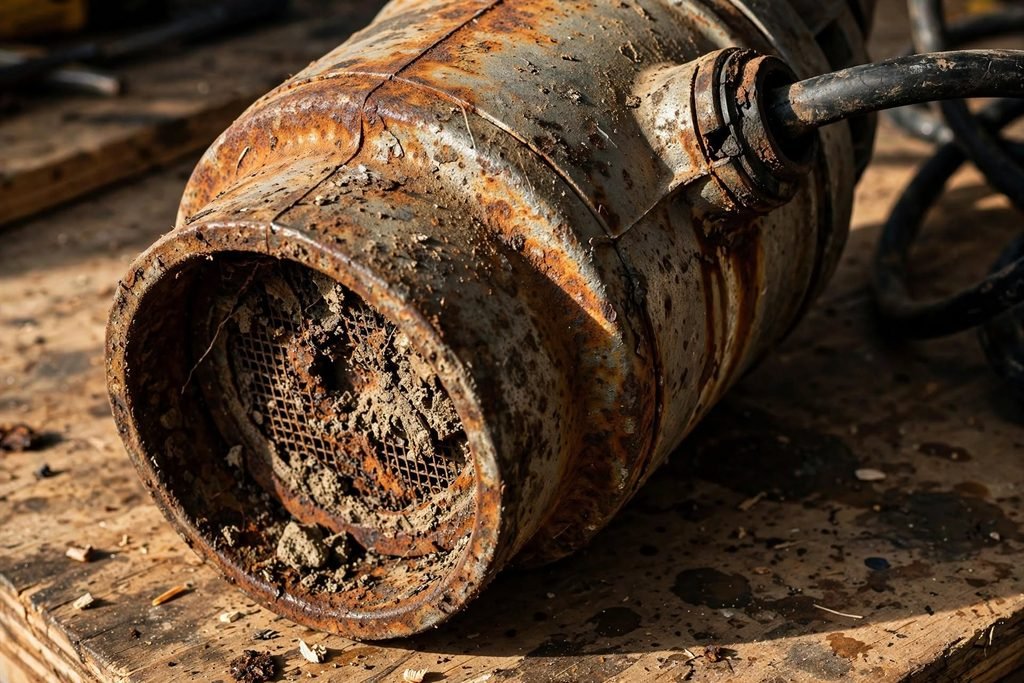
Silt, gravel, and sand abrade the impeller, clog the intake, and force the motor to work harder. A pit that has never been cleaned is a pit shortening its pump’s life continuously.
Correct sizing
Oversized pumps short-cycle because they empty the pit in seconds. Undersized pumps run continuously and overheat. Both fail early. The right size handles your inflow with cycles of roughly 10 to 30 seconds.
Installation quality
A missing weep hole causes airlocking. A missing or backwards check valve causes short-cycling. A pump sitting directly on the pit floor draws sediment straight into the intake. A discharge line with too many elbows increases the head the pump works against. None of these are the pump’s fault and all of them shorten its life.
The warning signs
Any two of these together justify replacement rather than repair.
Age past 7 years for a submersible, 10 for a pedestal. Even a pump that seems fine.
Visible rust on the housing or motor casing, particularly at seams and around the cord entry.
Changed sound. Grinding, rattling, screeching, or a distinctly different pitch than it used to make. Bearings and impellers announce themselves.
Excessive vibration, to the point the pump moves around the pit.
Longer cycles for the same volume. If it used to clear the pit in 15 seconds and now takes 40, output has dropped.
Frequent short cycling that is not explained by a check valve or discharge issue.
Intermittent failures to start that resolve when you jiggle the float. The switch is dying.
Visible motor oil in the pit water, which indicates a seal failure in a submersible.
It ran during a flood and survived. Pumps that have been pushed to their limit frequently fail shortly afterward.
You will only notice most of these if you are actually looking, which is the argument for testing quarterly with a bucket of water.
Repair or replace?
Sump pumps are generally not economical to rebuild. The calculation is simple.
Worth fixing:
- Float switch failure on a pump under 5 years old, $20 to $60 for the part
- A clogged impeller that cleans up and runs normally
- Check valve failure, which is a system part rather than a pump part, $15 to $40
- Discharge line blockage
Not worth fixing:
- Motor failure at any age
- Seal failure with oil in the water
- Worn or eroded impeller vanes
- Anything on a pump past 7 years
- A pump that has failed twice in two years
The rule of thumb: if the repair costs more than about half the price of a new pump, or if the unit is past 7 years, replace it. A new pump is $120 to $400, and the labour to diagnose and repair an old one often approaches that.
The case for proactive replacement
Replace on age, not on failure. The reasoning is straightforward.
A planned replacement is a $150 pump and an hour on a dry Saturday, or $400 to $900 if you have someone do it.
An unplanned failure happens during a storm, at night, when the power may also be out. It costs the same pump, plus emergency service rates, plus water extraction at $1,000 to $4,000, plus whatever was on the floor, plus the mold risk if it sat wet for 48 hours. And most homeowners policies exclude sump pump failure unless you carry a specific endorsement.
The asymmetry is enormous. Replacing a functional 8-year-old pump feels wasteful right up until the year you do not.
Practical habit: write the installation date directly on the pit lid with a permanent marker. Most homeowners have no idea how old their pump is, which makes the single best predictor of failure invisible to them.
What a replacement costs
| Item | Range |
|---|---|
| Pump, DIY purchase | $120 to $400 |
| Pump, professionally installed | $400 to $900 |
| Check valve | $15 to $40 |
| Float switch | $20 to $60 |
| New pit where none exists | $1,200 to $3,000 |
| Battery backup system | $600 to $1,500 |
| Water-powered backup | $800 to $2,000 |
| High-water alarm | $25 to $200 |
Replacing an existing pump in an existing pit is reasonable DIY work for someone comfortable with basic plumbing and electrical safety. Creating a new pit means cutting the slab, excavating beneath it, and penetrating the foundation, which is professional work and often requires a permit.
How to make yours last longer
Fix short-cycling. The highest-value intervention available. Check the check valve, confirm the discharge terminates well away from the house, and increase the float draw-down if the switch allows.
Clean the pit annually. Remove silt, gravel, and debris. A shop vac makes it a ten-minute job.
Keep the pump off the pit floor on a brick or a purpose-made stand so it does not draw sediment directly into the intake.
Use a sealed, gasketed lid. Keeps debris out, reduces basement humidity, and blocks soil gases.
Verify the weep hole is present and clear, so the pump cannot airlock.
Buy cast iron when replacing. The heat dissipation genuinely extends life.
Size it correctly. Match the pump to your inflow and head height rather than buying the largest one available.
Reduce the water arriving. The most overlooked step and possibly the most effective. Every gallon that never reaches the pit is a cycle the pump never has to run. Extending downspouts, cleaning gutters, and correcting the grading around the foundation can cut cycle counts substantially, which extends pump life while also reducing the pressure pushing water through your foundation walls.
Test quarterly. You cannot notice gradual decline in something you never observe.
Frequently asked questions
How do I know how old my sump pump is? Check for a date code or serial number on the housing, which manufacturers often encode with a year. Look at closing documents or a home inspection report if you bought the house. If you cannot establish the age and the pump looks worn, assume it is old and budget accordingly.
Do more expensive pumps last longer? Somewhat, and the reason is specific rather than general. Cast iron housings, better switches, and better impeller materials genuinely extend life. Brand prestige alone does not. Look at the materials, not the price.
Should I replace the pump when I sell the house? A recent replacement with documentation is a small, cheap positive in an inspection. An obviously rusted pump of unknown age invites a repair request or a price concession, usually for more than the pump costs.
Is a backup pump a substitute for replacing an old primary? No. The backup is for outages and unexpected failures, not for covering a primary you know is at the end of its life. Running a dying primary with a backup as a crutch just means the backup carries load it was not designed for.
My pump is 12 years old and works perfectly. Should I replace it? Yes. It is well past typical service life and its failure is a matter of when. A pump that has worked for 12 years has also had 12 years of wear you cannot see.
Does a pump that rarely runs last longer? Fewer cycles help, but disuse creates its own problems: seals dry, impellers seize with hardened silt, and switches stick. A pump in a pit that stays dry still ages and still needs quarterly testing.
What is the most common part to fail? The float switch, by a clear margin. Many pumps sent to landfill had a perfectly good motor and a $30 switch problem, which is why it is worth diagnosing before replacing on a newer unit.
How long do sump pumps last in a high water table? Often 3 to 5 years rather than 7 to 10, because cycle counts are so much higher. In those situations, plan on more frequent replacement and consider a pedestal pump or a cast iron submersible.
The bottom line
Seven to ten years for a submersible, ten to fifteen for a pedestal, with an enormous range on either side driven mostly by cycle count. Short-cycling from a failed check valve or a discharge line that returns water to the soil is the leading preventable cause of early death.
The practical takeaway is unglamorous: write the install date on the pit lid, test with a bucket four times a year, clean the pit annually, and replace on age rather than waiting for failure. A pump you replace on a dry Saturday costs a few hundred dollars. A pump that replaces itself during a storm costs considerably more, and most insurance policies will not help.