
The motor is humming. The pit is not emptying. Or it empties, then refills thirty seconds later and does it again, over and over, all night.
This is one of the most common sump pump complaints and it is also one of the most fixable. In the large majority of cases the pump itself is fine. Something in the system around it is either sending the same water back, blocking its exit, or telling it to run when it should not.
Work through these in order. The first four cost between nothing and forty dollars, and they solve most cases.
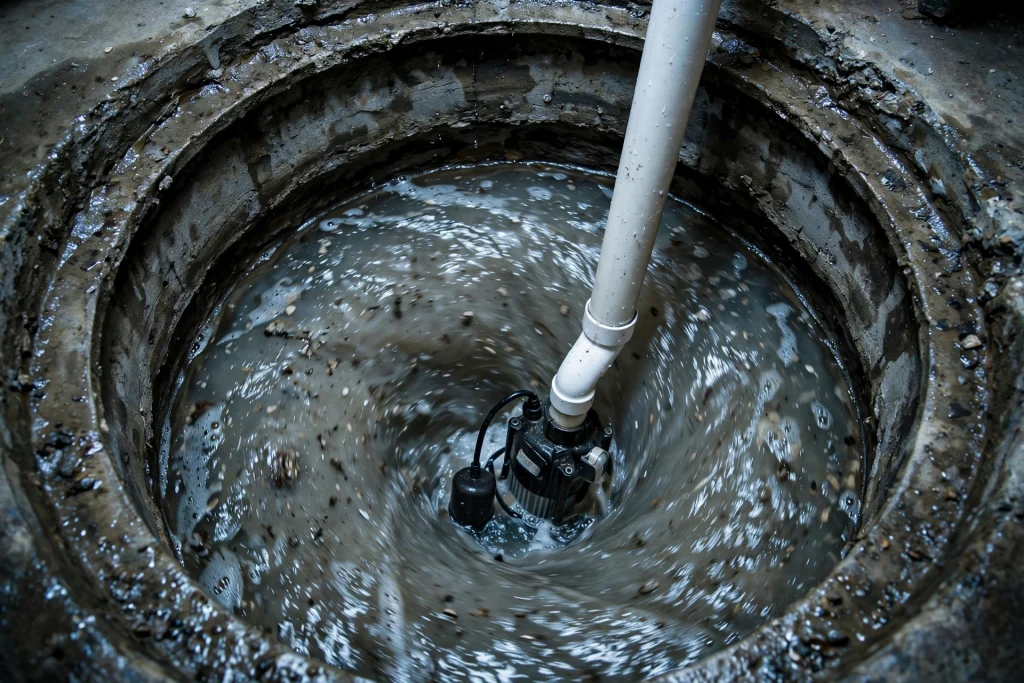
Start here: two questions that split the problem
Before troubleshooting, determine which of two very different situations you have.
Question 1: Is water leaving the discharge pipe outside?
Go outside while the pump is running and look at the discharge outlet.
- Water is coming out → the pump works. Your problem is that the water is returning, or the pit keeps refilling. Go to causes 1, 2, or 7.
- No water, or a trickle → the pump is not moving water. Go to causes 3, 4, 5, or 6.
Question 2: Does the pit level ever drop?
- Level drops, then rises immediately → recirculation. Causes 1 or 2.
- Level never drops at all → the pump is not pumping. Causes 3 through 6.
- Level drops normally but the pump keeps running → switch problem. Cause 7.
Those two observations narrow eight possibilities down to two or three in about five minutes.
1. Failed check valve
The most common cause by a wide margin.
The check valve is a one-way valve in the vertical discharge pipe, usually a foot or two above the pump. Its job is to stop the column of water standing in the pipe from falling back into the pit when the pump shuts off.
When the flapper inside wears out, sticks open, or the valve is installed backwards, that water returns to the pit every cycle. It raises the level, trips the float, and the pump runs again. And again. The pump can spend an entire night moving the same three gallons up and down.
How to confirm: Watch the pit right after the pump shuts off. If you hear a distinct backflow gurgle and see the level jump up within a few seconds, the check valve is the problem.
Fix: Replace it. A quality valve costs $15 to $40. Union-style valves with rubber couplings make future replacement easy without cutting pipe. Confirm the flow arrow points away from the pump; installed backwards, it blocks the pump entirely.
Missing check valve entirely? Add one. Some older installations never had one, and the system has been short-cycling for years.
2. Discharge water returning to the pit
The second recirculation scenario, and it operates outside the house.
If the discharge line terminates close to the foundation, the water soaks into the loose backfill soil, percolates down to the drain tile at the footing, and flows straight back to the pit. The pump is running a closed loop.
This is more common than people expect, because builders frequently terminate discharge lines a few feet from the wall and nobody revisits it.
How to confirm: Look at where the water actually goes after it exits. If it pools near the house, soaks in within a few feet, or runs back toward the foundation on a sloped lot, you have found it.
Fix: Extend the discharge at least 10 feet from the foundation, more on flat ground, and make sure the terminal point is downhill. Buried solid PVC running to a pop-up emitter is the tidiest solution. Do not use perforated corrugated pipe, which is designed to release water into the soil and defeats the entire purpose.
The same principle applies to your roof runoff. Downspouts discharging too close feed the pit the same way, and correcting both together makes a substantial difference.
3. Airlock
The pump hums, sounds like it is working, and no water moves.
Air becomes trapped in the pump housing, and the impeller spins in a pocket of air. It cannot generate suction because there is no water at the intake. The pump can run indefinitely in this state, heating up, moving nothing.
The prevention is a weep hole, a small hole roughly 3/16 inch drilled in the discharge pipe between the pump outlet and the check valve, below the water line. It lets trapped air escape. Manufacturers either pre-drill it or instruct you to, and it is one of the most commonly skipped steps in DIY installations.
How to confirm: The pump runs, the level does not move, and there is no water at the discharge outlet. Unplug and replug the pump; if it works briefly then stops moving water, airlock is likely.
Fix: Unplug the pump, lift it slightly and lower it to release trapped air, or tip it gently. Then drill a 3/16 inch weep hole in the discharge pipe just above the pump, angled downward so it sprays back into the pit. A small stream from that hole during operation is normal and correct.
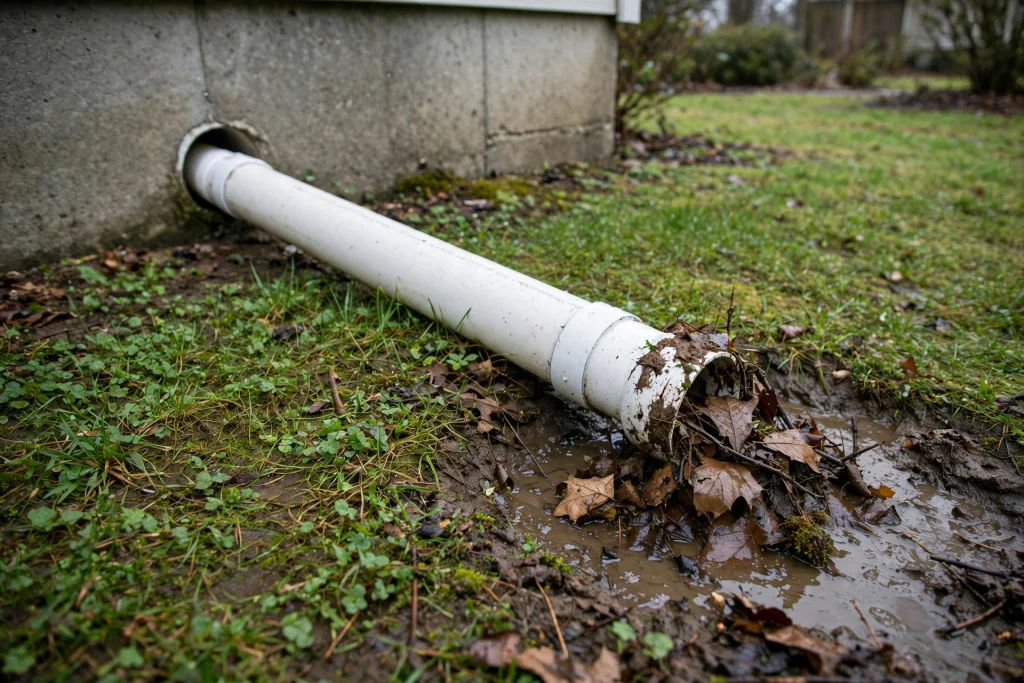
4. Blocked or frozen discharge line
The pump is working, but the water has nowhere to go.
Common blockages: ice in winter, mud and silt at the outlet, leaves and debris, a crushed section from vehicle traffic or settling soil, an animal nest at the terminal end, or a disconnected joint dumping water back into the ground beside the house.
A pump running against a fully blocked line will overheat and can burn out, so this is one to resolve quickly.
How to confirm: No water at the outlet with the pump clearly running. Feel the discharge pipe; a blocked line often feels rigid with standing water in it.
Fix: Clear the outlet. In winter, an ice guard fitting, which is a slotted section near the exit that lets water escape if the downstream line ices up, prevents the most common cold-weather version of this. Ensure the buried line slopes continuously downhill so it drains fully between cycles rather than holding water that can freeze.
5. Clogged or damaged impeller
The impeller is the spinning vaned disc inside the pump that actually moves the water. Gravel, silt, small stones, or debris jam it, or the vanes wear down over years of abrasive service.
How to confirm: The motor runs but sounds different, often a strained hum, sometimes with a grinding or rattling note. Little or no water moves.
Fix: Unplug the pump. Remove it from the pit. Take off the intake screen or base plate and clear the debris. If the vanes are visibly eroded or the impeller spins with obvious wobble, the pump is at the end of its service life and should be replaced rather than repaired.
Prevention: Keep the pit clean, keep the pump off the pit floor on a brick or a pump stand so it does not draw sediment directly, and use a sealed lid to keep debris out.
6. Worn-out motor
The pump runs, but not with the force it once had. Bearings wear, windings degrade, and output drops until it can no longer overcome the head height it needs to lift against.
How to confirm: Gradual decline rather than a sudden failure. Cycles take longer. The pump moves water but slowly. Visible rust on the housing. Age past 7 to 10 years.
Fix: Replacement. Sump pumps are not economically repairable. Expect $120 to $400 for the unit, or $400 to $900 professionally installed. See how long do sump pumps last for the full list of end-of-life indicators.
7. Stuck or failed float switch
The switch tells the pump when to start and stop. When it fails in the closed position, the pump runs continuously regardless of water level.
Common causes: a tethered float snagged on the pit wall, the discharge pipe, or the power cord; a vertical float jammed on its rod by debris; a waterlogged float that no longer rises; or a switch whose internal contacts have welded shut.
How to confirm: The pit is empty, or the level drops normally, and the pump keeps running. Unplug the pump, then move the float by hand through its full travel and check whether anything obstructs it.
Fix: Free the obstruction, reposition the float so it swings clear, or replace the switch. Vertical float switches work better than tethered ones in narrow pits precisely because there is less to snag on. A replacement switch runs $20 to $60.
Interim safety measure: Unplug the pump between manual operations if the switch is stuck on. A pump running dry indefinitely will destroy itself.
8. Genuinely high inflow
Sometimes the pump is not malfunctioning. It is losing.
If your water table is above the basement floor, or a storm has saturated the soil, water can arrive faster than the pump can remove it. That is a capacity problem, or more often a water-management problem.
How to confirm: The level drops when the pump runs, just not fast enough, and the pattern correlates with rainfall or seasonal groundwater. There is genuine water at the discharge outlet.
Fix, in order of cost:
Start outside. Clean the gutters and extend the downspouts, then check that the soil slopes away from the house. These reduce the water reaching your foundation more than most homeowners expect, and they cost a few hundred dollars at most.
If genuine hydrostatic pressure is the driver and surface fixes are already handled, then a larger pump, a second pump in the same pit, or improved perimeter drainage becomes the conversation.
Diagnostic quick reference
| What you observe | Most likely cause |
|---|---|
| Level drops, jumps back up within seconds | Failed check valve |
| Water at outlet but pit refills quickly | Discharge too close to house |
| Motor hums, level never moves, no water outside | Airlock or blocked discharge |
| Straining or grinding sound, little water | Clogged or damaged impeller |
| Pit is empty and pump still runs | Stuck float switch |
| Slow, weak pumping that has declined over time | Worn motor |
| Level drops but slower than inflow | Capacity or drainage issue |
| Nothing at all happens | Power, breaker, or dead motor |
Why this matters beyond the noise
A short-cycling pump is not just annoying. Every start draws a current surge and generates heat in the windings, so a pump cycling every thirty seconds experiences far more wear than one running steadily. Short-cycling is one of the main reasons pumps fail years before they should.
More importantly, a pump running in a fault state is a pump you cannot rely on. Discovering that your check valve failed months ago is much better done on a dry Saturday than during the storm that would otherwise have flooded the basement. If you have not run one recently, work through a proper sump pump test, and make sure you have a plan for what to do if the pump fails during a storm.
Frequently asked questions
Can a sump pump run continuously without damage? For a while, yes, and continuous running during a major storm is within design intent. But submersible pumps rely on surrounding water for cooling, so a pump running dry overheats quickly. Unplug it if the pit is empty and the switch is stuck.
Why does my pump run for a few seconds every minute? Classic short-cycling. Check the check valve first, then whether the discharge water is returning, then whether the float draw-down can be increased.
Should I hear water in the discharge pipe? Yes, a rush of water during the cycle and usually a single distinct clunk from the check valve closing afterward. Repeated gurgling after shutoff means water is falling back.
My pump is new and already doing this. Check the weep hole first, since new DIY installations frequently omit it, and check that the check valve is oriented with the flow arrow pointing away from the pump. Both are common installation errors rather than product faults.
Can I just unplug it until I fix the problem? Only if the pit is genuinely dry and you are certain no water is arriving. Unplugging a pump before a storm is how basements flood. If you must disable it, set a phone reminder and monitor the pit level.
How much does it cost to fix? Check valve $15 to $40. Float switch $20 to $60. Weep hole, free. Discharge extension $15 to $40 for surface, $10 to $25 per foot buried. New pump $120 to $400 DIY, $400 to $900 installed.
Is a second pump worth installing? If inflow genuinely exceeds one pump’s capacity, yes. More commonly, though, the useful second unit is a battery backup pump, which protects against outages rather than volume.
Could this mean my foundation is leaking? A pump working hard is doing its job, and that is not itself a leak. But if you are also seeing efflorescence, damp patches, or other signs of water moving through the walls, the pit is only handling part of the water arriving at your foundation.
The bottom line
Go outside and look at the discharge while the pump runs. That single observation splits the problem in half: water coming out means the water is coming back, and no water coming out means the pump cannot move it.
From there, check the check valve, watch for a backflow gurgle after shutoff, look for a weep hole, and confirm the discharge terminates well away from the house. Those four checks cost almost nothing and solve most cases before you have spent a dollar on parts.
[…] Also confirm the water is landing at least 10 feet from the foundation and flowing away. Discharge water soaking in near the wall returns to the pit, which is a common reason a sump pump runs continuously without ever emptying. […]
[…] If the sump pump is running but the water is not dropping, the discharge line is likely blocked, frozen, or disconnected. Go outside and confirm water is actually exiting where it should. A pump running against a blocked line will overheat and burn out, so unplug it if you cannot clear the blockage. […]
[…] cover the full diagnostic sequence in sump pump keeps running but no water, which is the specific version of this problem where the level never seems to […]
[…] Unplug it, lift the pump slightly and set it back down to release trapped air, then try again. The full troubleshooting sequence is here once the emergency has […]