
A dry sump pit worries people for two opposite reasons. Some assume the pump is broken. Others assume the system is fine and stop thinking about it, which is how you end up with a seized pump discovered during a storm.
The honest answer is that a dry pit is usually good news, and occasionally a signal that water is finding another route into your house.
The distinction comes down to one observation: whether the pit stays dry during and after heavy rain. A pit that is dry in August tells you nothing. A pit that is dry twelve hours after two inches of rain, while your basement walls are damp, is telling you something specific.
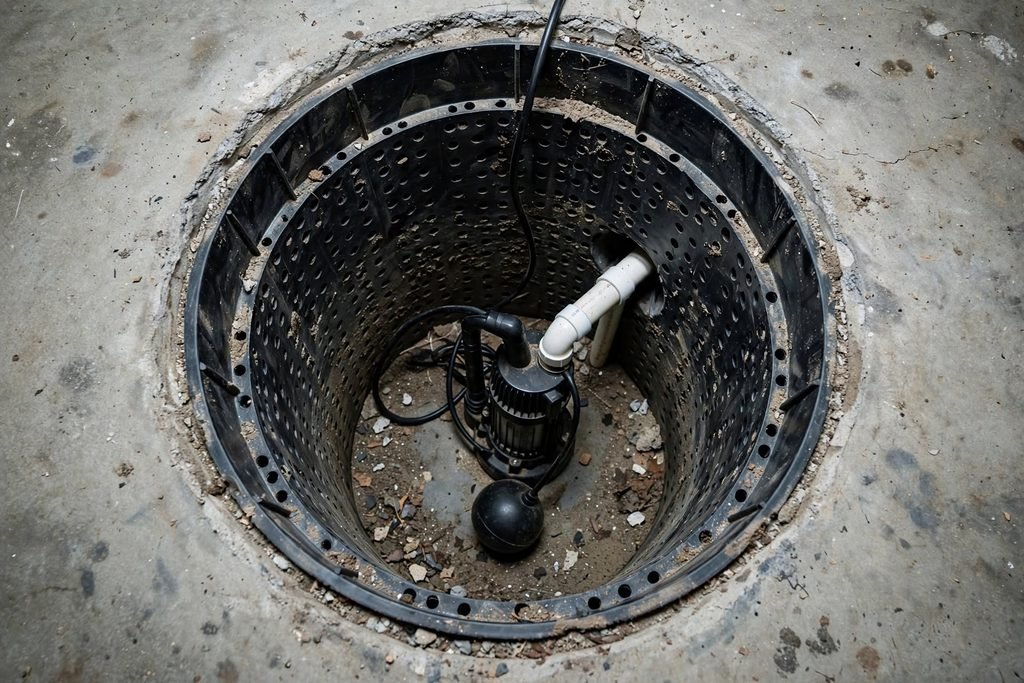
First: run the two-minute check
Before diagnosing anything, confirm the pump itself still works. A pump that sits unused for months can seize, and a dry pit is exactly the situation where nobody notices.
Pour a five-gallon bucket of water into the pit and confirm the pump activates, empties it, and shuts off cleanly. Then go outside and check that water actually exits the discharge line.
If it does not run, work through the electrical and float checks first. The full test procedure is here, and it should be a quarterly habit regardless of whether the pit ever fills on its own.
Once you know the pump works, the question becomes why no water is arriving.
The benign explanations
These account for most dry pits, and none of them require action beyond continuing to test the pump.
1. Your water table is simply below the pit
The most common reason, and it is not a problem.
The water table rises and falls seasonally, typically peaking in spring and bottoming out in late summer. If groundwater sits below the level of your pit for most of the year, the pit stays dry for most of the year. That is a house on well-drained ground, which is a good thing.
Many homes see their pump run heavily for six weeks in spring and then sit idle until the following year.
2. It has been dry weather
Obvious but worth stating. Weeks without meaningful rain means nothing is percolating down to the drain tile. Judge your pit against conditions, not against the calendar, the same way you judge how often the pump should be running.
3. Your soil drains freely
Sandy and gravelly soils let water move down and away rather than accumulating against the foundation. Homes on such soils often have a sump pit that was installed as insurance and never fills. Clay soils behave the opposite way, holding water against the wall and keeping pits busy.
4. Your surface drainage is genuinely good
If your gutters are clean, your downspouts discharge ten feet out, and your grading carries water away from the house, far less water reaches the backfill zone. The pit is dry because the system upstream of it is working.
This is the outcome you want, and it is the reason extending downspouts is such a high-value fix. A dry pit after you improved the drainage is evidence the improvement worked.
5. Your lot slopes and the drain tile daylights
On a sloped lot, exterior footing drains often terminate at a lower point on the property rather than routing to a pit. Water leaves by gravity and never reaches the sump. The pit exists as a backup for extreme conditions.
6. The pump has an aggressive draw-down
Some pumps empty the pit almost completely and shut off with very little water remaining. You may simply be looking at the pit shortly after a cycle. Watch it over several hours during wet weather rather than judging from one glance.
The concerning explanations
Here the pit stays dry through heavy rain, and especially if you are also seeing water or dampness elsewhere in the basement.
7. The drain tile is clogged
The perforated pipe around your footing collects groundwater and carries it to the pit. Over decades it silts up, fills with fine sediment, or becomes choked with tree roots seeking moisture.
When it clogs, water that should be intercepted at the footing has nowhere to go. It accumulates in the soil instead, builds hydrostatic pressure against the walls and under the slab, and finds its way in through cracks, the wall-floor joint, and the pores of the concrete.
The signature: a house that was dry for many years and gradually started leaking, with a pit that has become progressively less active over the same period.
8. The drain tile is collapsed or crushed
Older corrugated pipe crushes under soil load, heavy equipment, or root pressure. Clay tile sections shift apart at the joints. The result is the same as a clog: water is not delivered to the pit.
9. There is no drain tile connected to the pit
Surprisingly common in older homes and in retrofit installations. Someone cut a hole in the slab, dropped in a basin and a pump, and never connected it to any collection system.
Such a pit only fills when groundwater rises high enough to enter through its own perforated sidewalls. It offers very limited protection because it is not intercepting water at the footing where the water actually is.
How to check: look inside the pit for inlet pipes entering through the side walls. A proper installation has at least one, usually two. A pit with no inlets is collecting only what seeps in around it.
10. The pit is in the wrong place
Drain tile flows by gravity to a low point. If the pit was installed at a high point in the basement, or if the tile does not slope toward it, water collects somewhere else, often under the slab in a corner where you cannot see it.
11. Water is entering above the pit level
If your leaks are high on the walls, coming from window wells, or entering through cracks partway up, that water never reaches footing level and never enters the drain tile. A sump system is a groundwater management tool; it does nothing about water coming in above it.
This is worth checking against the full list of foundation leak indicators before assuming the sump system has failed.
The diagnostic question that settles it
Does the pit fill during heavy rain?
Go down during or immediately after a substantial rain event, ideally two inches or more, and look.
Pit fills and the pump cycles: the system is working. Your dry pit in normal weather is simply a low water table.
Pit stays completely dry, and the basement is also dry: most likely benign. Good drainage, free-draining soil, or a low water table. Keep testing the pump quarterly.
Pit stays completely dry, but the basement walls are damp, or you see efflorescence, or water appears at the wall-floor joint: this is the combination that matters. Water is reaching your foundation and is not being intercepted. Something between the footing and the pit is not working.
That third case is worth investigating properly, because the drainage system you think is protecting you is not.
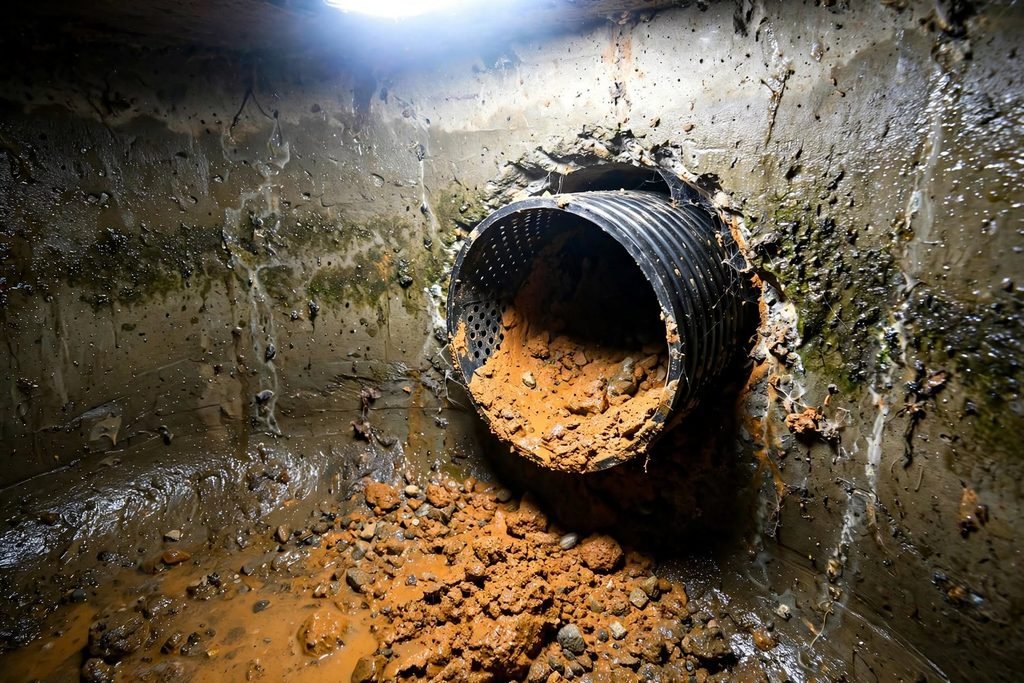
How to check the drain tile
Look for inlets. Shine a light into the pit and find the pipes entering through the sidewall. Note their diameter and whether they are visibly blocked with silt.
Run the hose test. Find the cleanout for your drain tile if one exists, or use an accessible inlet. Run a garden hose into it for several minutes and watch whether water arrives at the pit. If it does not, the line is obstructed somewhere.
Camera inspection. A plumber or drainage contractor can run a camera through the tile, typically $200 to $500. This is the definitive answer and it identifies whether the problem is silt, roots, a collapse, or a disconnection.
Hydro-jetting. If the tile is intact but silted, jetting can clear it, generally $400 to $1,200 depending on length and access.
Replacement. If the tile is collapsed, crushed, or was never installed, you are looking at either an interior perimeter drain, which involves cutting a channel in the slab, or exterior excavation. Interior systems run $60 to $150 per linear foot. Exterior work runs considerably more but treats the problem at the source and allows the wall itself to be waterproofed.
Before committing to either, address the cheap external work first. Gutters, downspouts, and grading resolve a substantial share of basement water for a few hundred dollars, and a contractor who quotes a perimeter drain before checking them is skipping steps.
Do not neglect a pump just because the pit is dry
An idle pump is not a maintained pump. Specific problems develop from disuse:
Seals dry out and crack. Submersible pumps are designed to sit in water. Extended dry periods can degrade seals and gaskets.
Impellers seize. Residual silt hardens around the impeller, and a pump that has not turned in eight months may not turn when asked.
Float switches stick. Debris, corrosion, and simple lack of movement all contribute.
Check valves gum up. The flapper can stick in position after long inactivity.
The remedy is the same quarterly bucket test that everyone should be doing anyway. Ten minutes, four times a year. And note the age of the unit somewhere you will find it, because pump lifespan is measured in years installed, not hours run. A pump that has sat unused for nine years is still a nine-year-old pump.
Frequently asked questions
Is a dry sump pit normal? Often, yes. A low water table, dry weather, free-draining soil, or good surface drainage all produce a dry pit. It only warrants investigation if the pit stays dry through heavy rain while the basement shows signs of water.
Should there always be water in a sump pit? No. Some pits hold a few inches permanently because the water table sits at that level. Others are dry for most of the year. Both are normal, and neither indicates a problem by itself.
How can I tell if my drain tile is clogged? The strongest indicator is a pit that no longer fills during heavy rain combined with new or worsening dampness in the basement, especially in a house that used to be dry. A camera inspection confirms it.
My pit is dry but my basement is wet. What does that mean? That water is reaching your foundation without being intercepted. Either the drain tile is not delivering to the pit, or the water is entering above footing level through cracks, window wells, or higher wall seepage. Both need investigating.
Do I still need a sump pump if the pit never fills? Keep it. Water tables fluctuate over years, an unusually wet season can change everything, and the cost of maintaining a working pump is trivial compared to the cost of not having one during the year it is needed.
Can I fill the pit with water to keep the seals wet? It is not usually necessary, and the quarterly bucket test accomplishes the same thing while also confirming the pump works. Running the pump periodically is more valuable than keeping it submerged.
Should I remove a sump pump I never use? No. It costs almost nothing to leave in place and it is your only protection when conditions change. Removing it also has to be disclosed at sale and looks worse to a buyer than a pump that has never needed to run.
My new sump pump has never turned on. Is it defective? Test it with a bucket. If it runs, it is fine and your water table is simply low. If it does not, check the plug, the GFCI, the breaker, and whether the float is jammed.
The bottom line
A dry sump pit usually means the water table is low, the soil drains well, or your surface drainage is doing its job. That is a good outcome, not a fault.
The one combination that matters is a pit that stays dry through heavy rain while the basement shows damp walls, mineral deposits, or seepage at the floor joint. That means water is arriving at your foundation and something between the footing and the pit is not delivering it.
Either way, do not let a quiet pit become an untested one. Pour a bucket in four times a year, confirm the water actually comes out the discharge outside, and write the install date on the lid. A pump that has sat idle for a decade is not a spare; it is an unknown.