
It is raining hard, the pit is filling, and the pump is silent. Or it is humming and the water is still climbing. Either way you have a window of somewhere between twenty minutes and a few hours before water reaches the floor, and what you do with that window matters.
This is the emergency sequence, written to be read fast. Safety first, then a sixty-second diagnosis that fixes a surprising share of cases, then how to move water when the pump genuinely will not.
Once the crisis is over, the broader flood-response guide covers cleanup, drying, and insurance documentation.
1. Safety first, even though you are in a hurry
Do not step into standing water if you cannot confirm the power is off. Submerged outlets, extension cords, and appliances make standing water a genuine electrocution risk, and you cannot tell by looking.
If water has reached outlets or if the electrical panel itself is in the wet area, do not go down. Call your utility and have them cut power at the meter. They treat this as an emergency and it is free.
If you smell gas, or water has reached the burners on your furnace or water heater, shut the gas off at the meter and leave the house before calling the gas company. Do not flip switches on the way out.
Wear rubber boots and gloves. Groundwater carries soil bacteria. Water coming up from a floor drain is worse and should be treated as contaminated.
If water is rising fast and you cannot control it, move to protecting property and get out of the space. No basement is worth a serious injury.
2. The 60-second diagnosis
Work through these in order. Each takes seconds and several of them are the entire problem.
Is it plugged in? Genuinely check. The outlet gets borrowed for a shop vac or a dehumidifier and not restored more often than anyone admits.
Has the GFCI tripped? Press reset on the outlet. GFCI outlets in damp basements nuisance-trip regularly.
Has the breaker tripped? Check the panel.
Is the float stuck? Unplug the pump first. Then look into the pit and see whether the float is jammed against the pit wall, the discharge pipe, or its own power cord. Free it by hand and plug back in. This is one of the most common failures and it takes ten seconds to fix.
Is the pump humming but not moving water? That points to an airlock, a blocked discharge, or a jammed impeller. Unplug it, lift the pump slightly and set it back down to release trapped air, then try again. The full troubleshooting sequence is here once the emergency has passed.
Go outside and look at the discharge outlet. If the pump runs and no water comes out, the line is blocked, frozen, crushed, or disconnected. Clearing the outlet end may restore the whole system in two minutes.
Is the power out entirely? Then the pump is fine and you need the backup, a generator, or manual removal. Skip to section 4.
3. If the power is out
Check whether your battery backup engaged. It should have. If it did not, check the battery connections and whether the charger has been reporting a fault. A backup that has quietly lost capacity is the most common reason it does not run when needed, which is why testing the battery under load annually matters more than watching the charger light.
Estimate your runtime. A healthy 100 amp-hour battery under moderate demand typically gives 8 to 20 hours, less under heavy inflow. Knowing roughly how long you have shapes every other decision.
Reduce the load on the backup. Anything you can do to slow water reaching the pit extends runtime directly. Divert downspouts away from the house with whatever is at hand, even a tarp or a length of scrap gutter.
If you have a portable generator, run it outdoors only, at least 20 feet from the house, away from windows and vents. Carbon monoxide from generators kills people every storm season. Never run one in a garage, even with the door open.
4. Moving water without a working pump
Ranked by how much water they move.
Backup or spare pump. If you have a second submersible pump, drop it in the pit and run it from a generator or an extension cord to a live circuit elsewhere in the house.
Utility transfer pump. Hardware stores rent these for $30 to $60 a day and they move a few thousand gallons per hour. Requires power. Run the discharge hose at least 20 feet from the house and downhill, or you are pumping the same water in a circle.
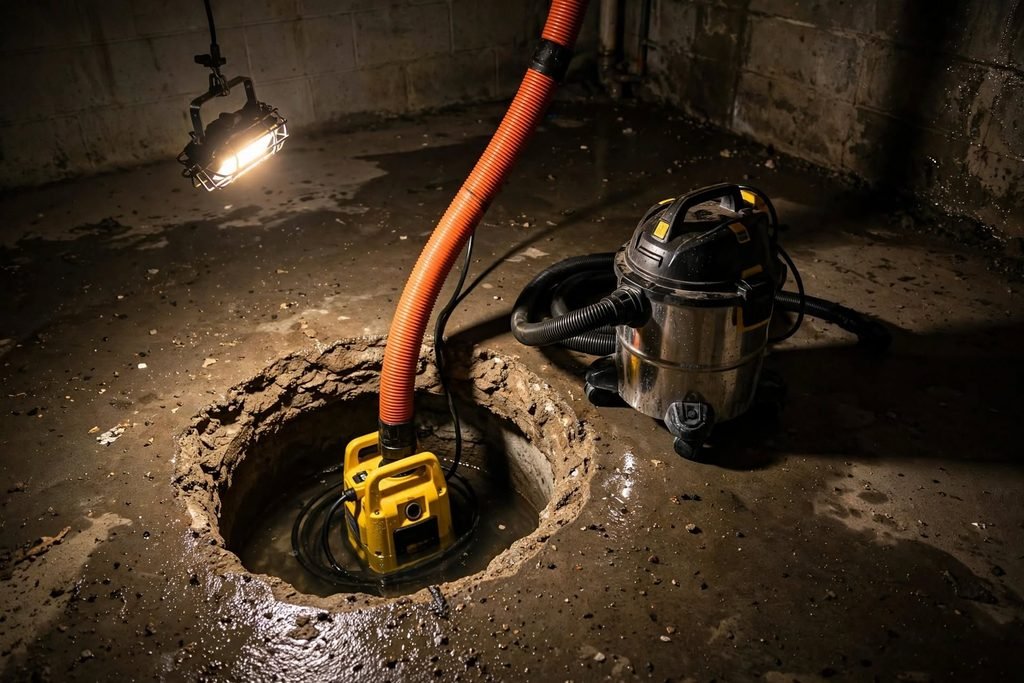
Wet/dry shop vac. Effective for an inch or two and for keeping ahead of moderate inflow. Empty it often; a full 16-gallon vac weighs about 130 pounds. Use a GFCI outlet and do not stand in standing water while operating it.
Drill-powered transfer pump. A small impeller pump that chucks into a cordless drill, around $20 to $40. Modest output, but it works when the grid does not and it fits in a drawer. A genuinely useful thing to own before you need it.
Manual diaphragm or hand pump. Slow, tiring, no power required. Better than buckets.
Buckets. Five gallons at a time up the stairs. Exhausting and slow, but during a short outage with two people it can keep the water below floor level.
Siphon. If there is anywhere lower than the pit that water can safely go, a garden hose siphon runs continuously with no power at all. Rarely applicable in a basement, but worth checking.
5. Protect property while you work
Assume some water is coming and spend five minutes reducing what it can damage.
Lift everything off the floor. Boxes, electronics, tools, stored furniture. Even four inches on scrap lumber or bricks saves most of it. Cardboard on a wet slab is the fastest total loss in the room.
Get valuables and documents upstairs. Photographs, paperwork, anything irreplaceable.
Unplug and raise electronics and appliances if you can do so safely with the power off.
Move vehicles out of a basement garage if applicable.
Roll up rugs. Carpet padding is essentially never salvageable once soaked, and removing it now saves the rug above it.
Photograph the scene before it gets worse. Timestamped photos with a tape measure in frame make a real difference to any insurance claim, and it costs thirty seconds.
6. Know when to stop and call for help
Call a plumber or an emergency restoration service if:
- Water is rising faster than you can remove it
- The water is coming up from a floor drain or a toilet, which means a sewer backup rather than groundwater and is a health hazard
- You cannot safely reach the electrical panel
- The water has reached your furnace, water heater, or electrical panel
- You are physically unable to keep up
Emergency restoration response for a residential basement typically runs $1,000 to $4,000, more for large volumes or contaminated water. Many companies bill insurers directly.
Note that most standard homeowners policies exclude groundwater seepage and sump pump failure. The coverage that applies is a water backup and sump pump overflow endorsement, usually $50 to $250 a year. If you do not have it, add it after this storm, because it cannot be bought retroactively.
After the storm: do not skip this part
The failure that happened tonight will happen again unless you find out why. Within the next week:
Diagnose the actual failure. Was it the float, the check valve, the discharge, the motor, or the power? Each has a different fix and a different cost.
Replace the pump if it is over seven years old, regardless of whether it survived. Age is the single best predictor of failure, and the thresholds are covered in how long do sump pumps last.
Install or replace the battery backup. If tonight taught you anything, it is that a pump on grid power alone has one predictable failure mode.
Add a high-water alarm. Basic units are under $30. Wi-Fi models that push a phone alert run $80 to $200 and would have told you about this hours earlier.
Start testing quarterly. Ten minutes with a five-gallon bucket, four times a year, catches most failures while they are still cheap. The full test procedure is here.
Reduce the water arriving in the first place. This is the part homeowners skip and it does the most good. Extending downspouts six to ten feet, cleaning gutters, and correcting the grading around the foundation cut the volume your pump has to move. Every gallon that never reaches the pit is a gallon the pump does not have to lift during the next outage.
The emergency kit worth assembling now
Buy these on a dry day. All of it fits in one plastic tote in the basement.
| Item | Cost | Why |
|---|---|---|
| Drill-powered transfer pump | $20 to $40 | Works without grid power |
| Wet/dry shop vac | $60 to $150 | Handles an inch or two |
| Heavy-duty extension cord | $20 to $40 | Reach a live circuit elsewhere |
| Rubber boots and gloves | $30 to $60 | Basic safety |
| Battery lantern and headlamp | $25 to $50 | Hands free in the dark |
| High-water alarm | $25 to $200 | Early warning |
| Spare check valve | $15 to $40 | Most common failure part |
| Spare float switch | $20 to $60 | Second most common |
| Hydraulic cement | $8 to $20 | Plugs an active leak fast |
| Plastic sheeting and tape | $20 | Temporary downspout diversion |
Total under $300, and it turns a crisis into an inconvenience.
Frequently asked questions
How fast will my basement flood if the pump stops? It depends entirely on inflow, which varies from a trickle to hundreds of gallons an hour. During a heavy storm with a high water table, water can reach the floor within an hour of the pump stopping. A high-water alarm removes the guesswork.
Can I pour water out of the pit by hand until power comes back? Yes, and during a short outage two people with buckets can genuinely keep up with moderate inflow. It is exhausting and it is better than a flooded basement.
Will my sump pump work on a portable generator? Yes. A typical 1/3 to 1/2 HP pump draws modest power and most portable generators handle it easily. Run the generator outdoors only, well away from the house, because of carbon monoxide.
My pump is running but the water keeps rising. What now? Either it is not actually moving water, which is an airlock, blockage, or impeller issue, or inflow genuinely exceeds capacity. Check the discharge outlet outside first. That single observation tells you which.
Should I turn the pump off if it is not working? If the pit is empty and the pump keeps running, yes, unplug it, because a submersible pump running dry overheats. If the pit has water and the pump is trying, leave it running while you troubleshoot.
Does homeowners insurance cover this? Standard policies typically exclude groundwater and sump failure. A water backup and sump overflow endorsement covers it, usually up to a set limit. Check your declarations page rather than assuming.
Is a water-powered backup better than a battery? For long outages, it has the advantage of unlimited runtime since it uses municipal water pressure rather than stored electricity. It consumes significant city water and is unavailable on wells. Neither is universally better.
How do I stop this happening again? Test quarterly, replace the pump on age rather than on failure, install a battery backup and an alarm, and reduce the water reaching your foundation. The last one is the cheapest and the most overlooked, and it also reduces the hydrostatic pressure pushing water through your walls.
The bottom line
Power off before you step in water. Then run the sixty-second checklist: plug, GFCI, breaker, stuck float, and the discharge outlet outside. Those five checks resolve a large share of storm failures and cost nothing.
If the pump is genuinely dead, move water however you can and get everything off the floor while you do it. Then, once it is dry, spend an afternoon on the boring version of this problem: a quarterly test, a battery backup, an alarm, and thirty dollars of downspout extension. It is a much better evening than this one.