
Most foundation leaks do not announce themselves with a puddle. They start as a faint odor, a patch of paint that will not stay stuck, a white powder on the block wall that gets wiped away and comes back. By the time there is standing water on the floor, the problem has usually been developing for a year or more.
That gap between when a leak starts and when it becomes obvious is expensive, because moisture works on framing, insulation, and stored belongings the whole time. Learning to read the early signals turns a $500 drainage fix into something you do before it becomes a $12,000 one.
Here are the fourteen indicators that matter, organized from most obvious to most easily missed.
Visible signs on the walls and floor
1. Damp patches and tide lines
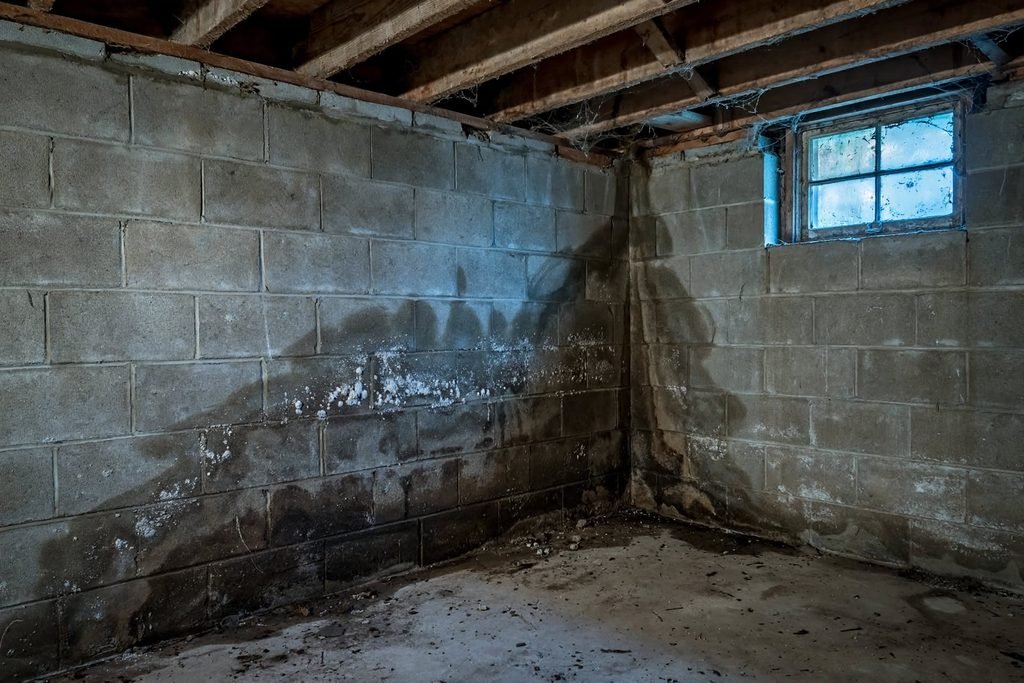
The most direct evidence. Look for areas of the wall that are visibly darker than the surrounding concrete, particularly after rain. Then look for horizontal lines where a previous water level dried and left a stain edge.
Tide lines on the wall, on the bottom of stored boxes, or on the legs of furniture tell you the historical high-water mark even if the basement is dry today. If you bought the house recently, these are often the only evidence a previous owner did not disclose.
What it tells you: Water is entering at or below that level. A damp patch high on a wall points to a crack or a window well. A damp band at the base points to the cove joint or hydrostatic pressure.
2. Efflorescence
The white, chalky, sometimes crystalline deposit on masonry walls, known as efflorescence. It is mineral salts that were dissolved out of the concrete or mortar by water passing through, then left behind when that water evaporated on the interior surface.
This one is important because it is proof of liquid water movement through the wall, not just dampness in the air. Condensation cannot create it.
Test it if you are unsure: efflorescence is gritty, dissolves when you dab it with water, and is white to gray. Mold is fuzzy or spotty, comes in black, green, or brown, and does not dissolve.
What it tells you: Water is moving through the masonry at that spot, whether or not you have ever seen it drip.
3. Peeling, blistering, or bubbling paint
Paint on a foundation wall fails from behind when moisture pushes outward through the concrete. It lifts in patches, bubbles, or flakes away in sheets, often exposing bare masonry underneath.
Note that this is a particularly common failure mode with masonry waterproofing paints applied over an active leak. The paint was applied to solve a moisture problem, the water pressure peeled it off, and the peeling itself is now the diagnostic.
What it tells you: Sustained moisture in the wall at that location. The size of the failed area roughly maps the wet zone.
4. Spalling and deteriorating concrete
Spalling is when the surface of the concrete flakes, chips, or crumbles away, sometimes exposing aggregate. In block walls, the equivalent is mortar joints that have gone soft, powdery, or receded.
It happens because water saturates the masonry, then freezes and expands, or because dissolved salts crystallize inside the pores and force the surface apart.
What it tells you: Long-term, repeated saturation. This is not a new leak. It is one that has been running for years.
5. Cracks with a mineral trail
A crack by itself is common and often harmless. A crack with a rusty or white streak running downward from it, or a fan-shaped stain below it, is a crack that water has been traveling through.
Pay particular attention to whether the trail is fresh or historical, and mark the ends of the crack with a pencil and the date to see whether it is growing.
What it tells you: Active water pathway. Vertical cracks are usually straightforward injection repairs. Horizontal cracks mean soil pressure is failing the wall and require structural evaluation, not sealant.
Signs you smell and breathe
6. Persistent musty odor
That distinctive basement smell is not “how basements smell.” It is microbial volatile organic compounds, the gases produced by mold and mildew as they metabolize.
The important detail is that odor often precedes any visible evidence, because the growth is happening behind finished walls, under carpet, inside stored cardboard, or in the insulation. A basement that smells musty but looks perfectly clean is a basement with a moisture source you have not located.
What it tells you: Relative humidity has been sustained above roughly 60 percent, or there is hidden wet material. Either way, there is water coming from somewhere.
7. Visible mold growth
Black, green, or brown spotting on walls, on the underside of floor joists, on stored items, or on the back of drywall.
Mold requires a moisture source. It does not appear in a dry basement. Finding it means finding the water, not just cleaning the surface, because surface cleaning without addressing moisture guarantees it returns.
What it tells you: Active or recent moisture at that spot. Growth on the back of drywall or on framing indicates the moisture is coming from the wall, not the room air.
8. Worsening allergy or respiratory symptoms
Household members with more congestion, coughing, or asthma flare-ups than usual, particularly symptoms that improve when they leave the house, can point to indoor air quality driven by basement moisture.
Basements exchange air with the rest of the house through the stack effect, meaning air rises through the building and is replaced by air drawn up from the lowest level. A significant fraction of the air you breathe upstairs came from the basement.
What it tells you: Enough biological growth to affect air quality, which means a moisture source of meaningful size.
Signs on your stuff and your systems
9. Rust at the base of columns, appliances, and shelving
Look at the bottom few inches of steel support columns, the feet of the water heater and furnace, metal shelving legs, and the base of any tool chest.
Rust lines at a consistent height around the room mark repeated standing water even if you have never seen it. Corrosion on appliance bases can also indicate chronically high humidity.
What it tells you: Water has stood at that level, more than once.
10. Warped or damaged stored belongings
Cardboard boxes that have gone soft or collapsed at the bottom corners. Books with wavy pages. Wooden furniture with swollen or delaminated bases. Photographs stuck together. Musical instruments out of adjustment.
These are moisture sensors you already own, and they respond long before the concrete looks wet.
What it tells you: Sustained elevated humidity, and possibly floor moisture wicking into anything sitting directly on the slab.
11. Insect activity
Certain pests are specifically attracted to damp environments, and an increase in them is a genuine diagnostic signal.
Millipedes, centipedes, sowbugs and pillbugs, silverfish, springtails, and camel crickets all require moisture. So do certain ant species and, more seriously, termites, which need moisture in wood to establish.
If you have suddenly started seeing these in numbers, something in the basement has gotten wetter.
What it tells you: Elevated moisture, often at the perimeter where they enter through the same gaps water uses.
12. Flooring problems in a finished basement
Vinyl plank or tile lifting at the edges. Laminate swelling at the seams. Carpet that feels cool and slightly damp underfoot. Adhesive failing so tiles pop loose.
Moisture vapor moves continuously through a concrete slab even without visible water, and flooring installed without a proper vapor barrier or over a slab that was never moisture-tested will fail from below.
What it tells you: Slab moisture, which could be groundwater beneath the floor or simply a missing vapor barrier under the original pour.
The signs that mean stop and call someone
13. Bowing, bulging, or horizontal cracking in a wall
Hold a long straightedge or stretch a string tightly across the wall from corner to corner. Any visible gap in the middle means the wall has deflected inward.
Combined with a horizontal crack, this means soil pressure is actively winning against the structure. Water is the driver, since saturated soil weighs far more and exerts far more pressure than dry soil, but the failure is now structural.
What it tells you: Urgent. Get a structural engineer’s evaluation, not just a waterproofing quote. Deflection beyond about an inch changes the repair from sealing to reinforcement with carbon fiber, steel beams, or wall anchors.
14. Water rising through the floor or from a floor drain
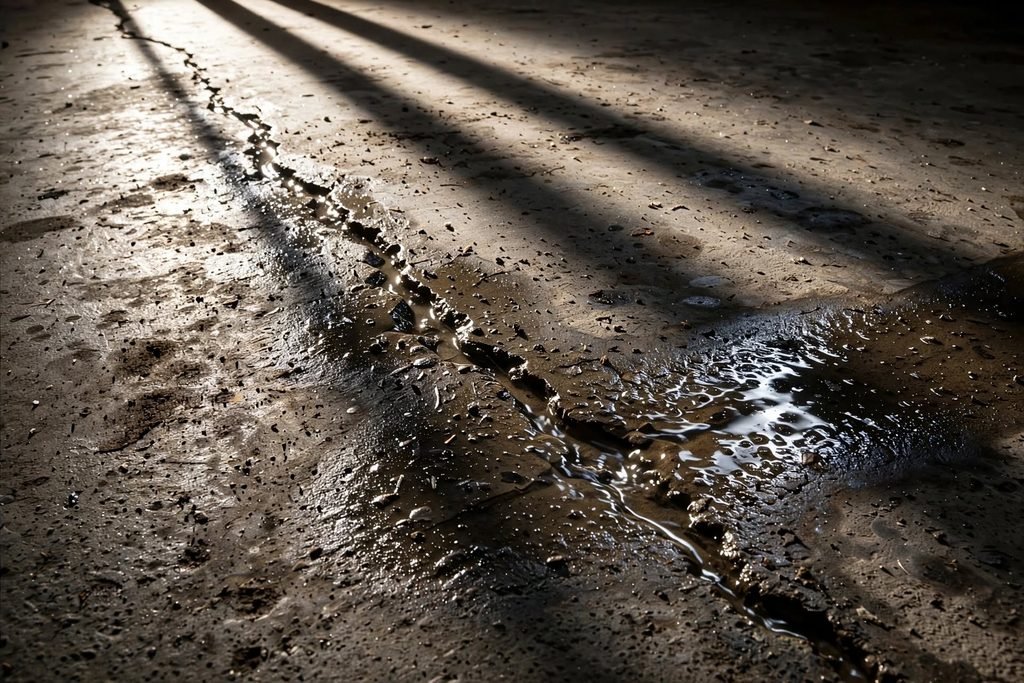
Water appearing in the middle of the slab, seeping up from floor cracks, or emerging from a floor drain is fundamentally different from water running down a wall.
Water through floor cracks means the water table has risen above your slab and hydrostatic pressure is pushing upward. Water from a floor drain or a toilet means a sewer or storm drain backup, which is a health hazard and a plumbing problem rather than a waterproofing one.
What it tells you: Either serious groundwater pressure requiring an interior drainage system, or a sewer issue requiring a plumber and possibly a backwater valve.
How to do a proper inspection
Set aside 45 minutes and do this the day after a heavy rain, when evidence is freshest.
Clear the perimeter. Move stored items at least two feet off the walls. Most leaks are found on the strip of wall that has been hidden behind boxes for eight years.
Bring a bright flashlight held at a low angle. Raking light across a wall reveals texture changes, mineral deposits, and hairline cracks that flat overhead lighting hides completely.
Work systematically. Walk the entire perimeter at eye level, then again looking at the wall-floor joint. Then look up at the rim joist and the underside of the floor above.
Check the specific weak points: every corner, both sides of each window well, every pipe penetration through the wall, the area beneath each exterior downspout location, the area behind the furnace and water heater, and any spot where an old crack was patched.
Photograph and date everything you find, with a coin or tape measure in frame for scale. This becomes your baseline for judging whether things are getting worse.
Mark crack ends with a pencil and the date. Re-check in three months and after a full wet season.
Measure the humidity with a $15 hygrometer, and consider the foil test if you cannot tell whether a wet wall is seepage or condensation.
What each pattern usually points to
| What you found | Most likely source |
|---|---|
| Damp high on one wall, near a window | Window well flooding |
| Damp patch below where a downspout sits outside | Downspout discharging too close |
| Wet band along the wall-floor joint | Cove joint, hydrostatic pressure |
| Water from a specific vertical crack | Crack requiring injection |
| Widespread dampness on all walls | Failed footing drain or high water table |
| Water up through floor cracks | Water table above slab level |
| Beading on walls and pipes in summer | Condensation, not a leak |
| Water from floor drain or toilet | Sewer or storm backup |
Frequently asked questions
How long can a foundation leak go unnoticed? Years, routinely. Behind a finished wall or under stored belongings, a slow seepage can run for a decade before it produces a symptom obvious enough to investigate. This is why periodic inspection of the actual wall surface matters more than waiting for a puddle.
Is a small amount of dampness normal in an old basement? Common, not normal. Older stone and block foundations were built without any waterproofing and many are chronically damp. That does not make it harmless. It means the condition has been tolerated, and it still degrades stored items, feeds mold, and corrodes mechanical equipment.
Does a musty smell always mean mold? Effectively yes. The odor compounds are produced by fungal metabolism. There are rare exceptions like sewer gas or decaying organic material, but a persistent musty basement smell almost always means microbial growth somewhere.
Should I test for mold? Visible mold does not need testing. You already know. Testing is more useful when there is odor with no visible source, when a health issue is involved, or when you need documentation for a real estate transaction. Air sampling from an independent testing firm, one that does not also sell remediation, typically runs $300 to $600.
Can I find a leak myself or do I need a professional? Most homeowners can locate the general area with a flashlight, a rainy day, and patience. Professionals add moisture meters, infrared cameras that reveal wet areas behind finished surfaces, and the experience to read patterns. If your basement is finished, a thermal inspection is genuinely worth the cost.
My basement leaked once three years ago and never again. Should I worry? Investigate what changed. If a gutter was clogged and you cleaned it, that is a solved problem. If nothing changed and it simply has not rained that hard since, the condition is still there waiting for the right storm.
Does insurance cover foundation leaks? Generally not. Standard homeowners policies exclude groundwater seepage and gradual water damage. A water backup endorsement covers sump failure and sewer backup. Flood insurance covers surface water. Neither covers a foundation that has been slowly seeping for years.
Will a leaking foundation affect my home’s value? Yes, and it must be disclosed in most states. A documented, professionally repaired water problem with a transferable warranty is routinely accepted by buyers. An active leak discovered by a buyer’s inspector usually costs more in price concessions than the repair would have.
The bottom line
Foundation leaks are usually visible for a long time before they are obvious. White powder on the block, paint that will not stay put, rust at the bottom of a support column, an uptick in silverfish, a smell you have stopped noticing because it has always been there. Any one of those is worth an hour with a flashlight on the day after a storm.
Move the boxes, light the wall at an angle, walk the whole perimeter, and write down what you find with dates. Early-stage water problems are almost always cheaper to fix from the outside with a shovel and a downspout extension. The ones that get expensive are the ones nobody looked at for ten years.