
Ask any waterproofing contractor in a cold climate which month generates the most emergency calls and the answer is March, sometimes February, occasionally April. Not the wettest month of the year — the thaw month.
A basement that handled every summer downpour without a drop can take on water during a mild week in early spring with no rain at all. The reason is that four separate conditions peak at the same time, and each one amplifies the others.
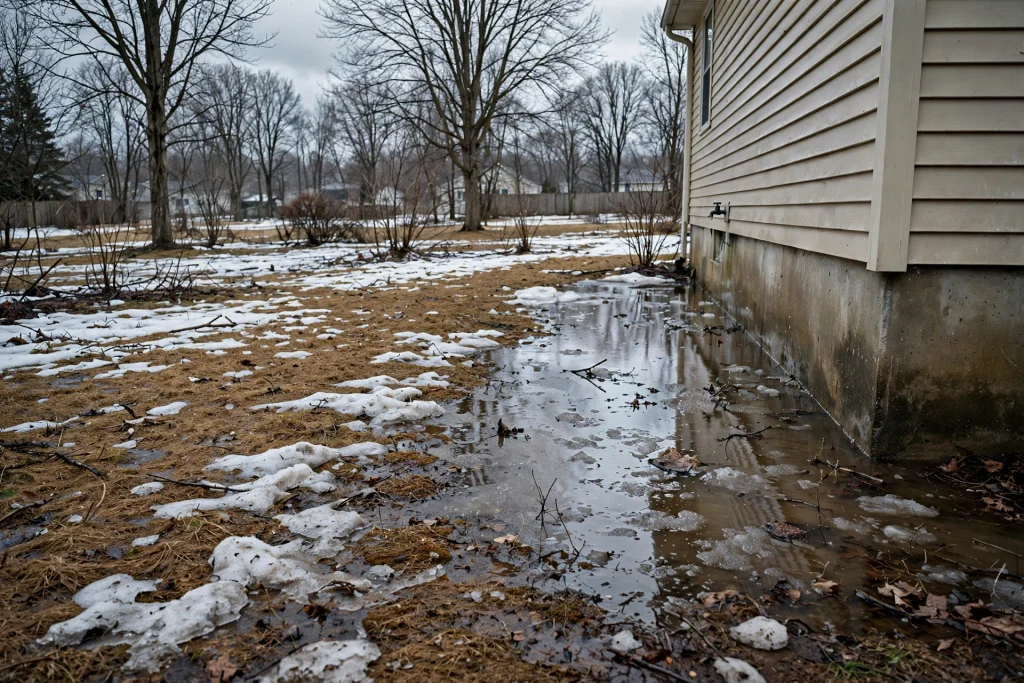
Four things stacking
1. Frozen ground cannot absorb water
This is the biggest factor and the least intuitive.
Soil normally absorbs a large share of precipitation. When the ground is frozen, the pore spaces are filled with ice, and infiltration rates drop dramatically — in many soils by 80 to 90 percent or more.
So meltwater does not soak in. It runs across the surface, following the slope, and the slope near your house leads to your house. Every deficiency in your grading that is harmless in July becomes fully effective in March.
2. Snowpack is a stored reservoir
Snow holds far more water than most people estimate.
The rough rule is 10 inches of snow equals 1 inch of water, though it ranges from about 5:1 for dense wet snow to 20:1 for very dry powder.
Take a modest 18-inch snowpack across a 6,000 square foot yard. At 10:1 that is roughly 11,000 gallons of water sitting on your property, waiting for a warm week. If it melts over three days onto frozen ground, essentially all of it becomes surface runoff.
3. The water table peaks
Groundwater levels are seasonal, and in most cold-climate regions they reach their annual maximum in spring, as accumulated winter precipitation finally recharges the aquifer.
If your water table rises above your basement floor, hydrostatic pressure pushes water up through floor cracks and out at the joint where the wall meets the slab. That is a fundamentally different problem from surface water, and it needs a different fix.
4. Everything is already saturated
By late winter, the soil that is not frozen is already holding as much water as it can. There is no absorption capacity left anywhere in the system.
Add a rain-on-snow event — rainfall onto an existing snowpack — and you get the worst case: the rain accelerates the melt and contributes its own volume, all onto ground that can accept none of it.
What fails during thaw
Sump pumps run continuously for weeks. Spring is by far the heaviest workload of the year, and it is when marginal pumps die. If yours is over seven years old, replace it in autumn rather than discovering the problem in March.
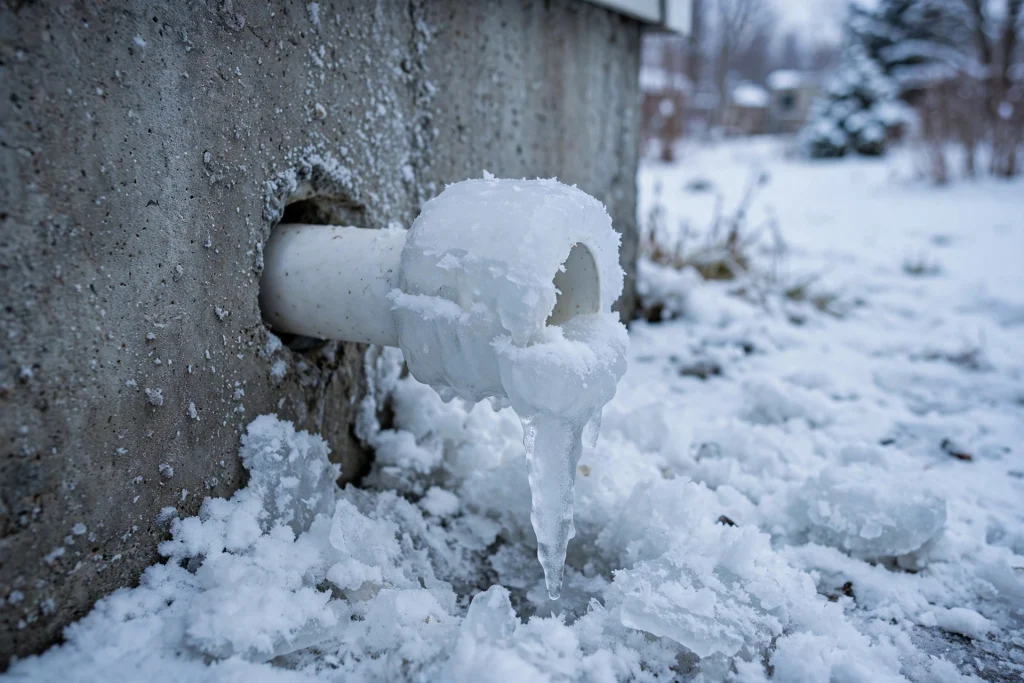
Discharge lines stay frozen. The single most common spring failure. The pump runs, the water has nowhere to go, and the motor overheats. A line that iced up in January may still be blocked during the first thaw.
Window wells fill. They collect drifted snow all winter, which melts into a well whose drain may still be frozen. Causes and fixes here.
Gutters overflow behind ice dams. Meltwater backs up behind ice at the eave and pours over the edge into the soil against the foundation.
Snow piled against the wall melts in place. Whatever was shovelled or plowed against the house releases directly into the backfill zone. More on how snow interacts with a foundation.
Cracks that were dry all year start weeping, because the pressure behind them has never been higher.
Footing drains that are marginal fail entirely. A weeping tile line running at reduced capacity from silt can cope in summer and be overwhelmed in spring.
The timeline
Late winter, before the thaw. Snowpack accumulating, ground frozen, discharge lines potentially iced. This is your last window to prepare.
First warm days, typically 40 to 50°F. Surface snow begins melting. Ground still frozen. Runoff starts. First basement calls.
Sustained thaw plus rain. The peak risk period. Rain-on-snow, full runoff, saturated soil, rising water table.
Ground thaws from the surface down. Absorption slowly resumes, but by now the water table is at its peak, so groundwater problems replace surface water problems.
Late spring. Water table recedes, soil dries, symptoms fade — and homeowners forget about it until next March.
That last point is why so few people fix this. The problem resolves itself in April, which removes the urgency to do anything before the following winter.
Preparation, done in autumn
Everything on this list is easier and cheaper before the ground freezes.
Clear and protect the sump discharge. The highest-value item. Confirm the line slopes continuously downhill so it drains fully between cycles, clear the outlet, and consider an ice guard fitting — a slotted section near the exit that lets water escape if the downstream line freezes.
Test the sump pump. Pour five gallons in, confirm it runs, empties, and shuts off cleanly, and go outside to verify water actually exits. Full procedure here.
Install a battery backup, or check the age of your existing battery. Spring storms and power outages arrive together, and a battery over four years old may be well below capacity. Runtime and lifespan details.
Clean the gutters after leaf fall. Clogged gutters guarantee ice dams and overflow. Why this matters more than it seems.
Check downspout extensions. Use rigid pipe with continuous fall so it drains rather than holding water that freezes. Six to ten feet minimum. Sizing and options.
Fix the grading before the ground freezes. Six inches of fall in the first ten feet. You cannot regrade frozen soil, so this is genuinely an autumn job. How to measure yours.
Cover and clear the window wells.
Address attic insulation and ventilation if you get ice dams. That is where the cause is, not in the gutter.
Get everything off the basement floor, onto shelving or pallets.
Add a high-water alarm. Under $30 basic, $80 to $200 for a Wi-Fi unit that pushes a phone alert.
The full winter checklist is here.
During the thaw
Shovel snow away from the foundation as it melts, ideally clearing a three to five foot band around the house.
Clear the discharge outlet before the first warm spell. Check it again after.
Check the sump pit daily during active melt. Confirm the pump is cycling and the water is leaving.
Break up ice dams at ground level where meltwater is being channelled toward the wall.
Divert flow with a trench in the snow, cut in a line leading away from the house. Crude and effective.
Watch for the second freeze. Meltwater refreezing overnight blocks drainage paths, so the following day’s melt has nowhere to go.
Do not use rock salt on concrete to clear meltwater paths. It accelerates freeze-thaw damage to the concrete itself.
Telling surface water from groundwater
This determines whether you have a $300 problem or a $12,000 one, so it is worth observing carefully.
Surface water appears within hours of melt starting, is concentrated in specific locations, correlates with where snow sits outside, and stops when the melt stops. Fixed by grading, downspouts, and snow management.
Groundwater appears at the wall-floor joint or up through floor cracks, arrives a day or more into the thaw, persists for days or weeks after, and affects multiple walls. Fixed by drainage systems.
The foil test distinguishes seepage from condensation if you are unsure what you are looking at. Details here.
Note that a basement which floods only in spring and stays dry all summer is usually telling you the system is adequate for normal conditions and overwhelmed by peak load. That often points to surface water management rather than a full drainage retrofit.
Frequently asked questions
Why does my basement only flood in spring? Because four conditions peak simultaneously: frozen ground blocking absorption, a large snowpack melting, the annual high water table, and already-saturated soil. Any one alone is manageable; together they overwhelm systems that cope fine the rest of the year.
How much water is in my snow? Roughly one inch of water per ten inches of snow, varying from 5:1 for wet dense snow to 20:1 for dry powder. An 18-inch pack over a 6,000 square foot yard is on the order of 11,000 gallons.
Should I shovel snow away from my foundation? Yes, ideally clearing three to five feet around the house, and definitely before a forecast thaw. Snow piled against the wall melts directly into the backfill zone.
Why did my sump pump fail in March? Most commonly a frozen discharge line, or a pump at the end of its life failing under the heaviest workload of the year. Both are preventable in autumn.
Can I fix spring flooding in spring? Only partially. You can shovel snow away, clear discharge lines, and divert surface flow. Grading and drainage work require unfrozen ground, so the real fixes happen in autumn.
Is spring flooding a sign I need a drainage system? Not necessarily. If it only happens during peak thaw and the basement is dry otherwise, surface water management may be sufficient. Do the cheap work first and observe next spring before committing to five figures.
Does insurance cover spring meltwater flooding? Generally not. Standard policies exclude surface water and groundwater seepage. Flood insurance covers rising surface water but has a 30-day waiting period, so it cannot be bought once a thaw is forecast. More on coverage.
What if water is already coming in? Get everything off the floor, clear the discharge line, confirm the pump is running, and shovel snow away from the affected wall. Emergency response sequence here.
The bottom line
Spring floods basements because frozen ground turns your whole yard into a hard surface, the snowpack releases thousands of gallons over a few days, the water table hits its annual peak, and your sump discharge may still be full of ice.
The awkward part is that the fixes belong to October and the problem belongs to March. Clear the discharge line, test the pump, replace the battery, clean the gutters, and check the grading while the ground is still soft. Then in March you will be watching the melt rather than standing in it.