
Nearly every winter basement problem is something that could have been handled in October for less money and considerably less discomfort.
The reason is that cold weather removes your options. You cannot regrade frozen ground. You cannot easily replace a sump pump during a thaw when you need it running. You cannot air-seal a rim joist with three feet of snow against the wall outside.
Here is the full checklist, in the order it should happen.
Early autumn: outside first
This is the highest-value work and it has to happen before the ground freezes.
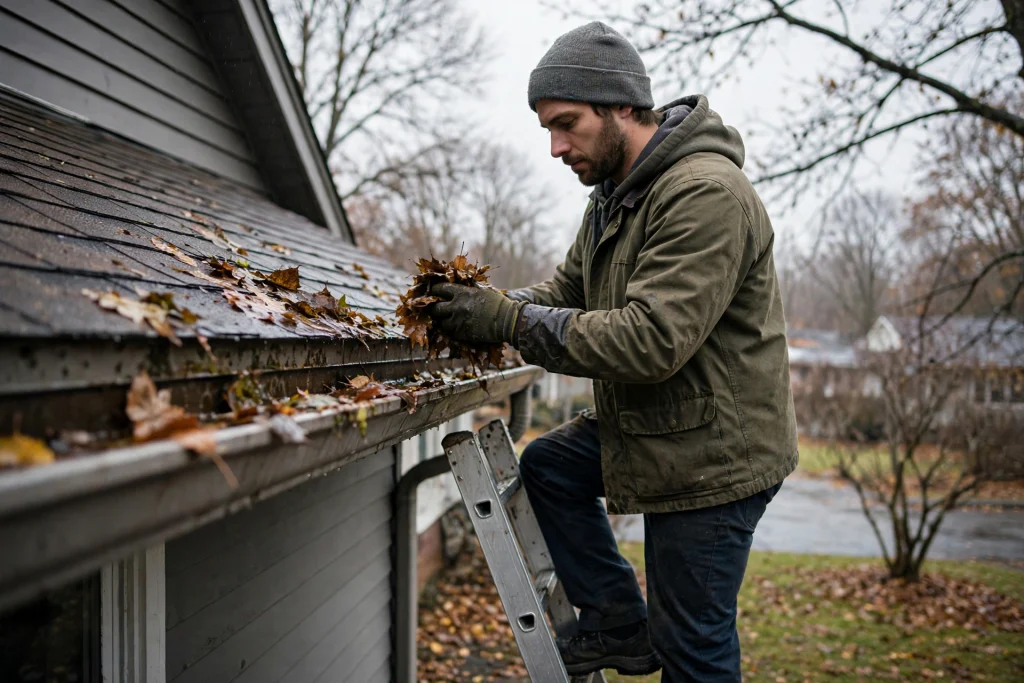
Clean the gutters after leaf fall. Not before — do it once the trees are actually bare, or you will be doing it twice. Packed debris holds water that freezes and contributes to ice dams. Why gutters matter to a basement.
Check gutter pitch and hangers. Sagging sections hold water and ice, and the added weight pulls them further.
Switch to rigid downspout extensions. Flexible corrugated tubing sags, holds water, and freezes solid. Use rigid pipe with continuous downhill fall so it drains completely between events. Six to ten feet minimum.
Fix the grading while the soil is workable. Six inches of fall in the first ten feet. This is genuinely impossible once the ground freezes. How to measure and correct it.
Clear and cover window wells. Remove debris, check the gravel base drains, and fit polycarbonate covers so they do not fill with snow. Details here.
Clear the footing drain outlet if you have a daylight discharge, and fit a rodent grate.
Shut off and drain exterior hose bibs. Close the interior valve, open the exterior spigot, and drain the line. Disconnect and store hoses — a connected hose is the classic cause of a burst bib.
Blow out irrigation lines.
Trim vegetation back from the foundation so you have working access all winter.
Plan where snow will go. Decide now, and tell whoever plows your driveway. At least 10 feet from the house, downhill where possible, and never against the wall. Why it matters.
The sump system
The single most likely thing to fail when you need it most.
Test the pump properly. Pour a five-gallon bucket into the pit, confirm it activates, empties, and shuts off cleanly. Then go outside and confirm water is actually exiting the discharge. The full test procedure.
Watch for backflow after shutoff. If the water level jumps back up within seconds, your check valve has failed. A $15 to $40 part.
Clean the pit. Remove silt and gravel that has accumulated.
Clear the discharge line end to end. Confirm continuous downhill slope with no low spots that hold water and freeze.
Fit an ice guard. A slotted section near the exit that lets water escape if the downstream line ices up. This is the fix for the most common winter pump failure, where the pump runs against a frozen line and overheats.
Disconnect flexible discharge extensions that will trap water and freeze.
Replace the pump if it is over seven years old. A planned $150 replacement in October beats an emergency one in March. Lifespan and warning signs.
Test the battery backup under load, not by looking at the charger light. Unplug the primary, pour water in, and confirm the backup handles a full cycle. Replace batteries every 3 to 5 years. Runtime and lifespan.
Add a high-water alarm if you do not have one. $25 for a basic unit, $80 to $200 for a Wi-Fi model that texts you.
Plumbing and freeze protection
Insulate exposed pipes, especially any running along exterior walls or through unheated areas. Foam sleeves cost pennies per foot.
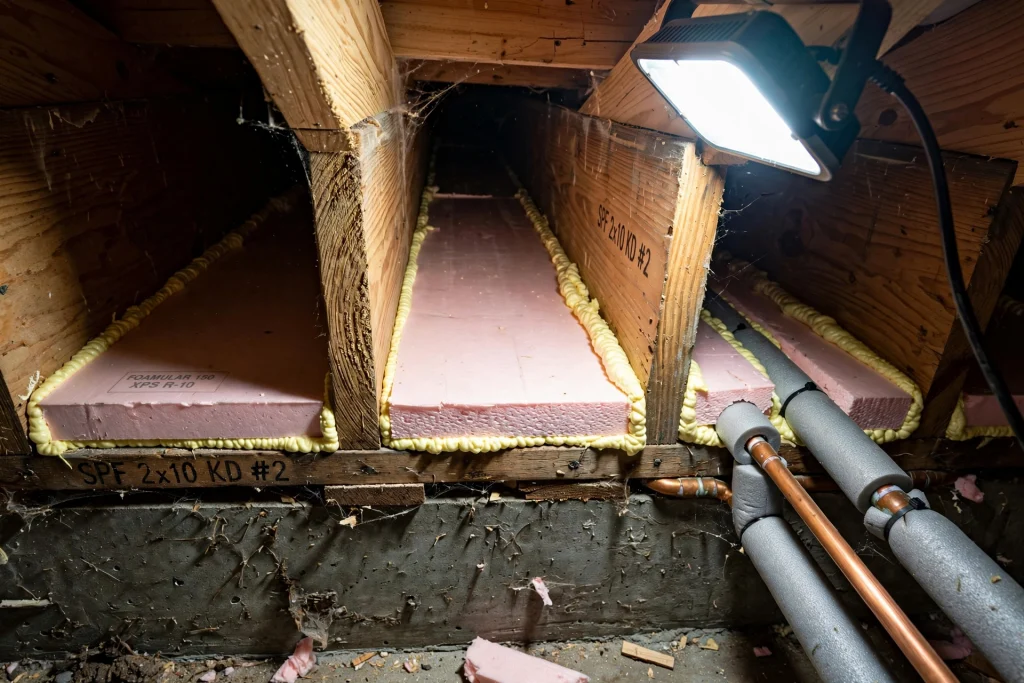
Air-seal and insulate the rim joist. The band of framing at the top of the foundation wall is one of the biggest air leaks in most houses and it sits right beside your pipes. Rigid foam cut to fit and sealed, or closed-cell spray foam.
Seal foundation penetrations where pipes, cables, and vents pass through the wall.
Know where the main water shutoff is, and make sure it turns. Tag it so anyone in the house can find it.
Keep the basement above 55°F. Pipes freeze well before the air reaches 32°F, because the air in a cold corner near a rim joist is much colder than the thermostat reading.
Open cabinet doors under sinks on exterior walls during severe cold.
If leaving for an extended period, either keep the heat at 55°F minimum or shut off and drain the water system entirely. Do not leave a house unheated with water in the pipes.
Humidity, air and structure
Decide about the dehumidifier. Most basements need much less dehumidification in winter, since cold air holds little moisture. Standard compressor units also lose capacity and can frost up below about 60°F. Monitor with a hygrometer and run it only if readings stay above 55 percent. Target range and reasoning.
Watch for winter condensation at cold spots — rim joists, window frames, uninsulated corners. Winter condensation is localised rather than general.
Keep crawl space vents sealed if you have an encapsulated space, or seal them for the season if you operate them manually. Vented vs encapsulated.
Photograph and date any cracks before the freeze. Mark both ends with a pencil. Winter is when frost pressure does its work, and a spring comparison against a dated photo tells you whether anything moved.
Seal exterior concrete with a penetrating silane or siloxane sealer if you have not in the last few years, and do it before the first freeze. Why penetrating rather than film-forming.
Get everything off the floor. Boxes on pallets or shelving, four inches minimum. Plastic bins rather than cardboard.
The winter kit
Assemble it in October, store it in one tote in the basement.
| Item | Cost | Purpose |
|---|---|---|
| Drill-powered transfer pump | $20 to $40 | Moves water without grid power |
| Wet/dry shop vac | $60 to $150 | Handles an inch or two |
| Heavy-duty extension cord | $20 to $40 | Reach a live circuit |
| Battery lantern and headlamp | $25 to $50 | Hands free in the dark |
| Spare check valve | $15 to $40 | Most common failure part |
| Spare float switch | $20 to $60 | Second most common |
| Hydraulic cement | $8 to $20 | Plugs an active leak fast |
| Rubber boots and gloves | $30 to $60 | Basic safety |
| Roof rake | $40 to $80 | Ice dam prevention from the ground |
| Sand or CMA de-icer | $15 to $40 | Traction without chloride damage |
Under $300, and it converts a crisis into an inconvenience. What to do if the pump fails mid-storm.
During winter
After each significant snowfall: clear a three to six foot band around the foundation, and check the sump discharge outlet for ice.
Monthly: walk the basement perimeter with a flashlight. Check for new dampness, and confirm the pump still cycles.
Watch for icicles along the eaves — the warning sign of ice dams. Rake the lower roof from the ground.
During any thaw: check the basement daily, and check the discharge outlet daily.
Before a hard freeze after a thaw: confirm the discharge line drained and did not refill.
Frequently asked questions
When should I start winterising? Outdoor work in early to mid autumn while the ground is still workable. Gutter cleaning after leaf fall. Sump system testing any time before the first hard freeze.
Should I run my dehumidifier in winter? Usually not much. Cold air holds little moisture and compressor units perform poorly below about 60°F. Monitor with a hygrometer and run it only if humidity stays above 55 percent.
How cold is too cold for a basement? Below about 55°F, freeze risk rises for pipes near exterior walls and rim joists. Air in cold pockets is considerably colder than your thermostat suggests.
Will my sump discharge freeze? It can, and it is the most common winter pump failure. Prevent it with rigid pipe, continuous downhill fall, no low spots, and an ice-guard fitting near the exit.
Should I turn my sump pump off in winter? No. Thaws happen, and a pump that has been off all winter may not start when it is needed. Leave it powered and test it monthly.
Do I need to worry if my basement is unheated? More so. Insulate pipes thoroughly, consider heat cable on vulnerable runs, and be prepared to drain the system if you leave for an extended period.
What if I find a crack in winter? Photograph it, mark the ends with a pencil, and date it. Cold-weather injection repairs are possible but resins slow considerably below their minimum substrate temperature. Monitoring until spring is usually reasonable unless it is leaking actively. How to read what a crack means.
Is there anything I genuinely cannot do until spring? Regrading, exterior excavation, and most concrete work. Which is exactly why the autumn window matters.
The bottom line
Winter preparation is mostly an October project done outside the house. Clean gutters, rigid downspout extensions, corrected grading, covered window wells, and a plan for where snow goes.
Then the sump system, because a frozen discharge line is the most common winter failure and an ice guard costs almost nothing. Test the pump with a bucket, test the backup battery under load, and replace anything over seven years old on your schedule rather than the weather’s.
Everything on this list is cheaper and easier in October than in March. That is the whole argument.