
Weeping tile is the perforated drainage pipe buried around the base of your foundation. It has been standard practice in residential construction for over a century, most houses built since the 1950s have one, and almost no homeowner knows whether theirs is still working.
That last part matters, because a clogged weeping tile is one of the most common explanations for a basement that stayed dry for twenty-five years and then started leaking with no other apparent change. And it is one of the few situations where a $500 diagnostic can turn a $20,000 quote into a $900 repair.
Where the name comes from
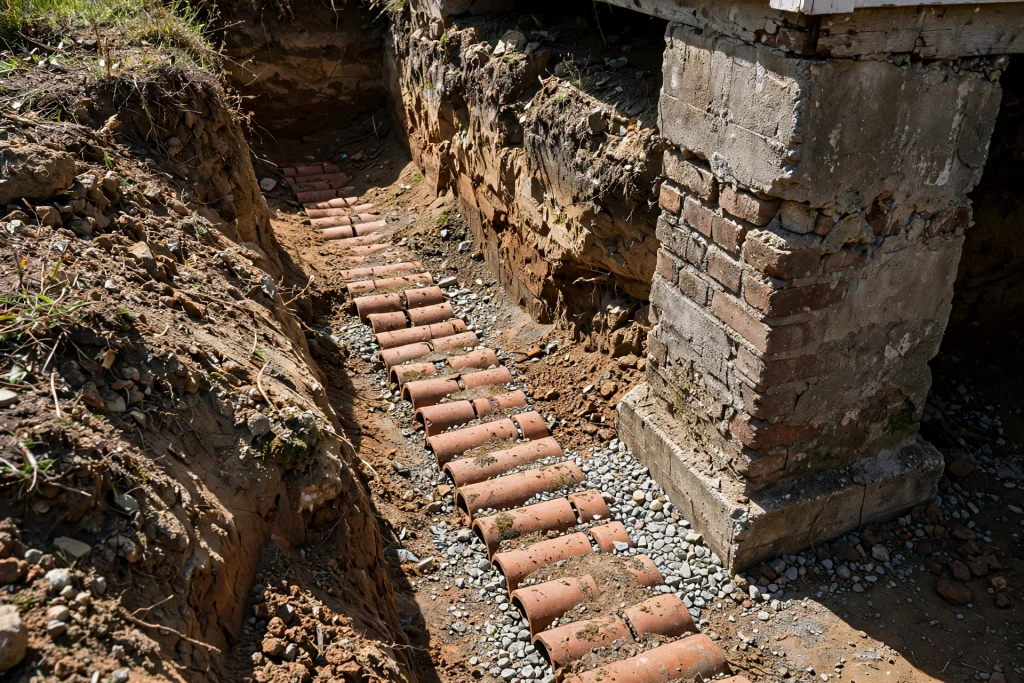
Original systems used short lengths of unglazed clay tile, laid end to end with small gaps between them. Water “wept” into the line through those gaps. The name outlived the material.
Modern installations use perforated PVC or corrugated HDPE, but the term stuck, particularly in Canada and the northern United States. Elsewhere you will hear the same thing called drain tile, a footing drain, a perimeter drain, or a french drain. They describe the same component.
What it does
Weeping tile sits at the base of the footing, bedded in clean stone, sloped continuously toward an outlet.
Groundwater percolating down through the soil reaches the gravel envelope, which offers far less resistance than compacted earth. It enters the pipe through the perforations and flows away by gravity, either to daylight on a sloped lot or to a sump pit on a flat one.
The point is to intercept water before it can accumulate against your foundation. Without it, water collects in the loose backfill soil surrounding the house, builds hydrostatic pressure, and eventually pushes through the concrete itself.
Some houses have exterior weeping tile only, some have interior drain tile only, and some have both.
Does your house have one?
Look in the sump pit. Shine a light in and check the side walls for pipes entering the basin. A proper installation has at least one inlet, usually two. This is the single most reliable indicator.
Check the age. Houses built after roughly 1950 usually have some form of footing drain. Pre-war homes frequently have none at all, particularly those with stone foundations.
Look for a cleanout. A capped vertical pipe at ground level near the foundation, or a capped riser in the basement floor.
Look for a daylight outlet. On a sloped lot, walk the low side of the property and look for a pipe emerging from the bank, often with a grate. Check whether it runs during heavy rain.
Check the plans. Original building drawings, if you have them, or your municipality’s building department records.
No sump pit, no cleanout, no daylight outlet, and an older home is a reasonable indication that you may not have one, or that it was never connected to anything.
Materials, and why yours matters
Clay tile, pre-1960s. Short sections with open joints. Prone to shifting apart, root intrusion at every joint, and collapse. If your house is old enough for clay tile, it has likely degraded substantially.
Concrete tile, mid-century. Similar issues to clay.
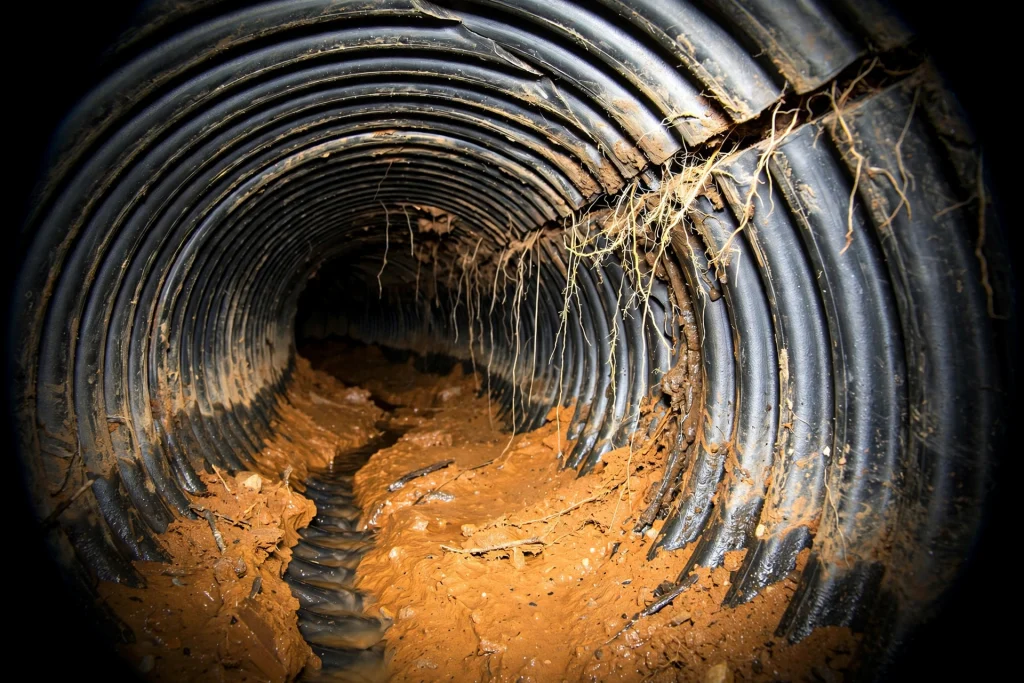
Corrugated HDPE, 1970s onward. The black flexible pipe. Cheap and easy to install. The corrugations trap sediment, the pipe crushes under soil load, and it is difficult to clean effectively because a jetter nozzle catches on every ridge.
Rigid perforated PVC, modern best practice. Smooth interior carries silt through rather than trapping it, resists crushing, and can be jetted clean. If you are ever replacing, this is what to specify.
With or without filter fabric. Systems installed without a geotextile filter are far more likely to have silted up. Fabric was not routinely used until the 1980s in residential work.
Why weeping tile fails
Silt accumulation. Fine soil particles migrate into the gravel and the pipe over decades, particularly without filter fabric, until flow capacity is gone. The most common failure.
Root intrusion. Roots seek moisture and enter through perforations and joints, then proliferate inside. Trees near the foundation are the usual source, and clay tile with open joints is especially vulnerable.
Crushing. Corrugated pipe collapses under soil load, heavy equipment, or vehicle traffic.
Joint separation. Clay and concrete tile sections shift apart as soil settles.
Iron ochre. In soils with high iron content, iron-oxidising bacteria produce a slimy orange-brown sludge that clogs pipe and gravel. It regenerates after cleaning and is one of the more difficult problems to resolve permanently.
Outlet blockage. Debris, soil, animal nests, or ice at the daylight discharge. Sometimes the entire problem, and sometimes fixable in ten minutes.
Never installed properly. No slope, no gravel, no fabric, or not connected to any outlet. More common than it should be.
Signs it has failed
The pattern is more diagnostic than any single symptom.
A house that was dry for years and gradually started leaking, with no change in landscaping, gutters, or grading. This is the classic signature of a drain silting up over time.
A sump pit that has become progressively less active while the basement has become wetter. Water is arriving at the foundation and is no longer being delivered to the pit. This combination is the strongest single indicator available.
Water appearing at the cove joint where the wall meets the floor, or up through floor cracks, which means water is accumulating under the slab.
Seepage on multiple walls at once rather than one localised spot.
A daylight outlet that stays dry during heavy rain, when it should be running.
New or worsening efflorescence across broad areas of wall.
Spring being dramatically worse than other seasons, since thaw conditions put peak load on a system with no remaining capacity.
How to diagnose it
Check the outlet first. If you have a daylight discharge, walk out during heavy rain and see whether water is coming out. Clear any debris and re-check. This is free and it sometimes ends the investigation.
Run the hose test. Find a cleanout and run a garden hose into it for several minutes. Water should arrive at the outlet or the sump within a reasonable time. If it does not, there is an obstruction.
Get a camera inspection. The definitive answer. A drainage contractor or plumber runs a camera through the line, typically $200 to $500, and identifies whether the problem is silt, roots, a collapse, a separation, or nothing at all.
This is the highest-value $300 in basement waterproofing, because it distinguishes between a line that can be cleaned and one that must be replaced. Those two outcomes differ by roughly an order of magnitude in cost.
Do not skip this before accepting a drainage system quote. A contractor who recommends a full interior system without checking whether your existing drain is simply clogged is selling rather than diagnosing.
Repair options
Hydro-jetting
High-pressure water blasts silt, sludge, and roots out of the line. Effective on rigid PVC, workable on clay, less effective on corrugated pipe where the ridges shelter debris.
Cost: $400 to $1,200. Caveat: it does not clear silt from the surrounding gravel bed, so results vary. If jetting restores flow and the basement dries out, you have saved a great deal of money.
Rodding or augering
Mechanical cutting, primarily for root intrusion. Often combined with jetting. Roots return, so it becomes periodic maintenance unless the source tree is dealt with.
Cost: $300 to $800.
Adding a cleanout
If your system has no access point, installing one makes all future maintenance possible.
Cost: $300 to $1,000.
Interior drain tile
Rather than excavating to replace a failed exterior line, install a new system inside. Far less disruptive and typically half the cost. The full comparison is here.
Cost: $60 to $150 per linear foot.
Exterior replacement
Excavate to the footing, remove the old line, install new rigid perforated pipe with filter fabric and clean stone, and apply a waterproofing membrane while the wall is exposed.
The most thorough option, and the most expensive.
Cost: $100 to $300 per linear foot, plus landscaping restoration.
Before you spend anything
A clogged weeping tile is a real and common problem. It is also a diagnosis that gets reached too quickly, because the alternative explanations are cheaper and less interesting to sell.
Check these first:
Downspout discharge. Hundreds of gallons per storm delivered against the wall will overwhelm any drainage system, working or not.
Gutters. An overflowing gutter puts a curtain of water into the backfill.
Grading. Six inches of fall in the first ten feet.
Whether the water is even coming in at footing level. Water entering high on a wall, through a crack, or through a window well never reaches the weeping tile and is not its job.
Lifespan and maintenance
Clay tile: 30 to 50 years, often less. Corrugated HDPE: 30 to 50 years. Rigid PVC with filter fabric and clean stone: 50 years or more.
Annually: check that the daylight outlet is clear and confirm it runs during rain. Every few years: hose test through the cleanout. Every 10 to 15 years: consider preventive jetting, particularly in silty soil or where trees are nearby. Keep large trees away from the drain line, and understand that root intrusion recurs unless the source is addressed.
Frequently asked questions
Does every house have weeping tile? No. Pre-1950s homes frequently have none. Some houses have it only on certain sides. Some have it installed but never connected to a functioning outlet.
How do I know if mine is clogged? The strongest signal is a pit that has become less active while the basement has become wetter, or a daylight outlet that stays dry during heavy rain. A camera inspection confirms it.
Can weeping tile be cleaned? Often, by hydro-jetting, provided the pipe is intact and there is access. It cannot be cleaned if the line has collapsed or separated, and results are less reliable in corrugated pipe.
How much does replacement cost? Exterior replacement runs $100 to $300 per linear foot plus restoration, commonly $15,000 to $40,000 whole-house. Interior drain tile is typically half that and far less disruptive.
Should I replace it before it fails? Not usually, because it is expensive and often still working. Do get a camera inspection if the basement has started leaking, if the house is over 40 years old with original clay tile, or if you are already excavating for another reason.
Can I install weeping tile myself? Excavating to footing depth alongside a loaded foundation is genuinely dangerous work; unshored trenches collapse. This is professional work, and usually permitted.
Does weeping tile stop condensation or humidity? No. It manages liquid groundwater. Vapour still moves through concrete, and most basements need a dehumidifier at 45 to 50 percent regardless.
What is iron ochre and can it be fixed? A sludge produced by iron-oxidising bacteria in iron-rich soils. It clogs pipe and gravel and regenerates after cleaning. Management usually means regular jetting, easy-access cleanouts, and sometimes a dedicated system designed for it. There is no simple permanent cure.
The bottom line
Weeping tile is the buried perimeter drain that has been quietly protecting your foundation since the house was built, and it does not last forever. Silt, roots, and crushing take it out over decades, and the failure is invisible until the basement starts leaking.
The tell is a specific combination: a house that used to be dry, a sump that has gone quiet, and walls that have gone damp. If that describes yours, spend $200 to $500 on a camera inspection before you spend anything else. It is the one test that reliably separates a $900 cleaning from a $20,000 replacement.