
There is one concept underneath this whole debate, and once you have it, most of the marketing claims sort themselves out.
Water pressure has a direction. It pushes from the wet side toward the dry side. Anything you apply to the wet side gets pressed against the wall. Anything you apply to the dry side gets pressed off it.
Engineers call these the positive side and the negative side. Exterior waterproofing is positive-side work. Interior waterproofing is negative-side work. That single physical fact explains why exterior membranes last for decades and why the bucket of waterproof paint in your basement peeled off in sheets.
It also explains why the best interior systems do not try to block water at all. They drain it.
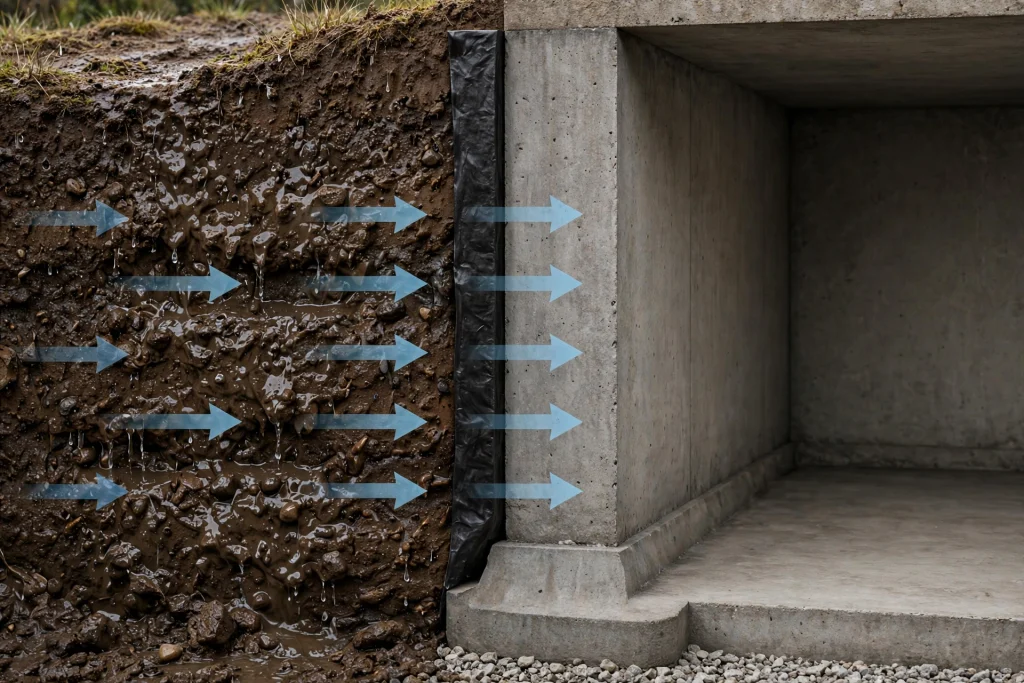
Positive side vs negative side
Positive side, the exterior
A membrane applied to the outside face of the wall has water pressing it into the concrete. The harder the pressure, the tighter the seal. Any imperfection in the bond is compressed rather than opened.
It also keeps the wall itself dry, which prevents freeze-thaw damage, mortar deterioration, efflorescence, and the slow saturation that degrades masonry over decades.
Negative side, the interior
A coating applied to the inside face has water pressing it away from the wall. It relies on adhesion to the outer fraction of an inch of concrete to resist a force measured in hundreds of pounds per square foot.
It loses. Not always immediately, but reliably. Coatings blister, delaminate, and peel, frequently taking the surface layer of concrete with them. Meanwhile the water still saturates the wall, and now it is trapped behind a film where it does more damage out of sight.
This is why the effective interior approach is drainage, not sealing. Instead of trying to hold water back, you give it a path to a sump pit and pump it out. You stop fighting the pressure and start relieving it.
What “waterproofing” actually means
Two terms get used interchangeably and they are not the same thing.
Damp-proofing resists moisture but not liquid water under pressure. The black asphaltic spray that builders apply to foundation exteriors is damp-proofing. It is required by code in many jurisdictions, it costs very little, and it is not waterproofing.
Waterproofing resists liquid water under hydrostatic pressure. It is a continuous, elastic membrane capable of bridging small cracks.
Many homeowners assume their house was waterproofed when it was built. In most residential construction it was damp-proofed, which is a substantially lower standard.
Exterior methods
Excavation and membrane
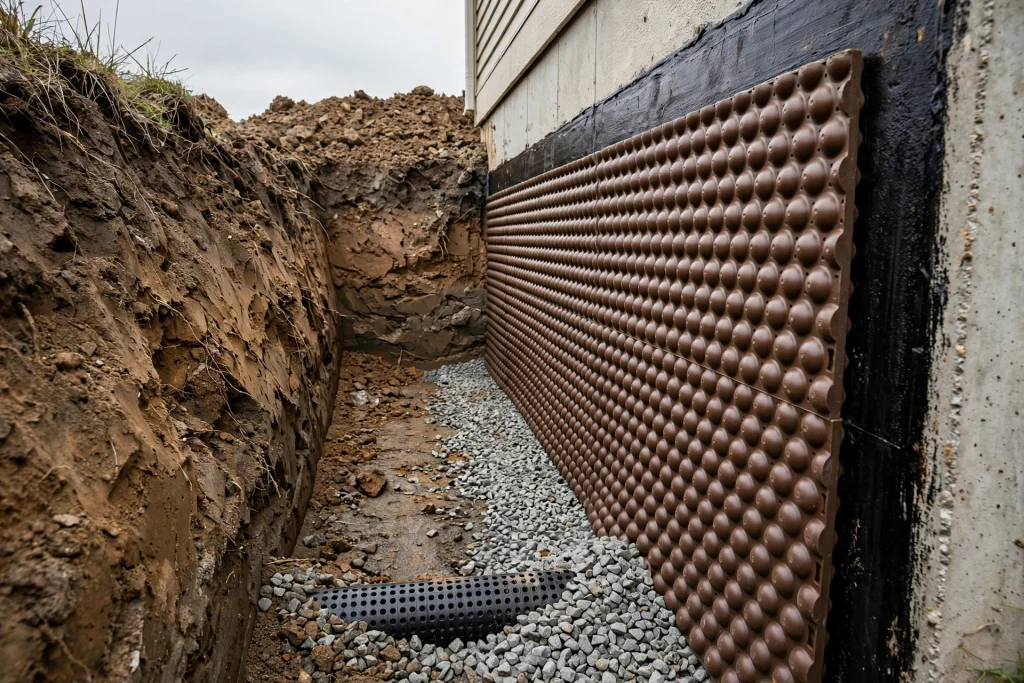
The full treatment: excavate to the footing, clean and repair the wall, apply a waterproofing membrane, add drainage board, install a footing drain in clean stone, and backfill with free-draining material.
Membrane types:
Rubberized asphalt sheet. Self-adhering peel-and-stick sheets, typically 60 mil. Reliable, consistent thickness, seams need care.
Liquid-applied elastomeric. Sprayed or rolled on, forming a seamless membrane. Conforms to irregular surfaces well, which matters on stone or rough block. Thickness depends on the applicator.
Bentonite panels. Clay panels that swell dramatically on contact with water to form a self-sealing barrier. Effective, and they self-heal small punctures.
Drainage board or dimpled membrane. A plastic sheet with raised dimples creating an air gap against the wall, giving water a vertical path down to the footing drain rather than sitting against the membrane. Not waterproofing by itself, but a valuable component.
Cost: $15,000 to $40,000 for an average house, plus landscaping restoration.
Partial exterior
Excavating only the affected wall. Practical when the problem is localised and access allows. Roughly proportional to the linear footage.
Exterior curtain drain
Not wall treatment at all, but intercepting water uphill before it reaches the foundation. On sloped lots this sometimes solves the problem for a fraction of full excavation.
Interior methods
Interior perimeter drainage — the one that works
A channel cut through the slab along the footing, perforated pipe in clean stone, weep holes drilled into block cores, a vapour barrier directing wall seepage down into the drain, new concrete over the top, and everything routed to a sump.
This does not stop water. It manages it, and it manages it well enough that the basement stays dry and usable. The detailed comparison with exterior drainage is here.
Cost: $8,000 to $20,000.
Crack injection
For a discrete leaking crack rather than general seepage, polyurethane injection fills the crack through the full wall thickness and often extrudes into the soil, forming a seal on the positive side. This is the one interior repair that genuinely reaches the outside.
Cost: $400 to $900 per crack.
Crystalline coatings
Chemicals that react with moisture and unhydrated cement to grow insoluble crystals inside the pore network rather than as a surface film. Because the seal forms within the concrete, it is not vulnerable to peeling under pressure.
The most technically defensible negative-side product, and it still will not overcome serious hydrostatic pressure or a structural crack.
Masonry sealer paints
The product most often sold as “basement waterproofing” at the hardware store. It has a narrow legitimate use: a wall that is only mildly damp from vapour, with no pressure and no active seepage, where the coating reduces vapour transmission and improves appearance.
Applied over an active leak, it fails and hides the evidence you need for diagnosis.
Vapour barriers and wall panels
Systems that catch wall seepage behind a plastic panel and channel it down into the perimeter drain. Not waterproofing, but a sensible component of an interior system if you plan to finish the space.
Side by side
| Exterior | Interior | |
|---|---|---|
| Pressure side | Positive, water pushes it on | Negative, water pushes it off |
| Keeps the wall dry | Yes | No |
| Stops water reaching the basement | Yes | Yes, by draining it |
| Requires a pump | Not always | Usually |
| Cost | $15,000 to $40,000 | $8,000 to $20,000 |
| Landscaping | Destroyed and restored | Untouched |
| Duration | 1 to 3 weeks | 2 to 5 days |
| Weather dependent | Yes | No |
| Works in tight lots | Often not | Yes |
| Protects deteriorating masonry | Yes | No |
| Typical warranty | 10 to 25 years | Often lifetime, transferable |
Which to choose
Exterior makes the strongest case when:
- The wall material itself is deteriorating: stone, crumbling mortar, spalling block
- You are already excavating for a sewer line, egress window, or foundation repair
- The house is under construction, where doing it right costs a fraction of retrofitting
- There is no viable discharge point for a sump
- You want the wall assembly genuinely dry before finishing to a high standard
Interior makes the strongest case when:
- Budget is a real constraint
- Access is blocked by property lines, an attached garage, a driveway, or a neighbouring structure
- Mature landscaping or hardscape has significant value
- Water is coming up through the floor or at the cove joint, which is under-slab water that exterior work does not address
- You want a transferable lifetime warranty
- You need the work done quickly, or in winter
The step that comes before both
Both of these are groundwater solutions in the $8,000 to $40,000 range. A substantial share of basement water problems are surface water problems in the $200 to $2,000 range.
Do these first, without exception:
Extend the downspouts six to ten feet. One inch of rain on an average roof delivers hundreds of gallons to each downspout.
Clean and inspect the gutters.
Fix the grading. Six inches of fall in the first ten feet.
Check whether the existing footing drain is merely clogged. A camera inspection at $200 to $500 sometimes turns a $20,000 quote into a $900 jetting job.
Then run through the full diagnostic sequence and see what is left. A contractor who quotes a system before walking the outside of your house deserves a second opinion.
What neither one fixes
Structural problems. A bowing wall or a horizontal crack needs reinforcement. Waterproofing removes the force that caused it; it does not restore lost strength.
Humidity. A dry basement in a humid climate can still sit above 60 percent relative humidity from vapour diffusion alone. You will still want a dehumidifier holding 45 to 50 percent.
Sewer backups. Water coming up a floor drain is a plumbing problem needing a backwater valve.
Bad surface drainage. Both systems will work harder forever if water keeps being delivered to the foundation.
Frequently asked questions
Is interior waterproofing a scam? Interior drainage is legitimate engineering and works well. Interior sealing sold as a standalone cure for an actively leaking wall is where the problems start, because negative-side coatings fail under pressure.
Why did my waterproof paint peel off? Because it was on the negative side. Water pressure and vapour accumulated behind the film until the bond failed. That is the coating behaving exactly as the physics predicts, not a defective product.
Can I do exterior waterproofing myself? Excavating eight feet down alongside a loaded foundation is genuinely dangerous. Unshored trench walls collapse and kill people every year. This is professional work with permits.
Does exterior waterproofing fix cracks? The membrane bridges small cracks and stops water entering through them. It does not restore structural continuity, which is what epoxy injection does.
How long does either last? Exterior membranes are commonly rated 10 to 30 years, often longer in practice because they are protected from UV and physical damage. Interior drainage should function for decades, with the pump as the consumable. More on expected service life here.
Will insurance pay for this? No. Standard homeowners policies exclude groundwater seepage and treat waterproofing as maintenance rather than damage. Coverage details here.
Can I do part now and part later? Yes, and partial systems are common. Treat the affected walls, monitor through a wet season, and extend if needed.
How do I judge a contractor? Ask them to explain the mechanism causing your water, not just the product. Get three quotes. Check whether the warranty is transferable and what specifically it covers. Be wary of same-day pricing pressure, and of any quote issued without an exterior walk-around.
The bottom line
Which side of the wall the water pressure is on decides what can work. Exterior treatments are pressed onto the wall and last. Interior coatings are pressed off it and fail. Interior drainage sidesteps the problem entirely by relieving the pressure instead of resisting it, which is why it is the standard retrofit.
Exterior is the better engineering answer for a wall that needs protecting. Interior is the better value answer for a homeowner who wants a dry basement. Both are the wrong first purchase if your downspouts still empty against the foundation.