
If your basement takes on water and the cheap fixes have not solved it, you will eventually be choosing between two systems. One is a drain installed outside the foundation. The other is a drain installed inside it.
Contractors have strong opinions, and the opinions correlate suspiciously well with what each company sells. Exterior specialists will tell you interior systems only manage water instead of stopping it. Interior specialists will tell you exterior work is a five-figure excavation for a marginal improvement.
Both have a point. Here is the comparison without a product to sell.
The short version
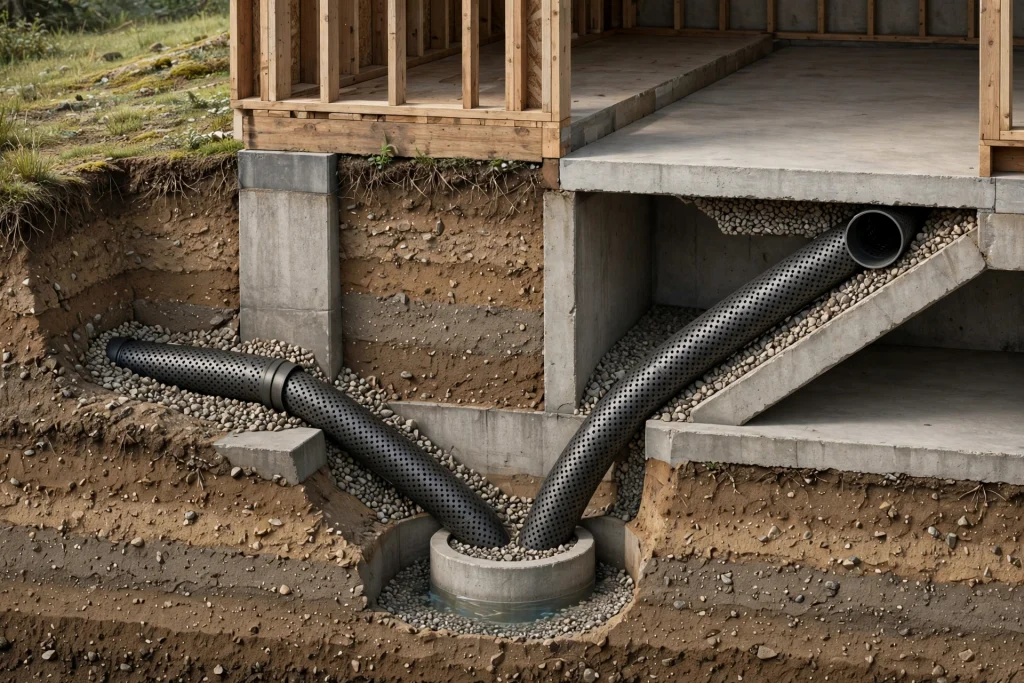
Exterior french drain, also called a footing drain, sits outside the wall at footing level, bedded in gravel. It intercepts groundwater before it touches the foundation. It requires excavating the perimeter of the house, and it costs $100 to $300 per linear foot.
Interior drain tile sits beneath the basement slab along the inside of the footing. It intercepts water after it reaches the foundation but before it reaches your floor, routing it to a sump pit. It requires cutting the slab, and it costs $60 to $150 per linear foot.
For most homes with a functioning sump discharge, interior systems deliver comparable dryness for roughly half the cost and a fraction of the disruption. Exterior wins when the wall itself needs protecting or when you are excavating anyway.
Same principle, different side
Both systems are a french drain: a perforated pipe bedded in clean gravel, sloped continuously, carrying water to an outlet. The physics is identical. What differs is where the interception happens.
The exterior system
Excavate to the base of the footing around the perimeter. Clean the wall. Apply a waterproofing membrane. Install drainage board or a dimpled membrane against it. Lay filter fabric, clean stone, and perforated pipe at the footing. Backfill with free-draining material. Restore the surface.
Water moving down through the soil hits the gravel envelope, enters the pipe, and leaves. It never contacts the wall.
The interior system
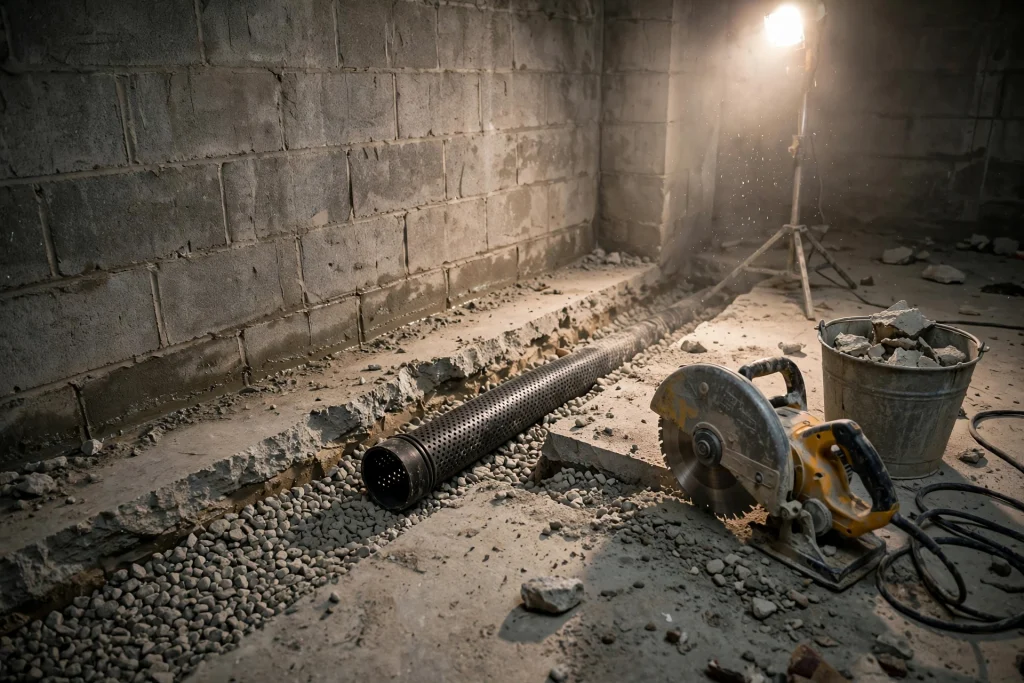
Cut a channel roughly 10 to 14 inches wide through the basement slab along the perimeter. Excavate below to footing level. Lay filter fabric, clean stone, and perforated pipe. In block walls, drill weep holes into the bottom course so the hollow cores drain into the system. Install a vapour barrier up the wall to direct wall seepage down into the drain. Pour new concrete over the channel. Route everything to a sump pit with a pump.
Water reaches the footing, enters the pipe, and gets pumped out. It contacts the wall on the way, but it never reaches your floor.
The honest trade-offs
Effectiveness
Exterior is theoretically superior. It keeps water off the wall entirely, which means no hydrostatic pressure against the concrete, no water migrating through the pores, no freeze-thaw saturation, no efflorescence.
Interior is practically equivalent for keeping a basement dry. The floor stays dry, the pressure under the slab is relieved, and wall seepage is captured and drained. What it does not do is stop the wall itself getting wet.
For most homeowners whose goal is a dry, usable basement, that distinction matters less than the price difference suggests. For a homeowner with a deteriorating stone or block wall, it matters a great deal.
Cost
Exterior is typically two to four times the price. The money goes into excavation, not materials: digging eight feet down around a house, working around utilities, gas lines, decks, and mature landscaping, and then restoring all of it.
Disruption
Exterior destroys landscaping, patios, walkways, decks, and anything else within reach of the excavator. Restoration is a separate cost that is easy to underestimate. Work takes one to three weeks and the yard is unusable throughout.
Interior produces concrete dust and noise inside the house for two to five days. It requires clearing the basement perimeter and it will damage any finished walls along that perimeter. The yard is untouched.
Access
Exterior work becomes difficult or impossible where the house sits close to a property line, where there is a neighbouring structure, where a driveway or attached garage blocks the wall, or where utilities run along the foundation.
Interior work is possible in almost any basement, but not in a crawl space and not where the slab sits directly on rock.
What each cannot do
Neither fixes a structural problem. A bowing wall or a horizontal crack needs reinforcement, and drainage only removes the force that caused it.
Interior systems depend on a pump. No power, no pumping, unless you have a battery backup. Exterior systems that discharge to daylight need nothing.
Neither addresses surface water. If a downspout is emptying against your wall or the ground slopes toward the house, both systems will be handling water that should never have arrived.
Side by side
| Exterior french drain | Interior drain tile | |
|---|---|---|
| Cost per linear foot | $100 to $300 | $60 to $150 |
| Typical whole-house | $15,000 to $40,000 | $8,000 to $20,000 |
| Where water is intercepted | Before the wall | At the footing, inside |
| Keeps the wall itself dry | Yes | No |
| Requires a pump | Not always | Almost always |
| Landscaping damage | Extensive | None |
| Interior disruption | None | Dust, noise, 2 to 5 days |
| Duration | 1 to 3 weeks | 2 to 5 days |
| Works in tight lots | Often not | Yes |
| Works on block walls | Yes | Yes, with weep holes |
| Allows wall waterproofing | Yes | No |
| Typical warranty | 10 to 25 years | Often lifetime, transferable |
| Weather dependent | Yes | No |
When to choose exterior
The wall itself needs protecting. Deteriorating stone, crumbling mortar, spalling block. These walls are being damaged by saturation, and only keeping water off them stops that.
You are already excavating. Replacing a sewer lateral, adding an egress window, installing a walkout, or doing foundation repair. The marginal cost of adding drainage while the hole is open is far lower.
The original footing drain has collapsed and the wall shows signs of long-term saturation.
You are finishing the basement to a high standard and want the wall assembly genuinely dry rather than managed.
There is no viable sump discharge point, so an interior system would have nowhere to pump to.
The house is new construction. Doing it right during the build costs a fraction of retrofitting.
When to choose interior
Budget matters, which for most homeowners it does.
Access is restricted by property lines, adjacent structures, driveways, or an attached garage.
Landscaping has real value. Mature trees, established gardens, hardscape. The restoration cost after exterior work is often shocking.
Water is coming up through the floor or at the cove joint rather than down the walls. That water is under the slab, which is precisely what an interior system addresses and an exterior system does not.
You want a transferable warranty. Interior systems commonly carry lifetime warranties that transfer at sale, which has real value.
The problem is localised to one or two walls, making a partial interior system practical.
You need it done quickly, or in winter when excavation is impractical.
Before you commit to either
This is the part contractors are least likely to lead with, and it matters most.
Both systems are for groundwater. A large share of basement water problems are surface water problems, and those are fixed for a few hundred dollars.
Work through this first:
Extend every downspout six to ten feet. A single inch of rain on an average roof sends hundreds of gallons to each downspout, and delivering that against your wall is the most efficient way to wet a basement.
Clean and inspect the gutters. An overflowing gutter puts a curtain of water into the soil right at the foundation.
Correct the grading. Six inches of fall in the first ten feet. Settled backfill is nearly universal in older homes.
Cover and drain the window wells.
Check whether the existing footing drain is simply clogged. A camera inspection of the weeping tile costs $200 to $500 and can reveal that jetting the line at $400 to $1,200 solves the problem entirely.
If a contractor quotes a drainage system without walking the outside of your house and looking at these, get another opinion. Many homeowners discover that what was diagnosed as needing a $14,000 system was a downspout and a settled flowerbed.
Hybrid and partial approaches
The choice is not always binary.
Partial interior systems treat only the affected walls. If water enters on one side of the house, a full perimeter may be unnecessary. Cost scales roughly with linear footage.
Exterior on the accessible side, interior on the rest. Common where a driveway blocks one wall.
Curtain drain uphill. On sloped lots, a french drain across the slope above the house intercepts water before it arrives, sometimes for a fraction of a perimeter system.
Drainage plus targeted crack repair. A single leaking vertical crack does not need a drainage system; it needs injection at $400 to $900.
Frequently asked questions
Is interior drainage just a band-aid? No, though it is sometimes sold that way by exterior contractors. It genuinely relieves pressure under the slab and keeps the basement dry. Its real limitation is that it does not keep the wall itself dry, which matters for deteriorating masonry and less for sound concrete.
Which lasts longer? Both should function for decades when properly built with filter fabric, clean stone, and rigid pipe. Interior systems depend on a pump, which is a consumable replaced every 7 to 10 years.
Can I install either myself? Realistically, no. Interior work means cutting a structural-adjacent slab and controlling silica dust. Exterior means deep excavation next to a loaded foundation, which is genuinely dangerous. Both usually require permits.
Will an interior system make my basement finishable? Generally yes, once it has proven itself through a full wet season including spring. Do not frame over a wall that is still actively seeping.
Does either affect resale value? A documented, warrantied system with transferable coverage is generally viewed positively, because it signals the problem was addressed properly. An undisclosed water history discovered by a buyer’s inspector is what damages a sale.
How long before I know it worked? A full seasonal cycle, including a wet spring, which is when foundations see peak load.
What if I have a crawl space rather than a basement? Interior drain tile is generally not applicable. Crawl space encapsulation with a liner and dedicated drainage is the equivalent approach.
Should I get an engineer involved? For drainage alone, usually not. For anything involving wall movement, bowing, or structural cracking, an independent structural engineer at $400 to $800 is worth it, because they have no stake in which repair you buy.
The bottom line
Exterior drainage is the better engineering answer and it costs two to four times as much. Interior drainage is the better value answer for most homes and it keeps the basement just as dry, provided you accept that the wall itself stays wet.
Choose exterior when the wall needs protecting, when you are already digging, or when there is no sump discharge. Choose interior when budget, access, or landscaping matter, which describes most people.
And before you sign anything in five figures, spend a Saturday on the downspouts and the grading. It is a genuinely common outcome that the drainage quote becomes unnecessary.